
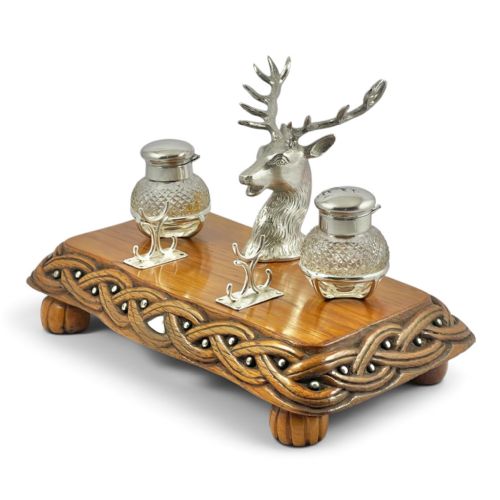


Victorian Oak Inkstand
A victorian oak inkstand sits at the heart of the nineteenth-century writing desk, offering a sturdy home for inkwells and pens that brings period character to any study.
Victorian Oak Inkstand
A victorian oak inkstand is a substantial desk accessory designed to hold writing materials securely in place during the nineteenth century. These pieces range from simple solid oak trays to elaborate stands fitted with stationery boxes, letter racks, and glass ink bottles.
Origins stretch across Britain and Ireland, taking in regional styles like Scottish Baronial and Celtic Revival alongside classic Victorian Gothic. Each variant reflects the serious approach Victorians took to correspondence and desk organisation.
How they were made
Makers utilised solid oak, frequently hand-carving the timber to create figural subjects like St. Bernard dogs, owls, or jockey caps. This dense wood provided a heavy, stable base that resisted the daily wear of dipping metal nibs into ink.
Metalwork played a structural and decorative role, with brass hinges, silver mounts, and silver-plate added to secure stationery compartments and pen trays. Glassmakers supplied heavy cut glass bottles with hinged lids to prevent the ink from evaporating.
Natural materials such as antler and hoof occasionally appear in Scottish and regional pieces, mounted alongside silver to create striking contrasts of texture and tone.
Victorian writers could dip their pens into ink housed inside carved wooden owls, St. Bernard dogs, and miniature jockey caps.
What varies in quality
The standard of carving defines the upper tiers of these desk accessories, separating mass-produced items from deeply detailed figural work. Crisp lines on an owl's feathers or the realistic proportions of a St. Bernard indicate a superior hand at work.
Materials and their combination also determine worth, as pieces featuring substantial silver mounts, original cut glass bottles, and integrated stationery boxes command greater attention than plain wooden trays.
Integration of design separates ordinary stands from exceptional examples, where letter racks, pen grooves, and inkwells form a cohesive architectural whole rather than a mere collection of parts.
The Victorian Oak Inkstand Glossary
- Inkstand
- A desk stand designed to hold one or more inkwells along with pens and sometimes stamps or wafers. They form the central apparatus of the Victorian writing table.
- Desk tidy
- An alternative term for a desk stand or standish that incorporates compartments for envelopes and letters. These keep correspondence neatly ordered.
- Standish
- An archaic term for a small stand or tray holding writing equipment, particularly popular during the nineteenth century. It often denotes a more formal or substantial desk accessory.
- Cut glass
- Glass decorated by cutting geometric or floral patterns into the surface using a wheel. This technique adds weight and brilliance to the ink bottles fitted into the stands.
Victorian Oak Inkstand: Frequently Asked Questions
What is a standish?
A standish is an antique writing stand that holds inkwells, pens, and sanders for blotting. The term was widely used in the nineteenth century for fitted desk accessories.
These pieces sat permanently on the desk surface as both a practical tool and a display of domestic order.
How were inkwells kept secure?
Inkwells fitted snugly into carved recesses or metal collars mounted directly onto the oak base. This prevented the heavy glass bottles from sliding around during vigorous writing.
Hinged lids made of brass or silver kept the ink moist and protected the nibs from accidental spills.
Where did these pieces sit?
They occupied the centre of a writing table, Davenport, or secretary desk in Victorian libraries and parlours. Their solid oak construction helped them anchor the paper and writing implements.
Affluent households kept them in studies, while smaller versions served in bedrooms and drawing rooms.
How do I care for oak desk accessories?
Keep wooden pieces away from direct heat sources and strong sunlight to prevent the oak from drying out or splitting. Occasional application of a suitable wax polish maintains the timber's natural lustre.
Glass inkwells should be washed gently by hand to remove dried ink residue without damaging any fitted silver collars.