
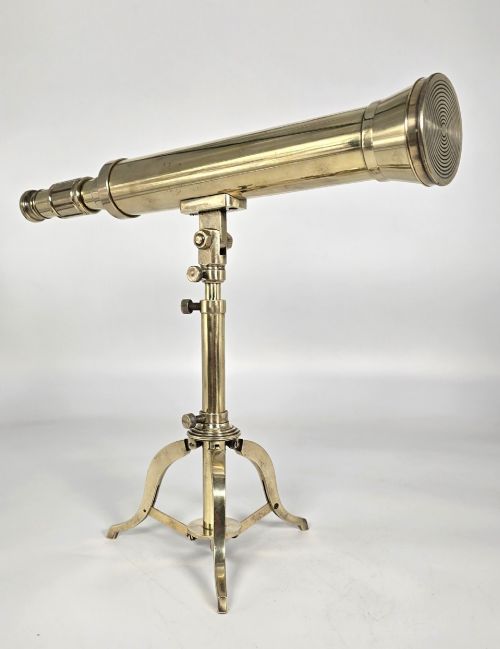


Victorian Nautical Telescope
A victorian nautical telescope is a practical brass optical instrument designed for maritime navigation and terrestrial viewing.
Victorian Nautical Telescope
When you search for a victorian nautical telescope, you encounter optical instruments that served aboard ships and in libraries during the nineteenth century. These pieces include single draw and multi-draw versions housed in leather or bare brass, alongside larger tabletop and library formats.
The most common variants on this page are English brass telescopes featuring multiple draws, sometimes accompanied by fitted wooden cases or original folding tripods. Makers such as Ross of London and Newton & Co produced these instruments for naval officers and civilian observers alike.
Examples range from compact officer of the watch perspectives to substantial astronomical and terrestrial library models. Each piece reflects the utilitarian engineering of the period, designed for clear magnification at sea or on land.
How they were made
Makers constructed these tubes primarily from turned brass, often applying leather grips or housing them in mahogany, oak, and fruitwood cases. Nickel plating and gilt brass appear on later or more decorative specimens.
Optical systems combine glass lenses within telescoping draw tubes that slide smoothly against one another. Woodwork and metal fittings display precise machining and hand-finished details characteristic of nineteenth century instrument workshops.
Materials across these listings include brass, glass, leather, wood, oak, nickel, mahogany, and steel.
What varies in quality
Quality rests in the precision of the optics and the rigidity of the draw tubes when fully extended. Finer examples retain clear lenses and original signed inscriptions on the draw or barrel.
The choice of secondary materials, such as stitched leather coverings or fitted mahogany cases, distinguishes standard utilitarian gear from library instruments intended for domestic display.
Ross of London·Steward of London·Newton & Co·L. Casella·Chadburn Brothers of Sheffield·Davis of London·Broadhurst & Co
The Victorian Nautical Telescope Glossary
- Draw
- A sliding tube section that extends the overall length of the telescope. Multiple draws allow a long instrument to collapse into a compact size.
- Terrestrial
- An optical configuration designed for viewing objects on land rather than stars. These systems erect the image so it appears right side up.
- Objective
- The main lens at the front of the telescope that gathers light. Its diameter determines the brightness and clarity of the field of view.
- Marine
- A designation for instruments built to withstand maritime environments. These typically feature robust brass construction and protective coverings.
Victorian Nautical Telescope: Frequently Asked Questions
How do I clean the brass?
Maintenance requires only a soft, dry cloth to remove dust from the metal and glass surfaces. Avoid modern chemical polishes that strip away age and patina.
Preserving the original finish maintains the historical character of the instrument without harming the softer brass components.
Can I use it outside?
These instruments function for terrestrial viewing when adjusted properly in daylight. The draw tubes must be pulled out fully and focused against a distant target.
Care should be taken outdoors to protect the vintage glass and unsealed brass barrels from moisture and impacts.
What does draw mean?
A draw refers to one of the sliding brass segments that fit inside the main barrel. Telescopes are categorized by how many draws they possess, such as three draw or six draw.
Pulling out each section increases the focal length and magnification power of the optical system.
Are signed makers common?
Signatures appear engraved on the draw tubes or barrels of many English instruments. Names like Ross of London or Newton & Co indicate the original workshop.
Unsigned examples are also frequent, representing standard military or civilian production from the period.