
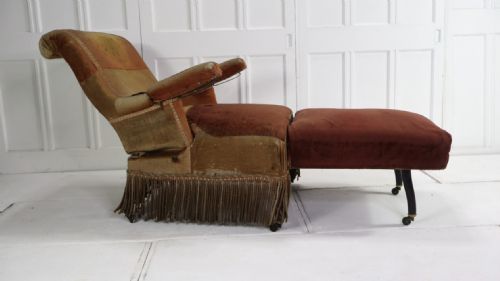


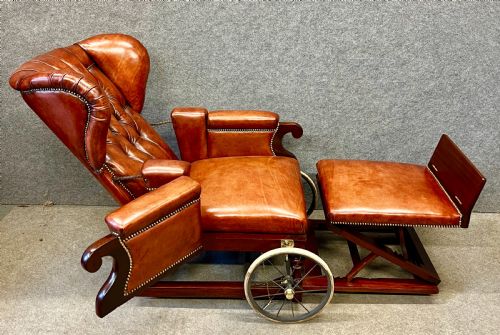

Victorian Mechanical Armchair
These Victorian mechanical armchairs are sophisticated nineteenth century seats built to adjust for reading, resting, and recovery.
Victorian Mechanical Armchair
When you search for a victorian mechanical armchair, you are looking at nineteenth century seating designed with adjustable mechanisms for library, reading, and convalescing use. These forms encompass reclining armchairs, daybeds, and invalid wheel chairs engineered to alter posture through mechanical adjustment.
The versions you are most likely to meet on this page span the 19th Century, including specific 1860 and 1890 examples. They range from French recliners and wing armchairs to British library and reading chairs equipped with footstools.
Makers such as Minter, J Foot and Son, and John Ward appear alongside French Second Empire, Regency, and William IV styles. Mahogany and timber frames dominate, upholstered in leather, velvet, and fabric with brass and iron operational hardware.
How they were made
Makers built the structural frameworks using timber and solid mahogany, providing the robust support necessary to house moving parts. These wooden frames supported mechanical actions designed to shift the seat and back into various reclining positions.
Brass and iron components formed the internal mechanisms, ratchets, and wheels that allowed the chairs to adjust smoothly. Upholsterers then finished the pieces in leather, velvet, or fabric over internal padding.
Listings feature mahogany, timber, brass, iron, leather, velvet, and fabric across nineteenth century periods.
What varies in quality
The sophistication of the internal mechanism dictates the calibre of the piece, distinguishing basic adjustable seats from complex metamorphic designs by noted makers. Smooth operation of the reclining and adjusting apparatus indicates superior engineering.
The choice of primary timber and the execution of the mahogany framing establish the standard of the woodwork. Premium examples combine high-grade leather upholstery with fully functioning iron and brass mechanical systems.
Minter·J Foot and Son·John Ward
The Victorian Mechanical Armchair Glossary
- Metamorphic armchair
- A seat designed to transform into another form, such as a daybed or recliner, through mechanical action. These pieces utilise hidden hinges and ratchets to alter their configuration.
- Reclining library chair
- A nineteenth century seat intended for reading and study, often fitted with an adjustable back and associated footstool. They frequently incorporate mahogany frames and leather upholstery.
- Invalid wheel chair
- A convalescing chair fitted with wheels and mechanical adjustment for sick or recovering users. Makers like John Ward specialised in these mobility designs during the Victorian period.
- William IV
- A British design style spanning the 1830s characterised by robust classical proportions and heavy mahogany use. Pieces from this period often display bold scrolling woodwork.
Victorian Mechanical Armchair: Frequently Asked Questions
What is a Victorian mechanical armchair?
It is a nineteenth century seating form engineered with adjustable mechanisms to alter the angle of the back or seat. These chairs were built for libraries, reading rooms, and invalid care.
They combine timber frames, typically mahogany, with iron and brass hardware that controls the movement. Upholstery usually consists of brown leather, velvet, or fabric.
How do you operate the mechanism?
The mechanical systems utilise internal ratchets, hinges, and levers controlled by the user or an attendant. Adjusting the backrest allows the chair to function as a standard seat, a recliner, or a daybed.
Well-preserved examples move smoothly between positions using their original brass and iron hardware.
Where were these chairs used?
They served primarily in domestic libraries, studies, and drawing rooms as comfortable reading seats. Convalescing rooms also utilised them for patients requiring supported rest.
Invalid wheel chair variants provided mobility and adjustable positioning for individuals with limited movement.
How do you identify the maker?
Maker attribution relies on stamped names, patent plates, or structural signatures left on the wooden frame or iron mechanism. Prominent nineteenth century firms included Minter, J Foot and Son, and John Ward.
Stylistic markers and specific mechanical patents also help attribute pieces to particular workshops.