


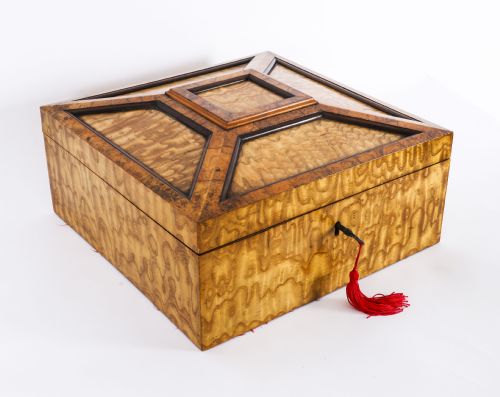


Victorian Marquetry Casket
These Victorian marquetry caskets are timber storage boxes decorated with intricate wood inlay, prized for holding letters and trinkets on a nineteenth-century desk.
Victorian Marquetry Casket
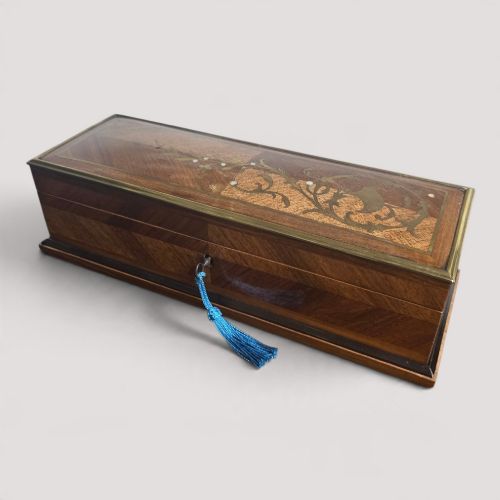
A Victorian marquetry casket is a desktop or table box surfaced with precise wood veneers, appearing in forms such as jewellery boxes, stationery boxes, and music boxes. The pieces gathered under this search span the mid to late nineteenth century, taking shape as rosewood and walnut work boxes alongside specialised Tunbridge ware and French boulle examples.
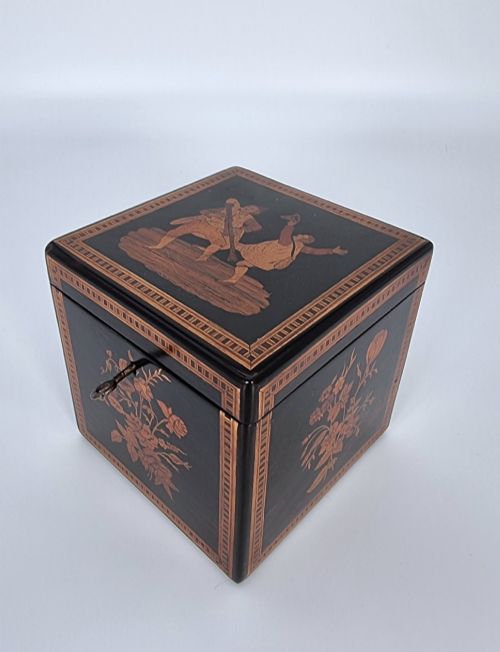
Makers produced these caskets in various regional styles, including English Tunbridge ware, French Napoleon III workshops, and Italian Sorrento production. Most examples date from the eighteen-fifties to the eighteen-eighties, utilising dense hardwoods as a foundation for decorative geometric or pictorial inlay.
Materials and inlay techniques
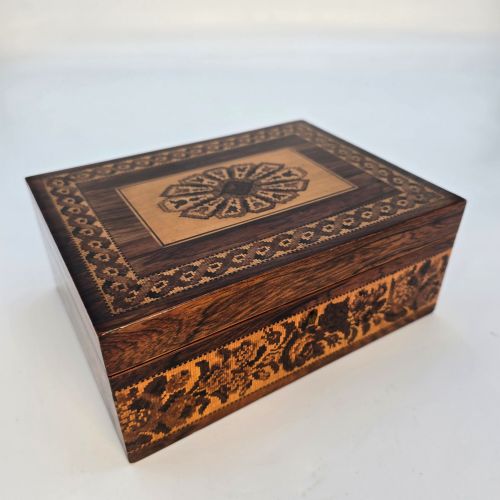
Craftsmen built the carcases of these caskets using solid woods like walnut, rosewood, and olive wood, applying contrasting veneers of boxwood, ebony, and fruitwood to the exterior surfaces. Tunbridge ware pieces rely on thousands of tiny tinted wood blocks assembled to create mosaic pictures, while French and Italian caskets employ cut veneers of mixed hardwoods.
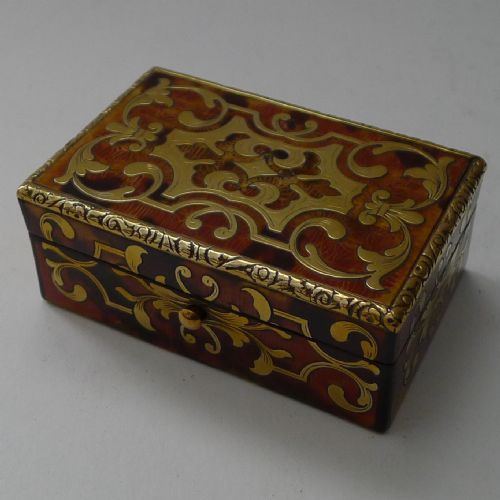
Surface ornamentation often integrates brass, ormolu mounts, or tortoiseshell alongside the marquetry panels. Interior fitments utilise secondary timbers and velvet or silk linings to house letters, gloves, or trinkets.
Victorian Marquetry Casket Retail Price Guide 2026
Typical asking prices for victorian marquetry casket among the pieces listed under this phrase on Sellingantiques today, from the lower quarter to the upper quarter. They describe what is for sale here now, not the wider market.
Several boxes on display were built purely to house a single pair of gloves or a solitary feathered dove.
Standards of execution and design
The distinction between standard production and superior work lies in the precision of the veneer cutting and the complexity of the mosaic or pictorial composition. Fine examples demonstrate tight joints, perfectly flush inlay without visible gaps, and dense wood grains selected for decorative figure.
Edmund Nye·Lund Of Cornhill
The Victorian Marquetry Casket Glossary
- Marquetry
- The art of applying decorative pieces of veneer to a structural carcase to form geometric or pictorial designs. This technique defines the surface decoration of the boxes found on this page.
- Tunbridge Ware
- A specialised form of nineteenth-century wood mosaic originating in Kent, utilising tiny multi-coloured prisms of wood to create detailed geometric and pictorial motifs.
- Boulle
- A method of marquetry consisting of tortoiseshell and brass inlay, popularized in France and frequently seen on nineteenth-century stationery and trinket boxes.
- Ormolu
- Gilded bronze used for decorative mounts, feet, and handles on nineteenth-century French caskets and boxes. It provides a bright metallic contrast to dark woods.
Victorian Marquetry Casket: Frequently Asked Questions
What were Victorian marquetry caskets used for?
These boxes served practical domestic functions on nineteenth-century writing desks and drawing room tables, storing personal correspondence, stationery, or sewing equipment. Many were specifically designated as glove boxes, needlework caskets, or trinket repositories.
Fitted interiors often included velvet-lined compartments, removable trays, or small partitions tailored to keep delicate personal items organised. Their decorative exteriors ensured they remained displayed in prominent household rooms rather than stored away.
How do I identify Tunbridge Ware boxes?
Tunbridge ware boxes feature distinctive mosaic decoration made from thousands of tiny wood prisms arranged to form pictorial scenes, such as butterflies or flowers, or complex geometric borders. The natural colours of different British timbers provide the palette without the use of artificial stains.
Many examples incorporate a characteristic perspective cube pattern across the lid or sides. Makers often applied small labels to the interior surfaces of these pieces to identify their origin in Kent.
What is the difference between a casket and a work box?
A casket generally implies a more substantial, decoratively mounted container with architectural proportions, often utilised for valuable stationery or letters. These frequently incorporate brass handles and heavy ormolu or boulle work.
A work box is specifically designed for sewing and needlework implements, housing internal lift-out trays with compartments for spools, needles, and pins. Both forms utilise similar marquetry techniques on their exterior surfaces.
How should I care for a rosewood or walnut box?
Maintain stable humidity levels in the room to prevent the wood carcase from expanding or contracting, which can cause the delicate veneer or mosaic inlay to lift. Avoid placing the box in direct sunlight, as UV rays will fade the natural tones of rosewood, walnut, and boxwood.
Dust the surface gently with a dry, soft cloth rather than using liquid polishes or silicone sprays. Wax can be applied very sparingly to the timber if the finish appears dry.