
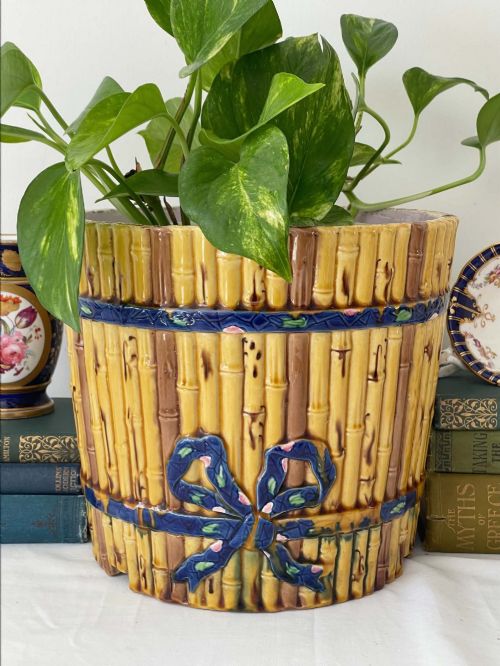


Victorian Majolica Jardiniere
These Victorian majolica jardinieres are lead-glazed earthenware plant vessels designed to bring bold colour and naturalistic form into domestic interiors.
Victorian Majolica Jardiniere
A victorian majolica jardiniere sits for plant display, taking the form of heavy glazed earthenware decorated with botanical or rustic motifs. The pieces gathered here range from simple vessels to grand combinations involving matching pedestal stands or griffin columns.
Most examples date from the nineteenth century, spreading from the eighteen-seventies and eighties through to Edwardian interpretations. You will frequently encounter forms shaped like bamboo, water lilies, swan bodies, fern rockwork, or naturalistic bark textures.
Many survivors include their original supporting pedestals or plant stands, transforming a tabletop pot into a substantial floor-standing furnishing. The aesthetic spans straightforward Victorian naturalism into later Art Nouveau and Arts & Crafts sensibilities.
Materials and technique
Potters built these vessels using earthenware clay, shaping them into elaborate relief patterns of leaves, animals, and rustic pillars. The resulting body required a solid foundation to support both its own heavy mass and the soil within.
Coloured lead glazes were painted directly onto the porous clay or an opaque tin-opacified ground before firing. This technique produced deep greens, browns, blues, and ochres that pooled in the recesses of the relief work to create rich tonal depth.
Glazed ceramic plant stands frequently accompany these pots as matching columnar pedestals or griffin supports.
Judging quality
Quality rests in the crispness of the moulded relief and the richness of the coloured lead glazes. Superior items display sharp botanical details, such as individual fern fronds or feather textures on swan bodies, rather than soft, blurred outlines from worn moulds.
The glaze application dictates the visual success of the piece, with better examples showing vibrant, even coverage that accentuates the contours without pooling awkwardly. Matching stands that share the exact glaze tone and clay body elevate the status of the complete jardiniere.
Minton·Royal Worcester·George Jones·Clement Massier·Burmantofts·Woodlesford·Julius Dressler·Copeland
The Victorian Majolica Jardiniere Glossary
- Majolica
- A type of pottery glazed with coloured lead glazes over an earthenware body, popular for its vibrant hues and sculptural relief decoration.
- Jardiniere
- A large ornamental pot or container designed to hold a live plant or floral arrangement inside the home.
- Earthenware
- Porous pottery fired at relatively low temperatures, forming the structural base for nineteenth-century glazed majolica wares.
- Lead glaze
- A glossy coating containing lead oxide that melts during firing to give pottery a brilliant shine and intensive colour saturation.
- Rockwork
- A rustic decorative motif imitating natural stone formations, frequently used on nineteenth-century plant containers and garden seats.
Victorian Majolica Jardiniere: Frequently Asked Questions
How do I use a jardiniere safely?
Place a protective saucer or liner inside the vessel before introducing a potted plant to prevent moisture from seeping through the porous earthenware body.
Position the container away from heavy foot traffic to protect the projecting relief details from accidental impacts.
Did these come with stands?
Many large pieces were manufactured as a paired set comprising the pot and a matching column pedestal.
Some survivors remain as single vessels, while others retain their original griffin or columnar supports.
How do I clean the glaze?
Dust the surface gently with a dry microfibre cloth to prevent dirt from settling into the deep recesses of the moulded relief.
Avoid harsh chemical detergents or abrasive scrubbers that might dull the glossy lead glaze finish.
How can I tell periods apart?
Earlier nineteenth-century examples often favour strict botanical naturalism like water lilies and rustic bark.
Later pieces from the turn of the century tend to incorporate flowing Art Nouveau lines or simpler Arts & Crafts forms.