

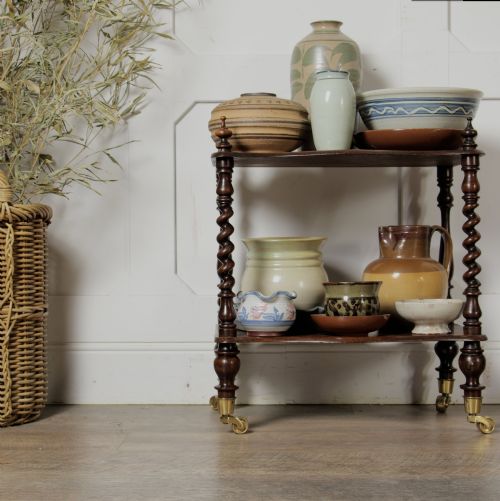


Victorian Mahogany Cake Stand
These Victorian mahogany cake stand pieces bring tiered elegance to your room, offering clever multi-level display for tea time or everyday interiors.
Victorian Mahogany Cake Stand
A victorian mahogany cake stand brings tiered display surfaces into domestic spaces, serving as a practical accessory for tea and gathering. You will frequently encounter multi-tier structures, folding frames, and revolving tray designs across these listings.
The materials span solid timbers alongside brass hardware and occasional felt details, anchored firmly in the Victorian, Edwardian, and Georgian eras. Forms range from simple circular cheese stands to elaborate étagères, dumb waiters, and standing tiered configurations.
Many examples utilise clever folding mechanisms or revolving actions on tripod bases, combining portability with stable display. These pieces function equally well as standalone occasional tables or functional serving tiers in traditional and modern interiors alike.
Materials and Making
Makers relied primarily on rich mahogany timber, shaping the wood into turned columns, tripod bases, and shaped shelves. Grain patterns and natural patination play a central role in the visual weight of each tier.
Brass fittings and hinges appear regularly to facilitate the folding actions and secure the tiered levels. Selected pieces integrate bevelled glass shelves or subtle inlaid details to elevate the overall surface texture.
Structural joinery balances stability with lightness, particularly on tall folding cake stands and revolving dumb waiters. Carpenters shaped the tripod legs and central columns to support weight without encumbering floor space.
Victorian Mahogany Cake Stand Retail Price Guide 2026
Typical asking prices for victorian mahogany cake stand among the pieces listed under this phrase on Sellingantiques today, from the lower quarter to the upper quarter. They describe what is for sale here now, not the wider market.
Listings span pieces from the Georgian era through the Victorian and Edwardian periods, constructed in mahogany, brass, and felt.
Assessing Quality
Quality rests in the crispness of the turning on the central columns and the stability of the tripod bases. Superior examples maintain rigid alignment across multiple tiers without wobble or loose joints.
The choice of timber grain and the precision of any folding mechanism distinguish standard production from finer workshop output. Well-fitted brass hardware and clean bevelling on glass inserts signal careful original construction.
The Victorian Mahogany Cake Stand Glossary
- Mahogany
- A dense tropical hardwood prized for its deep reddish-brown colour and stable grain. It forms the structural foundation for the vast majority of these stands.
- Dumb waiter
- A tiered serving stand designed to hold food or dishes without requiring a servant present. These pieces often feature multiple rotating or fixed levels.
- Tripod base
- A three-legged support system providing stable balance on uneven floors. This configuration appears frequently on revolving stands and small tables.
- Étagère
- A piece of furniture consisting of open shelves for displaying small objects. These tiered structures maximise vertical space in compact rooms.
- Lazy Susan
- A revolving tray placed on a table or stand to assist in moving food easily. This mechanism allows items to spin smoothly within reach.
Victorian Mahogany Cake Stand: Frequently Asked Questions
What is a Victorian mahogany cake stand used for?
These tiered pieces were originally designed to serve cakes, afternoon tea, or cheese during social gatherings. Today, they function wonderfully as display surfaces for plants, books, or decorative objects.
Their vertical design allows you to showcase multiple items while occupying a minimal footprint on the floor.
How do I spot a folding cake stand?
Folding stands feature hinged vertical supports or scissor-action frames that allow the entire structure to collapse flat. This clever engineering made them simple to store away when not in use during the Victorian period.
Examine the pivot points and brass hinges to understand how the tiers fold down into a compact unit.
Are revolving trays common on these stands?
Revolving trays appear on several dumb waiter and cake stand variants, allowing diners to access items easily from any angle. The rotating mechanism relies on a central pivot built into the top of the tripod base.
This spinning feature distinguishes working service furniture from standard stationary display tables.
How do I date a mahogany stand?
Dating relies on observing the combination of timber selection, turning styles, and hardware details like brass hinges. Victorian examples often feature rich dark mahogany with barley twist columns or tripod bases.
Comparing the construction methods against known Georgian and Edwardian stylistic shifts helps narrow down the period of origin.