
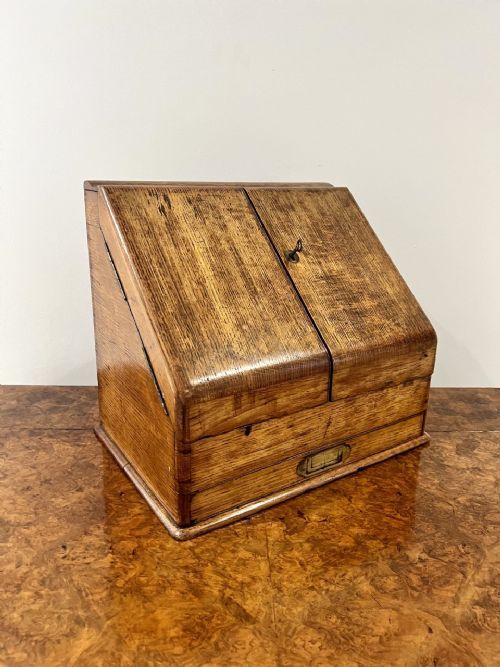




Victorian Letter Compendium
These Victorian letter compendium pieces are desktop organizers for correspondence, prized for keeping writing materials tidy.
Victorian Letter Compendium
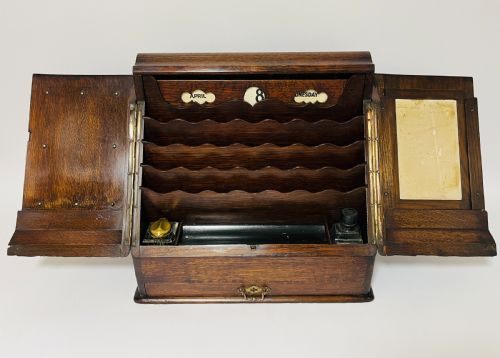
A victorian letter compendium brings order to correspondence through fitted interiors designed to hold paper, envelopes and writing implements. The forms range from simple desk boxes to elaborate cabinets with drop fronts and adjustable dates.
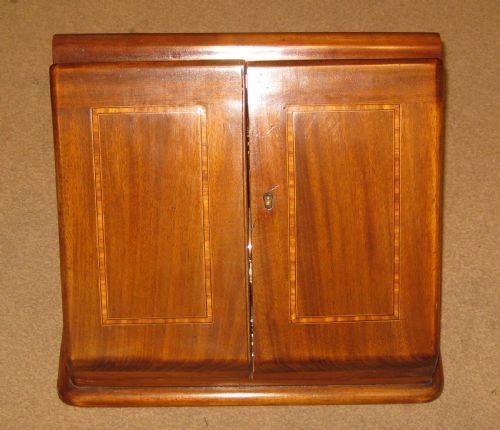
Oak dominates the examples seen here, often accompanied by mahogany, walnut, coromandel, olivewood and Japanese lacquer. These pieces date principally from the Victorian era through to the turn of the twentieth century, reflecting the heavy correspondence culture of the period.
Materials and construction
Cabinet makers utilised dense hardwoods such as oak, mahogany and walnut for the primary carcases, frequently applying fine veneers like coromandel and satinwood to the exterior surfaces. Brass mounts, hinges and locks provided structural reinforcement and functional security for private papers.
Interior fittings involved precision joinery to create tiered stationery slots, pen trays and compartments for inkwells and stamps. Drop-front mechanisms and sloping lids required careful balancing to operate smoothly without straining the timber.
Recorded periods stretch from the mid-nineteenth century through the Victorian era and Edwardian times up to nineteen-twenty.
Distinctions in quality
The standard of a victorian letter compendium rests on the choice of timber figure, the crispness of any inlay and the complexity of the interior arrangement. Plain utility boxes sit at one end, while pieces featuring maker signatures, drop fronts and integrated calendar functions occupy the other.
Hardware choice also separates grades, with heavy cast brass fittings and functioning locks indicating superior workshop output. The harmony between the exterior veneers and the fitted internal compartments demonstrates the maker's overall skill.
Houghton and Gunn·F Waller
The Victorian Letter Compendium Glossary
- Stationery cabinet
- A desktop box designed specifically to hold writing paper and envelopes upright within tiered slots.
- Drop front
- A hinged panel that folds forward to reveal internal compartments and provide a writing surface.
- Coromandel
- A dense, heavily figured exotic timber from Asia utilised for high-end Victorian decorative items.
- Meiji Period
- A Japanese historical era spanning from 1868 to 1912, associated here with imported lacquer writing boxes.
Victorian Letter Compendium: Frequently Asked Questions
What is a victorian letter compendium?
A victorian letter compendium is a specialised desktop cabinet designed to hold writing paper, envelopes, ink and correspondence tools.
These pieces kept desks organised during an era when letter writing was the primary form of communication.
How were these cabinets used?
Users stored blank correspondence cards in the tiered internal slots and kept smaller items like stamps and nibs in enclosed compartments.
Drop-front models allowed quick access to the writing surface without opening the entire top section.
What woods were commonly used?
Makers relied heavily on domestic hardwoods like oak and mahogany for everyday office use.
Exotic timbers such as coromandel, satinwood and olivewood appeared on grander examples intended for prominent display in a study.
How do I date these pieces?
Dating relies on stylistic clues, construction methods and occasionally incorporated items like adjustable date perpetual calendars.
The inventory here spans the nineteenth century through to the early nineteen-hundreds, covering late Victorian and Arts and Crafts aesthetics.