


Victorian Hunting Dog Artwork
Victorian hunting dog artwork captures the intensity of field sports through oils on canvas and watercolours of spaniels, pointers and hounds.
Victorian Hunting Dog Artwork
Victorian hunting dog artwork encompasses oil paintings, watercolours and original lithographs depicting spaniels, setters, pointers, terriers and hounds in rural landscapes.
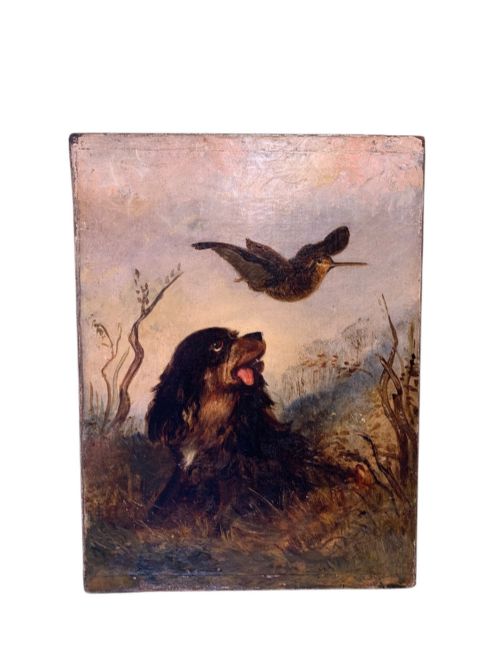
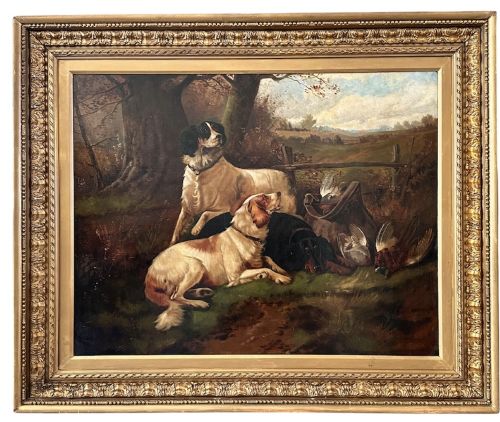
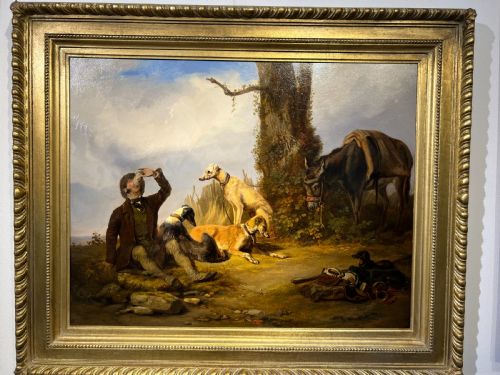
The version most commonly encountered on this page is the nineteenth-century oil painting on canvas or board, often framed in gilt wood, showing gun dogs or pack hounds in the field.
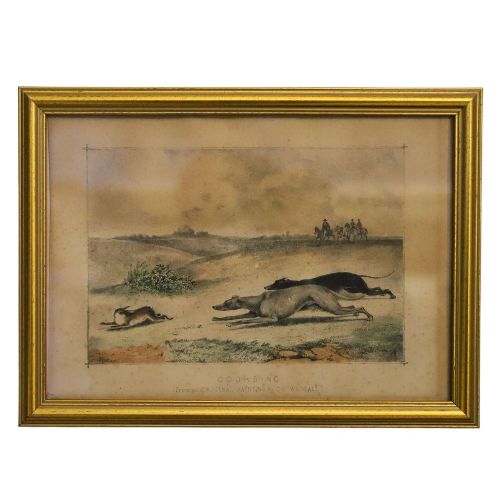
These pieces emerge from schools of sporting art that documented country pursuits, ranging from solitary retrievers with game birds to full hunts across moorland scenes.
Materials and Techniques
Artists worked primarily in oil paint upon canvas or wooden board, utilising rich brushwork to render the textures of animal coats and natural landscapes.
Watercolour on paper appears alongside original lithography, capturing finer details in muted tones for framed prints and portfolio plates.
Gilt wood frames frequently encase these works, providing a decorative border that complements the dark palettes of nineteenth-century canvases.
Terriers are captured mid-mission guarding a trapped rat.
Quality and Execution
The distinction between ordinary decorative sporting pieces and finer works lies in the anatomical accuracy of the animals and the liveliness of the brushwork.
Skilled handling of light across a landscape and the expressive posture of a working dog elevate a composition far beyond a stiff, formulaic animal portrait.
Sir Edwin Henry Landseer·Arthur Wardle·Colin Graeme Roe·Fannie Moody·Alfred Duke·Robert Cleminson·Thomas Blinks·Henry Frederick Lucas-Lucas·Samuel John Egbert Jones·Charles Hunt Jnr
The Victorian Hunting Dog Artwork Glossary
- Gun dog
- A type of hunting dog bred to find, flush or retrieve game for shooters. Spaniels, pointers and retrievers fall into this category.
- Lithograph
- A print made from a flat stone or metal plate on which an image has been drawn with a greasy substance. This technique allowed multiple reproductions of original sporting scenes.
- Sporting art
- Genre of painting and printmaking that depicts field sports, hunting, shooting, fishing and associated animals. It flourished during the nineteenth century.
- Board
- A rigid wooden panel used as a painting support instead of stretched canvas. Artists often utilised boards for smaller outdoor studies.
Victorian Hunting Dog Artwork: Frequently Asked Questions
What subjects appear in this artwork?
Paintings and prints feature spaniels, pointers, setters, terriers and hound packs engaged in field sports or resting in rural landscapes.
Human figures occasionally accompany the animals, depicted as sportsmen, riders or cottage dwellers alongside horses and game.
How do I date these pieces?
Dates rely on period costume, artist lifespans, framing styles and canvas stamps recorded from the nineteenth century onward.
Victorian sporting art spans several decades, with distinct shifts from romantic early century compositions to more naturalistic later works.
Where were these pieces displayed?
Original oils and watercolours hung in country houses, estate libraries and sporting lodges to celebrate working animals and rural pursuits.
Framed prints and lithographs offered a more accessible way for households to display traditional field sports imagery.
How do I care for these paintings?
Keep canvases and watercolours away from direct sunlight and heavy moisture to protect oil pigments and paper supports from degradation.
Dust gilt wood frames gently with a dry cloth and avoid touching the painted surface directly.