



Victorian High Back Settee
These Victorian high back settee examples offer commanding seating designed to block draughts and anchor a room with period presence.
Victorian High Back Settee
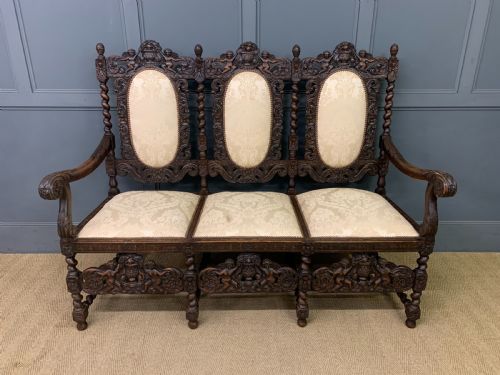
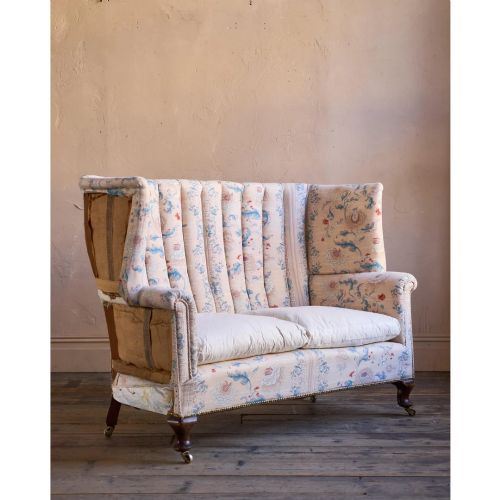
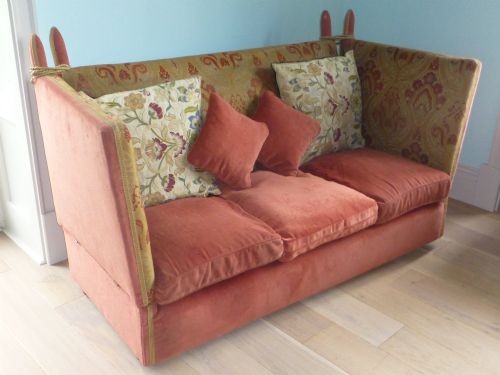
A Victorian high back settee combines deep seating with an elevated rear rail, appearing across forms such as wingbacks, Knole sofas, and panelled settle seats. These pieces emerge primarily from the nineteenth century, including specific dates from eighteen sixty to eighteen ninety, alongside later nineteenth and early twentieth century examples.
Makers and workshops construct these large seats in traditional English styles, drawing on George II and Carolean revival motifs. Buyers encounter mahogany, walnut, oak, and giltwood frames supporting leather, velvet, fabric, hessian, and button-backed upholstery.
Materials and construction
Frames rely on hardwoods including mahogany, walnut, and oak, often shaped with hand carving or finished with giltwood surfaces. Joinery methods support heavy structural loads, particularly on large three-seat frames and pieces fitted with castors.
Upholstery involves traditional stuffing secured beneath leather, velvet, fabric, or hessian. Workers apply finishing details such as brass studs, hand-dyed leather hides, and button-backed padding across high curved backs and wing arm structures.
Victorian High Back Settee Retail Price Guide 2026
Typical asking prices for victorian high back settee among the pieces listed under this phrase on Sellingantiques today, from the lower quarter to the upper quarter. They describe what is for sale here now, not the wider market.
Some high backs are built so tall they double as indoor windbreaks for when the parlour butler left the front door open too long.
Judging quality in high back seating
Quality rests on the depth of the timber carving and the architectural balance of the frame, where substantial walnut and mahogany structures demonstrate superior presence. The execution of Revival styles, such as Carolean or George II interpretations, dictates the visual authority of the piece.
Upholstery choices reveal distinct tiers of execution, from standard fabric coverings to hand-dyed leather finishes paired with intricate button-tufting. The integrity of internal padding and the weight of the supporting hardwood frame separate standard production from exceptional country house seating.
The Victorian High Back Settee Glossary
- Knole sofa
- A historic settee design featuring hinged or drop arms that can be adjusted to upright positions. This form provides distinct versatility within period seating.
- Carolean revival
- A nineteenth-century design movement copying late seventeenth-century English styles, characterised by rich walnut framing and elaborate carving. Pieces in this style emulate Restoration-era opulence.
- Giltwood
- Timber treated with gold leaf or metallic gilt paint to create a brilliant decorative surface. This treatment appears on grand country house furniture.
- Showwood
- Exposed polished timber framing on an upholstered piece, displaying the grain and craftsmanship of the wood alongside the fabric. Mahogany and walnut are frequent choices for this treatment.
- Settle
- A wooden wooden bench featuring a high back designed to block draughts, often incorporating enclosed storage or panelled construction. These seats originate in domestic halls.
Victorian High Back Settee: Frequently Asked Questions
What is a Victorian high back settee?
A Victorian high back settee is a large nineteenth-century seat featuring an elevated backrest designed for comfort and draught exclusion. These pieces utilise substantial timber frames and diverse upholstery.
Craftsmen built them in various revival styles, incorporating wings, drop arms, and deep buttoning. They served as primary seating in substantial parlours and halls.
Where were these settees used historically?
These settees occupied large reception rooms, country house halls, and formal parlours where their imposing scale commanded attention. Their high backs provided shelter from cold draughts in large domestic spaces.
They functioned as comfortable seating for multiple occupants, combining decorative presence with practical utility.
How do I care for leather upholstery?
Leather upholstery requires regular dusting and periodic conditioning to maintain the suppleness of the hide. Avoiding direct sunlight prevents the leather from drying and cracking.
Hand-dyed and brown leather finishes benefit from specialised balms that preserve the historic tone without altering the surface texture.
How do I date a Victorian settee?
Dating relies on examining the timber species, joinery techniques, and stylistic revival cues visible in the frame. Nineteenth-century pieces often display specific characteristics of periods like eighteen eighty or eighteen ninety.
Upholstery methods and secondary woods inside the frame further clarify the era of manufacture, distinguishing early Victorian examples from later revivals.