




Victorian Height Adjustable Chair
A victorian height adjustable chair offers practical mechanics and period character, providing adaptable seating for the desk, piano, or dressing table.
Victorian Height Adjustable Chair
A victorian height adjustable chair encompasses a variety of seating forms designed for specific domestic tasks that require varying elevations. The pieces on this page span several periods including the 19th Century, Victorian, Edwardian, and Regency eras, with forms ranging from piano stools and dressing chairs to swivel desk chairs.
Piano stools and music chairs form the majority of the selection, often utilising a screw mechanism or rise and fall action to adjust for the player. Desk chairs and dressing table chairs provide revolving or swivelling functions alongside standard height adjustment, rendered in styles such as Arts and Crafts, Industrial, and Grand Regency.
Materials vary widely across the inventory, reflecting the preferences of nineteenth and early twentieth-century makers. Mahogany, walnut, and rosewood provide the primary timber structures, while leather, fabric, and standard upholstery cover the seats.
What varies in quality
The smoothness of the revolving action and the precision of the height adjustment mechanism distinguish finer examples from standard production pieces. A well-engineered screw or swivel thread operates without excessive play or binding when rotated.
The choice of cabinet timber and the crispness of the carved detail on the legs and revolving collar indicate the original workshop standard. Solid mahogany and rosewood frames with intact, matching leather or fabric upholstery represent the higher tier of surviving pieces.
Victorian Height Adjustable Chair Retail Price Guide 2026
Typical asking prices for victorian height adjustable chair among the pieces listed under this phrase on Sellingantiques today, from the lower quarter to the upper quarter. They describe what is for sale here now, not the wider market.
Listings feature 19th Century, Victorian, Edwardian, and Regency periods, constructed in mahogany, walnut, rosewood, brass, and leather.
Gillows·James Shoolbred
The Victorian Height Adjustable Chair Glossary
- Rise and fall
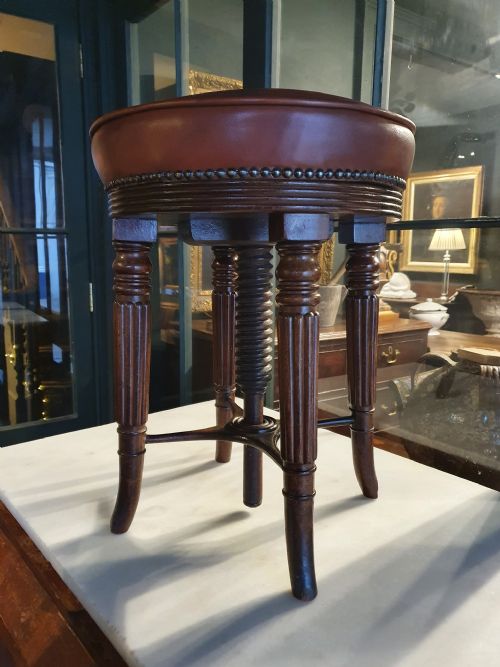
- A mechanical system using a threaded spindle or internal screw to adjust the height of a stool seat by rotation. This allows the user to modify the seating level for the piano or desk.
- Swivel base
- A pivoting assembly allowing the upper portion of the chair or stool to turn through three-degrees. It often incorporates a central iron or wooden threaded column.
- Bentwood
- Wood softened by steam or boiling water and bent into curved structural forms under pressure. This technique produced fluid lines on chairs and stools.
- Ebonised
- Timber finished with a dark stain or black lacquer to imitate ebony. This treatment was popular for decorative piano stools and music chairs.
Victorian Height Adjustable Chair: Frequently Asked Questions
How does the height adjustment work?
Most pieces utilise a central wooden or metal screw mechanism hidden beneath the seat top. Turning the seat clockwise or anticlockwise raises or lowers the platform along the threaded spindle.
Some designs incorporate a rise and fall lever or a patent ratchet system to lock the seat at the preferred level.
How do I identify a Victorian piece?
Victorian seating often exhibits dense timbers like mahogany and walnut, combined with heavy cast iron or brass mechanical components. Stylistic details borrow from earlier Regency and Georgian idioms or later Arts and Crafts movements.
Patent stamps, maker labels, and traditional joinery methods help confirm the period of manufacture.
What is a revolving music chair?
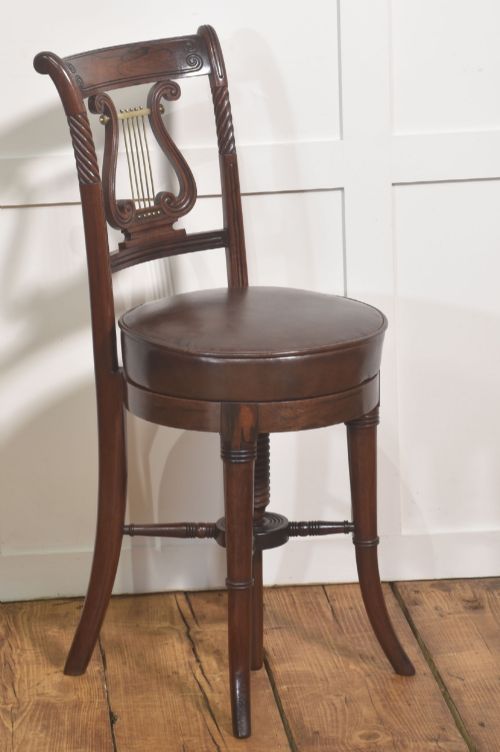
A revolving music chair is a specialised seat designed for musicians, featuring a swivelling top and frequently a backrest for posture support during long practice sessions. The rotating action allows easy movement toward sheet music cabinets.
These pieces typically date from the nineteenth century and combine sturdy hardwood frames with upholstered leather seats.