


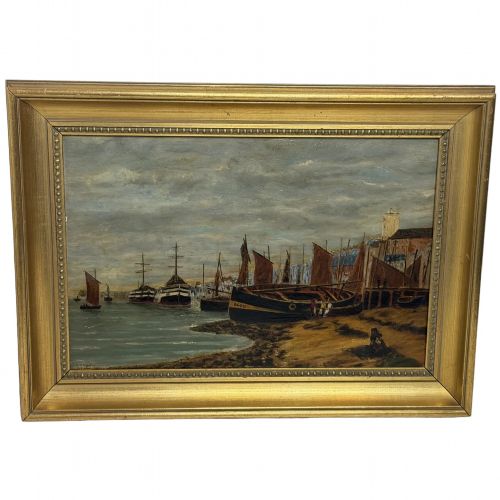


Victorian Harbour Scene
A victorian harbour scene captures the bustling maritime life of the nineteenth century through oil paint and watercolour.
Victorian Harbour Scene
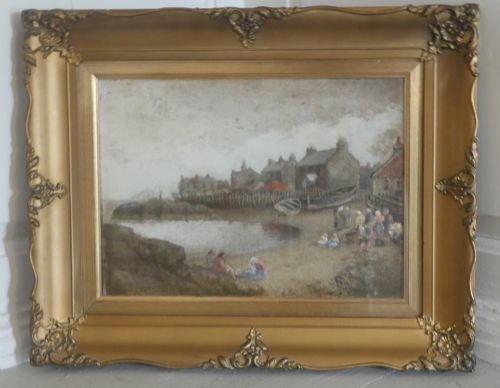
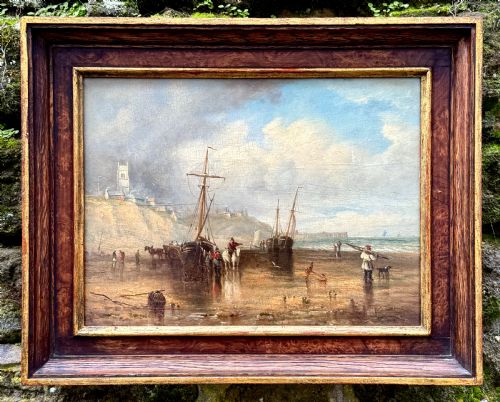
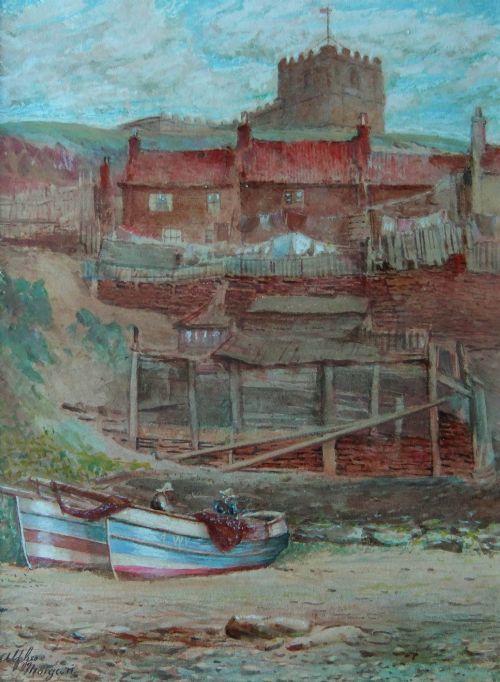
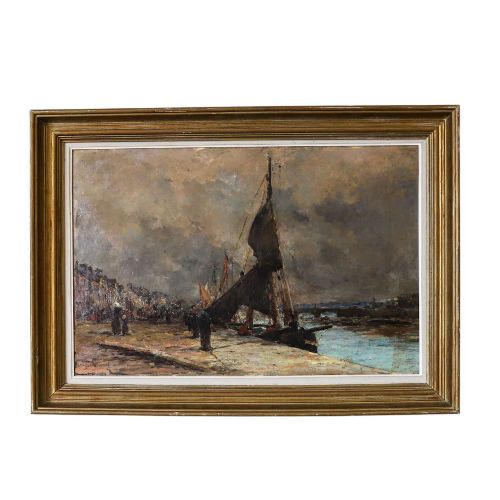
A victorian harbour scene depicts coastal life, fishing boats, and busy ports during the nineteenth and early twentieth centuries. These works record bustling British and continental harbours, often focusing on local vessels and maritime architecture.
Most examples found here take the form of detailed watercolours or rich oil paintings on canvas, framed in period gilt wood or gesso. They frequently document specific locations such as Whitby, St Ives, and Portsmouth.
The compositions range from tranquil moonlit estuary views to dramatic depictions of fishermen landing their catch amidst tidal waters.
Materials and technique
Artists applied oil paint or watercolour onto prepared canvas, wood panel, or heavy paper to create these coastal vistas. Oils provided depth and texture for turbulent water and cloudy skies, whilst watercolour allowed for luminous, transparent washes of light over coastal buildings.
Many works are housed in their original moulded wood frames, frequently enhanced with ornate gesso enrichment and gilding. The physical structure relies on traditional stretcher frames for canvas or mount boards for works on paper.
Several canvases manage to make a grey North Sea look positively inviting through clever touches of golden sunset light.
Assessing quality
Quality rests upon the artist's handling of atmospheric light, maritime perspective, and the fluidity of brushwork in rendering moving water and rigging. Stronger compositions balance the architectural weight of harbour walls against the organic movement of boats and figures.
The preservation of the pigment and the originality of the accompanying frame contribute significantly to the standing of a piece. Works executed with confident, unworked strokes display a direct observation that elevates them above formulaic studio copies.
Edward Mills·William Banks Fortescue·Hector Caffieri·Thomas Creswick·Alfred G Morgan·James Kyd·James Webb·Gustave de Breanski·Ralph Todd·Harry Wanless·Thomas Clavering Alder·Jane Vivian·Hubert Thornley·Ludwig Hermann·Charles France·Edward Fletcher·Arthur Joseph Meadows·William Edward Webb·Walter Meegan·Frank William Scarbrough·William Dommersen
The Victorian Harbour Scene Glossary
- Gesso
- A plaster-like mixture applied to wood frames as a base for ornamentation and gilding. This material was moulded to create ornate decorative corners and borders.
- Watercolour
- A paint consisting of pigment suspended in a water-soluble binder, traditionally painted on paper. Artists utilised this medium to capture delicate coastal light and transparent sea spray.
- Oil on Canvas
- Pigment mixed with drying oil applied to a woven fabric stretched across a wooden frame. This combination allowed artists to build rich, textured layers representing heavy seas and stormy skies.
- Seascape
- A work of art depicting the sea, coastal views, shipping, or marine subjects. These compositions form the core of nineteenth-century maritime artistic output.
Victorian Harbour Scene: Frequently Asked Questions
What subjects appear in these paintings?
These works depict coastal towns, fishing boats, quayside activities, and shipping vessels operating in British and European ports.
Scenes frequently capture specific locations such as Whitby Harbour, St Ives, and the Pool of London during the nineteenth century.
How were these watercolours framed?
Watercolours from this era were typically set behind protective glass within wooden frames, often featuring hand-enamelled or gilded mouldings.
Many retain their original mounts and backing papers, which help protect the delicate pigment from environmental damage.
How do I date a maritime painting?
Dating relies upon costume details of the figures, the type of vessels shown, and stylistic markers associated with nineteenth-century landscape painting.
Signatures, artist dates, and original framing techniques also provide reliable chronological benchmarks for these works.
Where should I hang a coastal painting?
These artworks suit rooms with stable humidity away from direct sunlight, which can fade watercolours and discolour old varnish on oils.
Pairing them with period interiors allows the gilt frames and traditional maritime subjects to complement neutral or dark-toned wall colours.