

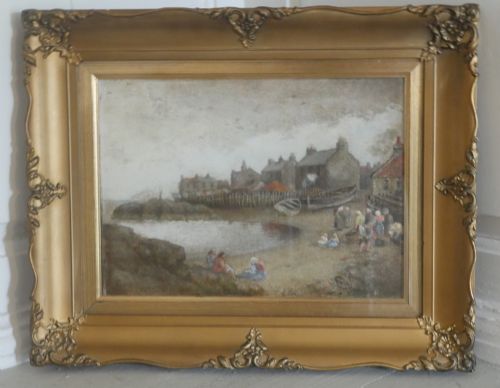


Victorian Harbour Landscape Picture
A victorian harbour landscape picture brings the maritime bustle and coastal calm of the nineteenth century straight onto the wall.
Victorian Harbour Landscape Picture
A victorian harbour landscape picture captures maritime scenes, coastal towns, and river estuaries from the nineteenth century. These artworks record bustling ports, moored sailing yachts, and quiet fishing villages along British and European shores.
Most examples found here take the form of original oil paintings on canvas or delicate watercolour paintings on paper. Subjects range from Whitby harbour and the River Thames to continental views in Venice and Seville.
The works span the nineteenth century and the turn of the twentieth century, created within recognizable movements such as Victorian marine art and nineteenth-century maritime painting.
Materials and technique
Artists painted these scenes using oil on canvas or watercolour on paper, often framing the finished works in wood, gilt wood, or gold leaf. Some watercolours are preserved behind glass within hand-enamelled polychrome frames.
Makers applied oil paints with confident brushwork to build textured coastal water and skies, while watercolourists employed washes to capture the changing light of northern ports and southern destinations.
Victorian Harbour Landscape Picture Retail Price Guide 2026
Typical asking prices for victorian harbour landscape picture among the pieces listed under this phrase on Sellingantiques today, from the lower quarter to the upper quarter. They describe what is for sale here now, not the wider market.
Listings feature works from the nineteenth century up to nineteen-ten, utilising paper, oil on canvas, and watercolour.
Assessing the work
Quality rests in the fidelity of the perspective, the handling of coastal light, and the skill with which the artist renders water, shipping, and architecture. Works by named painters with documented exhibition histories stand apart from unsigned or generic pieces.
The condition of the canvas or paper, the preservation of original pigments, and the compatibility of the surrounding wooden or giltwood frame influence the overall presence of the piece.
Edward Mills·Alfred George Morgan·Charles William Wyllie·T.S. Wallis·James Webb·James Thomas Watts·Kate E Booth·Alfred Henry Vickers·Frank Wasley·Edward Henry Holder·William Langley·Robert Anderson·Frank Rousse·John James Wilson
The Victorian Harbour Landscape Picture Glossary
- Watercolour painting
- A work executed with water-soluble pigments on paper. This medium allows for translucent washes that suit atmospheric coastal skies and reflective harbour water.
- Oil on canvas
- Pigments bound in a drying oil applied to a stretched woven fabric support. This technique provides rich colour saturation and durable textures.
- Gilt wood
- Wood carved and coated with a thin layer of gold leaf or metallic powder. Frames made in this manner give nineteenth-century paintings a traditional decorative boundary.
- Maritime art
- Artistic imagery that depicts ships, sea views, coastal towns, and harbour life. It forms the core category for these nineteenth-century paintings.
Victorian Harbour Landscape Picture: Frequently Asked Questions
What subjects appear in these paintings?
These works depict British and European ports, rivers, and coastal settlements. Common subjects include moored sailing yachts, fishing boats, abbeys overlooking harbours, and busy trading rivers like the Thames.
Artists recorded specific locations ranging from Whitby and Scarborough to Venice and Seville, capturing everyday maritime life of the period.
How do oils and watercolours differ?
Oil paintings utilise pigments suspended in oil on canvas, offering rich textures and deep colour layers. They generally require careful preservation behind glass depending on the frame.
Watercolours use translucent pigments on paper, creating bright, luminous effects. These works need protection from direct sunlight to prevent fading.
Where should I hang these pictures?
These framed paintings suit traditional living rooms, studies, or hallways where their nineteenth-century aesthetic can be appreciated up close. Their maritime subjects pair well with neutral walls and period interiors.
Keep them away from direct heat sources and strong sunlight to protect the paper, canvas, and giltwood frames.
How do I identify the date of a piece?
Dating relies on artist signatures, exhibition records, stylistic clues, and framing materials. Many works carry specific nineteenth-century dates or reflect the distinct artistic styles of the Victorian era and the turn of the century.
Signatures often link directly to known painters active during specific decades of the eighteen-hundreds.