
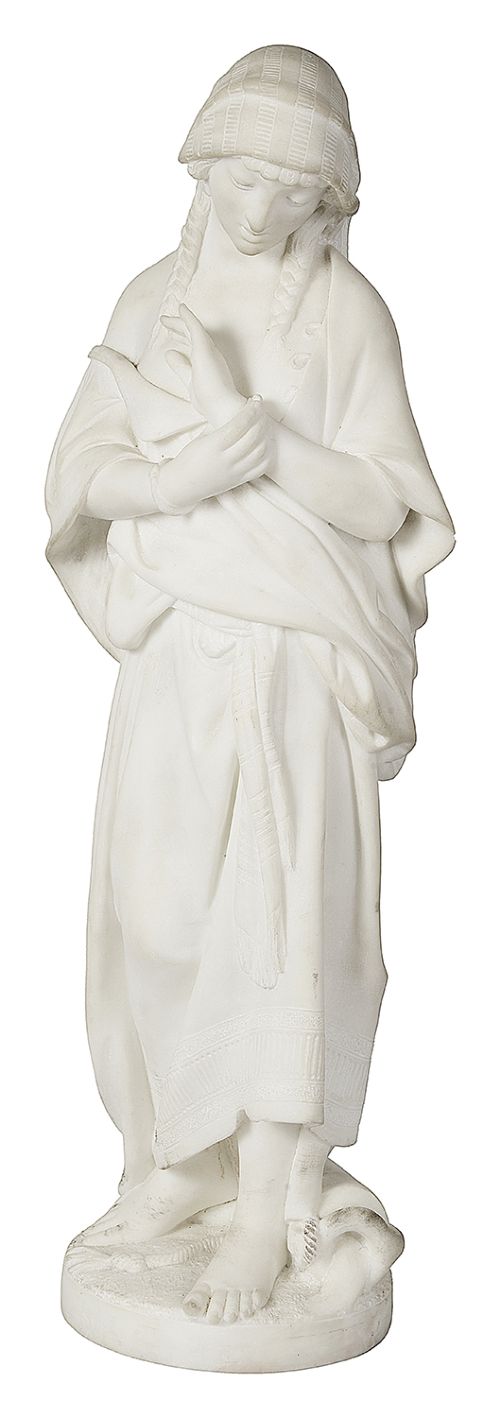


Victorian Girl Figurine
These nineteenth-century figures capture youthful innocence in porcelain, marble, terracotta, and bronze, offering collectors charming studies of children in varied traditional settings.
Victorian Girl Figurine
When you search for a victorian girl figurine, you encounter a diverse range of decorative sculptures spanning nineteenth-century European production. These pieces take the form of freestanding porcelain figures, carved marble busts, terracotta studies, and earthenware subjects produced by major European factories and independent studios.
You are most likely to meet glazed and unglazed porcelain examples from British and continental makers, alongside terracotta fishermen and rustic children. The selection includes modest cabinet figures as well as substantial majolica jardinieres and marble statues depicting young girls with baskets, flowers, or domestic animals.
The objects reflect distinct regional aesthetics, moving from Victorian neoclassical subjects and Rococo revival pieces to Art Nouveau creations and Italian carved marbles. While some portray named nationalities like Dutch or Italian girls, others capture anonymous rustic youths engaged in everyday pursuits.
Materials and methods
Parian porcelain, also known as bisque, provides a matte, marble-like surface that became popular for capturing delicate flesh tones and fabric folds without distracting glaze reflections. Factories utilised slip-casting and intricate hand-modelling to shape these figures before firing them at high temperatures.
Polychrome decoration relied on hand-painted enamel colours and gold leaf highlights applied over or under the glaze, depending on whether the piece originated from porcelain works or majolica kilns. Terracotta and earthenware pieces were similarly modelled in relief, then painted or left in their natural fired earth tones.
Carved marble and cast bronze represented higher-cost artisan methods, involving hand-chisel work on Italian stone or lost-wax casting for metal sculptures. These varied techniques ensured that each medium contributed its own specific tactile quality to the depiction of the subject.
The documented objects span multiple stylistic periods, taking the form of figural groups, jardinieres, portrait busts, and freestanding statues.
Distinguishing craftsmanship
The distinction between standard commercial output and superior work rests on the crispness of the modelling and the precision of the hand-painting. Finer porcelain and terracotta examples retain sharp facial expressions and delicate finger articulation, whereas lesser pieces show softened details from worn moulds.
Surface finish significantly influences the standing of a piece, with careful enamel work and subtle gilding elevating painted earthenware. Sculptures carved from solid marble or cast in bronze demonstrate anatomical accuracy and depth of carving that mass-produced earthenware cannot replicate.
Barranti Florence·Royal Worcester·Bernard Bloch·Ernst Bohne and Soehne·Helena Wolfsohn·Royal Dux·Leon Pilet·Ernst Wahliss
The Victorian Girl Figurine Glossary
- Parian porcelain
- A fine-grained bisque porcelain developed in the nineteenth century to imitate carved marble. It is left unglazed to showcase sculptural detail.
- Majolica
- A type of earthenware coated with an opaque tin-glaze and painted with metallic oxide colours. It produces vibrant, glossy finishes seen on nineteenth-century figural pieces.
- Terracotta
- Fired unglazed clay ranging in colour from light buff to deep red-brown. It is widely used for expressive nineteenth-century portraiture and rustic figures.
- Bisque
- Unglazed ceramic fired once before decoration or left plain for a matte finish. This texture highlights the subtle contours of nineteenth-century figuary work.
- Jardiniere
- An ornamental pot or stand designed to hold plants or flowers. In nineteenth-century ceramics, these often incorporate figural groups into their structural design.
Victorian Girl Figurine: Frequently Asked Questions
How do I identify a parian figure?
Parian figures are distinguished by their matte, unglazed surface that closely resembles carved white marble. They feel cool and smooth to the touch and lack the glossy shine associated with standard glazed porcelain.
Makers used this specific ceramic body in the nineteenth century specifically to replicate classical sculpture in miniature, often detailing drapery and hair with high precision.
What is majolica pottery?
Majolica is a earthenware ceramic coated with a tin-lead glaze that accepts bright, vibrant metallic oxide colours. These pieces often feature rich greens, blues, and browns applied to figural bases and decorative vessels.
The technique was widely utilised by nineteenth-century potteries to create durable, highly decorative domestic items with a glossy finish.
Where were these figures made?
These decorative sculptures originated across Europe during the nineteenth century, with major production centres in Britain, Germany, Austria, and Italy. Factories such as Royal Worcester produced porcelain in England, while continental firms worked in terracotta, majolica, and bronze.
Italian workshops specialised in carved marble figures, reflecting regional access to quality stone and traditional sculpting skills.
How should I display a marble bust?
Marble busts require a stable, level surface capable of supporting considerable weight, as carved stone sculptures are surprisingly heavy. Position them away from direct heat sources and strong sunlight to protect the natural stone.
Dust them gently with a dry, soft cloth, avoiding commercial chemical cleaners that can damage the porous surface of nineteenth-century marble.