

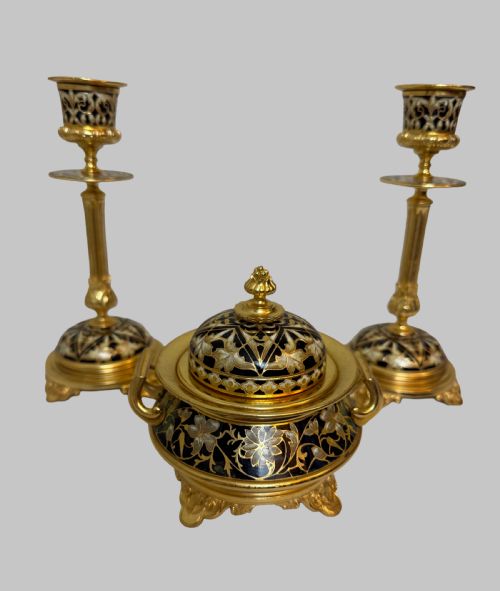


Victorian Gilt Bronze Inkstand
These victorian gilt bronze inkstand pieces are heavy desktop deskside furnishings that bring architectural weight and rich metallic sheen to any study.
Victorian Gilt Bronze Inkstand
A victorian gilt bronze inkstand is a substantial desktop accessory designed to hold writing materials, most commonly incorporating glass inkwells alongside heavy metal trays or mounts. The pieces collected under this search phrase span the nineteenth century, drawing heavily on French Empire, Napoleon III, and Victorian aesthetics.
You will encounter pieces combining gilt bronze or ormolu with marble bases, alongside more elaborate desk sets featuring champleve enamel or figural bronze animals. Many originate from French workshops, though English makers also produced figural designs utilising gilded bronze and original glass inserts.
The standard form takes the shape of a stand or casket supporting one or more inkwells, occasionally expanding into larger desk sets that include matching candlesticks or clocks. Marble plinths in vert or onyx varieties frequently anchor the metalwork, providing a solid foundation for the heavy cast bronze components.
How they were made
The primary construction relies on bronze cast through traditional methods, then treated with mercury gilding or surface ormolu to create a bright golden finish. This metalwork is frequently combined with carved marble bases, secured via internal pins and threaded bolts.
Decorative detailing incorporates champleve enamel work, where recessed cells in the metal are filled with vitreous pastes and fired. Glass inserts serve as the internal ink reservoirs, whilst occasional pieces integrate specialist elements such as porcelain bodies or carved coromandel wood.
Listings combine gilt bronze, ormolu, and brass with marble bases in vert and onyx varieties across nineteenth-century periods.
What varies in quality
The sharpness of the cast bronze ornament dictates the upper tier of quality, where fur, feathers, and acanthus leaves retain crisp, deep definition rather than soft edges. Better examples employ heavier gauge metals and dense, richly veined marbles that provide genuine heft to the stand.
Integration of secondary materials marks the difference between standard production and superior workshop output. Original glass ink inserts, undamaged enamel work, and multi-part construction with patinated highlights separate exceptional desk sets from simpler iterations.
A. MARIONNET·Moser
The Victorian Gilt Bronze Inkstand Glossary
- Ormolu
- A gilded bronze technique utilising a mercury amalgam to bond gold to a bronze base, producing a warm, enduring lustre. This finish characterises the finest nineteenth-century desk accessories.
- Champleve
- An enamelling technique where troughs are dug into a metal surface, filled with enamel, and fired. It appears frequently on nineteenth-century French desk pieces.
- Vert marble
- A rich green decorative stone quarried for architectural and ornamental mounts. It provides a dark, contrasting base for gilt bronze metalwork.
- Animalier
- A nineteenth-century artistic style focusing on realistic depictions of animals. Pieces in this genre often portray lions, stags, or playing cats upon desk stands.
- Escapement
- The internal mechanism within a clock that regulates the release of power. Moser desk clocks incorporate specific escapement types like the chaff-cutter.
Victorian Gilt Bronze Inkstand: Frequently Asked Questions
What is a gilt bronze inkstand?
A gilt bronze inkstand is a heavy desk accessory made from cast bronze treated with a gold-coloured finish, designed to hold writing ink.
These pieces typically incorporate glass wells and stone bases, serving as both functional writing tools and decorative desk centrepieces during the nineteenth century.
Where were most inkstands made?
The majority of nineteenth-century desk stands and inkwells originate from French workshops in Paris, following Empire and Napoleon III styles.
English makers also produced notable figural designs, but the dominant aesthetic across these listings leans towards French ormolu and marble manufacturing.
How do I care for ormolu?
Ormolu requires gentle dusting with a soft, dry brush to prevent the accumulation of dirt in recessed cast details. Avoid chemical polishes entirely, as aggressive rubbing strips the thin layer of historical gilding from the bronze base.
Are the glass inserts original?
Glass inkwell inserts frequently suffered breakage or loss over decades of daily use, meaning many surviving stands contain matched replacements.
Checking the fit and glass quality helps determine whether an insert matches the age and exact collar dimensions of the surrounding bronze mount.