
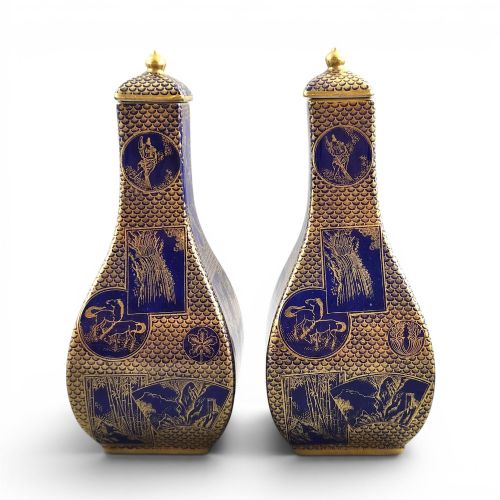


Victorian Gilded Ironstone
Victorian gilded ironstone combines heavy earthenware durability with bright gilt enrichment, offering robust utility and display presence in equal measure.
Victorian Gilded Ironstone
Victorian gilded ironstone comprises dense, heavy earthenware vessels and dinnerware decorated with gold leaf or gilding, appearing across the nineteenth century from Georgian origins into the early twentieth century. These pieces encompass utilitarian tablewares like dinner services and cheese domes alongside display items such as vases, ewers, comports, and potpourri vessels.
The versions most commonly met on this page are robust ironstone plates, jugs, and tureens bearing elaborate patterns, frequently displaying Chinoiserie, Imari, or fence and doves motifs. Many examples stem from established production centres, most notably Mason's, with forms ranging from miniature watering cans and porringers to large serving platters and multi-piece dinner sets.
The stylistic repertoire bridges practical dining needs and decorative parlour display, utilising deep cobalt blue grounds, mazarine blue backgrounds, and intricate hand-painted details. Buyers encounter these items as individual decorative accents or as surviving portions of larger nineteenth-century services designed for both formal dining and interior ornamentation.
Assessing Quality
Quality rests upon the crispness of the moulded form and the ambition of the vessel shape, distinguishing straightforward utilitarian pottery from sculptural, highly modelled pieces like grotesque handles or potpourri jars. Finer examples display precise execution in complex forms such as miniature watering cans or well and tree serving platters.
The application of the palette and gilding dictates visual success, separating simply decorated wares from those featuring rich mazarine or cobalt blue grounds paired with extensive gold leaf work. Superior pieces maintain vibrant hand-painted details across intricate patterns like fence and doves or Imari motifs without muddying the underlying ceramic body.
Listings span periods from Georgian and Regency eras through Victorian production into the early twentieth century, utilising ironstone, enamel, gold leaf, and glaze.
Mason's·Copeland·Minton·Coalbrookdale
The Victorian Gilded Ironstone Glossary
- Ironstone
- A heavy, durable type of earthenware patented in the nineteenth century to provide a strong alternative to porcelain. It forms the solid body for most nineteenth-century dinnerware and decorative vases.
- Gilding
- The application of gold leaf or gold paint to ceramic surfaces for ornamentation. It provides the bright metallic highlights characteristic of Victorian decorative ceramics.
- Comport
- A raised dish or bowl used on the dining table for serving fruit or sweets. These pedestal pieces often feature hand-painted patterns and gilt borders.
- Chinoiserie
- A European artistic style reflecting Chinese motifs and decorative themes. It appears frequently on nineteenth-century ceramic plates, ewers, and vases.
- Porringer
- A small, handled bowl used historically for porridge, soups, or liquids. In ironstone, these survive as compact vessels with single or double handles.
Victorian Gilded Ironstone: Frequently Asked Questions
What is ironstone pottery?
Ironstone is a dense, heavy earthenware body developed in the nineteenth century to mimic porcelain while offering greater strength for daily dining and display. It serves as the primary material for durable dinner services, large platters, and decorative vases.
The ceramic composition accepts glazes and enamels readily, allowing manufacturers to produce brightly coloured tableware that withstands frequent use while retaining its structural integrity over generations.
How were tureens and comports used?
Tureens held soups or sauces at the dining table, accompanied by ladles for serving guests during formal nineteenth-century meals. Comports functioned as elevated centrepieces for presenting fruit, nuts, or sweetmeats.
Both forms combined practical utility with decorative display, often matching the wider dinner service to create a unified tablescape for wealthy households.
How do I date these pieces?
Dating relies on maker marks, ceramic bodies, stylistic shifts, and recorded production periods spanning from Georgian origins through the Victorian era into the early twentieth century. Stylistic markers like Chinoiserie motifs or Regency shapes help narrow down the decade of manufacture.
Changes in pattern registration and factory output provide further chronological reference points when examining individual jugs, plates, and vases.
How should I clean gilded ironstone?
Cleaning requires gentle washing with warm water and mild soap, avoiding abrasive sponges or harsh chemical detergents that might wear away the delicate gold leaf and enamel decoration. Careful handling prevents chipping the dense earthenware body.
Displaying pieces away from direct, harsh sunlight and handling them with clean hands preserves the integrity of the hand-painted surfaces and gilt highlights over time.