
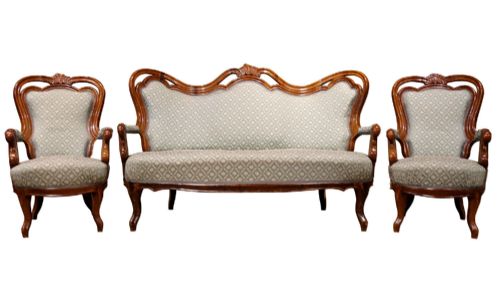
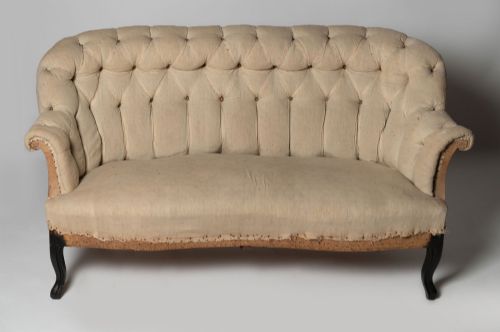
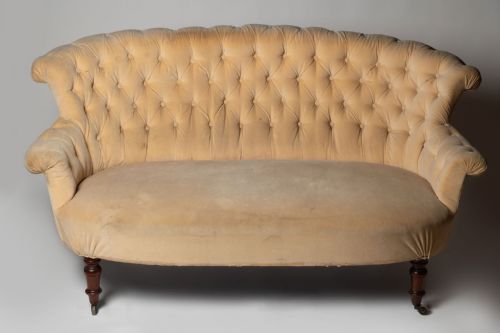


Victorian French Canape Sofa
A victorian french canape sofa brings ornamented walnut frames and upholstered seating into the home, offering deep comfort and period character.
Victorian French Canape Sofa
When you search for a victorian french canape sofa, you encounter a selection of nineteenth-century seating spanning the 1840s to the early 1900s. These pieces include salon suites, settees, and large giltwood settees originating from continental and English makers.
The most common examples on this page are carved walnut frames and giltwood pieces, often upholstered in velvet, calico, or textile. Styles range from Rococo Revival and Louis XV Revival to Napoleon III and French Country.
Buyers select these settees to anchor a drawing room or salon with distinct period forms. The variations in design reflect the broader revival movements of the Victorian era.
How they were made
The frames rely on solid walnut, wood, and giltwood, shaped through hand carving to produce the curved lines characteristic of revival styles. Brass elements occasionally appear on these frames to provide structural or decorative support.
Upholstery techniques involve materials such as velvet, fabric, calico, and textile stretched over internal padding. Button back detailing is used on specific models to secure the fabric and create a textured surface.
Listings feature walnut, giltwood, and wood frames paired with velvet, calico, and textile upholstery across the nineteenth and early twentieth centuries.
What varies in quality
Quality rests in the depth and execution of the carved walnut or giltwood frame work. Crisp, detailed floral and scroll motifs distinguish finer output from simpler production.
The integrity of the timber frame and the standard of the upholstery materials determine the overall execution. Pieces offered for upholstery allow an assessment of the underlying wood construction.
The Victorian French Canape Sofa Glossary
- Giltwood
- Wood that has been coated with gold leaf or a gold-coloured finish. This treatment highlights the carved decorative elements of the frame.
- Rococo Revival
- A nineteenth-century design style emulating the elaborate, asymmetric curves of the eighteenth-century Rococo movement. It is defined by C-scrolls and naturalistic floral carvings.
- Salon Suite
- A matched set of seating furniture, often comprising a settee and matching armchairs. These suites were designed for formal reception rooms.
- Button Back
- An upholstery style where buttons are pulled deep into the padding in a diamond pattern. This method secures the internal stuffing and creates a tufted texture.
Victorian French Canape Sofa: Frequently Asked Questions
How are these sofas used today?
These settees function as statement seating in living rooms, studies, and bedrooms. Their distinct silhouettes allow them to serve as focal points in traditional or eclectic interiors.
They provide practical seating while introducing nineteenth-century design character to a space. Many owners place them away from walls to showcase the carved backs.
What styles do these pieces represent?
The listings show a strong presence of Rococo Revival and Louis XV Revival aesthetics. These styles draw on continental European design traditions adapted during the Victorian period.
Victorian interpretations often combine French shaping with heavier walnut timbers. Napoleon III and French Country influences also appear across the selection.
How do I identify the period?
Dating relies on stylistic clues, timber choice, and construction methods spanning the nineteenth century. Pieces range from mid-century walnut frames to later examples from the 1890s and 1900s.
Specific design markers, such as button-backed upholstery and giltwood finishes, help align pieces with their decade of origin. The transition from walnut to gilt finishes maps the shift in interior tastes.
What is a salon suite?
A salon suite consists of a matching settee and accompanying armchairs designed to furnish a formal reception room. They share identical wood carving, frame styles, and upholstery fabrics.
These coordinated sets provide a unified aesthetic for large entertaining spaces. Surviving suites keep the complete nineteenth-century grouping intact.