



Victorian Expanding Book Slide
A Victorian expanding book slide keeps your library tidy on the desk with a clever folding mechanism that adjusts to hold any number of volumes.
Victorian Expanding Book Slide
A Victorian expanding book slide is a desk accessory designed to hold a varying number of volumes upright between two hinged or sliding ends. When you search this phrase, you find practical library furnishings that double as decorative pieces for a desk or side table.
The versions most common on this page are made from rich timbers like walnut and coromandel, often fitted with brass mounts that strengthen the sliding action. These functional objects range from plain wooden book rests to elaborately decorated novel rests with painted plaques or inlaid stone.
Originating largely in the nineteenth century, these book holders reflect the Victorian taste for orderly study spaces and clever mechanical items. Makers utilised extending actions to accommodate growing rows of poetry or reference books without taking up permanent extra space.
How they were made
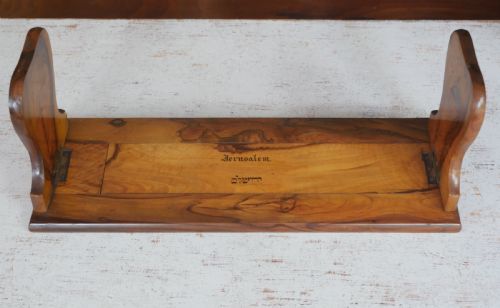
Cabinet makers constructed these book slides using dense hardwoods such as walnut, rosewood, coromandel, and ebonised wood, which took a fine polish and endured the daily friction of the sliding mechanism. These timbers were often selected for their striking grain patterns, particularly burr walnut and olive wood.
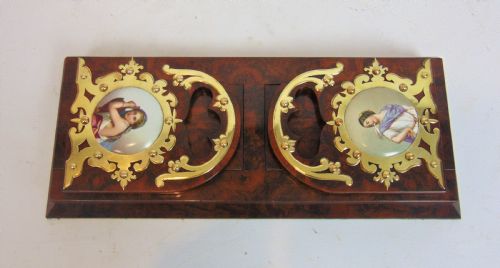
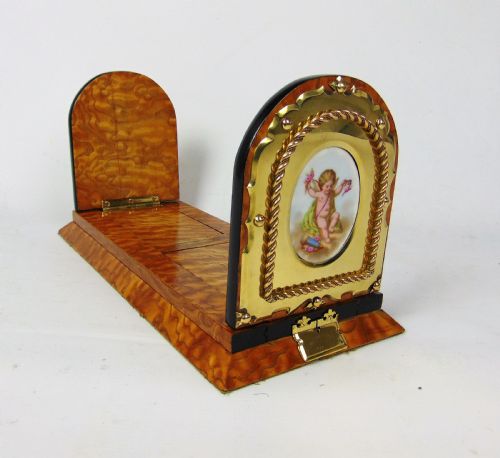
Metalwork played a vital role in the construction, with brass hinges, mounts, and tracks allowing the two ends to pull apart smoothly while keeping the base rigid. Artisans also integrated decorative elements like porcelain plaques, carved teak, micro-mosaic Pietra Dura, and Tunbridge Ware inlay into the wooden framework.
Listings feature nineteenth century book slides in walnut, coromandel, and brass-mounted mahogany, spanning Regency to Victorian Gothic styles.
What varies in quality
The distinction between standard examples and superior ones rests on the ambition of the materials and the precision of the mechanics. Pieces featuring exotic timbers like coromandel, combined with specialist ornamentation such as pietra dura or hand-painted plaques, sit at the upper end of the range.
Engineering also dictates value, as seen in patented extending actions by makers like Betjemanns that operate without catching or sagging. Solid brass mountings that remain firmly fixed to the timber indicate careful initial manufacture, whereas loose joints suggest lesser craftsmanship.
Tiffany and Co·Charles Westerton·Betjemanns
The Victorian Expanding Book Slide Glossary
- Tunbridge Ware
- Woodworking decorated with tiny mosaic wooden tiles to form geometric or pictorial patterns. This technique originated in the Kent spa town of Tunbridge Wells during the nineteenth century.
- Pietra Dura
- Inlay work using cut and fitted polished coloured stones to create pictorial designs. It appears frequently on high-status Victorian desk accessories.
- Coromandel
- A dense, heavy timber imported from Asia, featuring dark brown stripes over a rich fawn background. It was favoured for luxury nineteenth century boxes and book slides.
- Novel Rest
- A nineteenth century term for a small desktop book holder designed to keep current reading material upright. These often feature folding or expanding actions.
- Ebonised Wood
- Timber treated with chemical stains or dark paint to imitate expensive ebony. This finish provided a stark, fashionable contrast to brass mounts.
Victorian Expanding Book Slide: Frequently Asked Questions
How do expanding book slides work?
These desk accessories feature a hinged or sliding base that extends outward to create more space for books. As you add or remove volumes, the ends glide smoothly along hidden tracks or brass mountings to keep the row supported.
Most designs use a scissor action underneath the wooden platform, allowing both ends to move outward simultaneously while maintaining a stable foundation on the desk.
What woods were used for book slides?
Cabinet makers utilised a range of dense hardwoods capable of withstanding daily mechanical movement. Walnut, rosewood, and mahogany appear frequently across nineteenth century examples.
More luxurious versions employ exotic coromandel or burr walnut, sometimes accented with ebonised wood or olive wood sourced from Jerusalem.
How do I care for a wooden book slide?
Keep the timber away from direct heat sources and strong sunlight to prevent the wood from drying out or warping. Dust the carved surfaces and brass mounts regularly with a soft, dry cloth.
Apply a modest amount of quality beeswax occasionally to nourish the grain, taking care not to let polish build up inside the sliding mechanism.
Were these used in the home library?
Victorian households placed these accessories on study desks, drawing room tables, and library reading slopes. They held working volumes, Bibles, or current novels close to hand.
Their adjustable nature made them particularly useful for keeping loose collections of books tidy without requiring a full bookcase.