



Victorian Exhibition Credenza
A victorian exhibition credenza represents the absolute pinnacle of nineteenth-century cabinet-making, built to display status and supreme joinery.
Victorian Exhibition Credenza
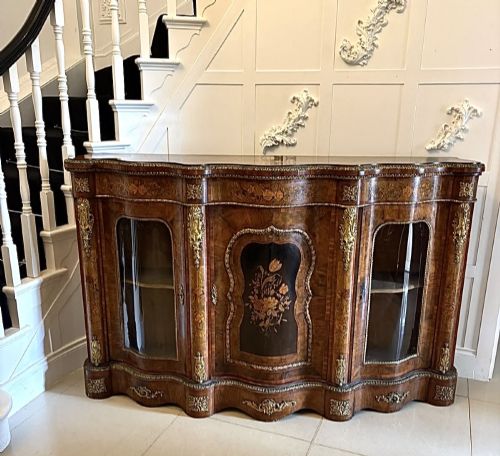
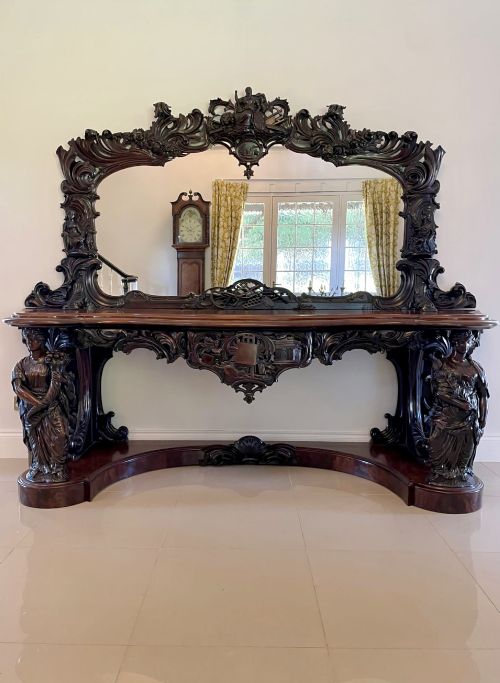
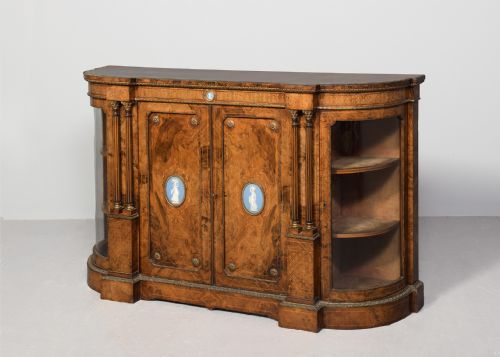
A victorian exhibition credenza is a grand reception-room cabinet designed to showcase the finest decorative arts and woodworking skills of the era. These pieces frequently appear in serpentine or four-door formats, often paired with mirror backs or delicate open shelving.
The pieces listed on this page originate predominantly from the Victorian period, spanning the mid-nineteenth century, with specific examples dated around eighteen-fifty and eighteen-sixty, alongside later twentieth-century interpretations.
Forms extend beyond traditional credenzas to encompass sideboards, side cabinets, console tables, and display cabinets, reflecting the versatile grandeur expected in elite nineteenth-century drawing rooms.
Materials and construction methods
Makers utilised rich timbers such as burr walnut, mahogany, and kingwood, frequently applying intricate marquetry patterns across curved serpentine surfaces. These foundational woods provide the dramatic grain figures characteristic of high-status nineteenth-century furniture.
Gilded ormolu mounts and porcelain panels frequently adorn the framework, particularly within French Revival and Louis XVI Revival designs. Mirrored backs and glass panelling are integrated to enhance light and display capacity within the principal cabinet spaces.
Victorian Exhibition Credenza Retail Price Guide 2026
Typical asking prices for victorian exhibition credenza among the pieces listed under this phrase on Sellingantiques today, from the lower quarter to the upper quarter. They describe what is for sale here now, not the wider market.
Listings span the nineteenth century, including specific dates from eighteen-fifty to eighteen-eighty, alongside a twentieth-century example from nineteen-twenty.
Discerning quality and execution
The distinction between standard Victorian cabinetry and an exhibition piece lies in the ambition of the design and the precision of the marquetry. Superior examples display fluid serpentine shaping, complex timber veneers, and harmonious integration of ormolu mounts without mechanical stiffness.
Finer credenzas maintain rigorous symmetry in their wood grain selection and superior finishing on concealed internal surfaces. The crispness of carved mahogany details and the quality of porcelain plaque painting further separate exceptional workshops from routine production.
The Victorian Exhibition Credenza Glossary
- Serpentine
- A curved furniture front characterised by a convex centre flanked by concave ends, creating a flowing, wave-like contour. This shape demands advanced woodworking skill to veneer accurately.
- Marquetry
- The art of applying small pieces of veneer to a structure to form decorative patterns and pictorial designs. Cabinet-makers used contrasting timbers to achieve tonal depth.
- Ormolu
- Gilded bronze mounts applied to furniture for decorative enrichment, popular in French Revival and neoclassical nineteenth-century styles. The finish provides metallic contrast against dark woods.
- Credenza
- A low dining or drawing-room cabinet, typically featuring central cupboards flanked by curved glass doors. In the nineteenth century, it evolved into a primary display piece for porcelain and silver.
Victorian Exhibition Credenza: Frequently Asked Questions
What is a victorian exhibition credenza?
A victorian exhibition credenza is a high-status cabinet produced to showcase exceptional woodworking, marquetry, and decorative arts during the nineteenth century. These pieces were often made for display at trade exhibitions or commissioned for wealthy homes.
They combine intricate timber veneers, such as burr walnut and kingwood, with glass doors, mirrored backs, and ormolu mounts to create a striking visual centrepiece for a formal reception room.
How were these credenzas used historically?
Historically, these cabinets served as both storage and display furniture in drawing rooms and grand parlours. The glass-fronted sections held prized porcelain, silver, and decorative objects.
The flat top surface provided additional space for ornaments, while the enclosed cupboards stored linens or dining accessories when not in active use during formal gatherings.
How do I style a credenza in a modern interior?
A victorian credenza works effectively as a focal point in a dining room, hallway, or living space, paired with neutral walls that allow the burr walnut or mahogany grain to stand out. Keep surrounding decor balanced to let the intricate marquetry and ormolu details remain the visual priority.
Avoid overcrowding the top surface; a few carefully chosen lamps, ceramic pieces, or framed artworks will complement the cabinet without obscuring its proportions.
How can I tell different revival styles apart?
Victorian French Revival and Louis XVI Revival pieces often incorporate symmetrical ormolu mounts, porcelain plaques, and lighter wood selections like kingwood. Rococo Revival designs tend to feature more exuberant, asymmetrical carved mahogany motifs and fluid serpentine curves.
Examining the specific combination of veneers, hardware, and structural silhouettes helps identify which continental design philosophy influenced the British cabinet-maker.