





Victorian Equestrian Pottery Figure
A victorian equestrian pottery figure brings the bold, unvarnished pageantry of the nineteenth century straight to the mantelpiece.
Victorian Equestrian Pottery Figure
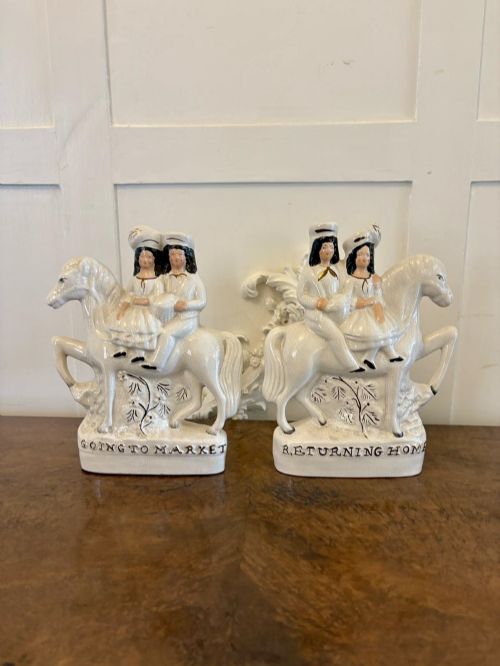
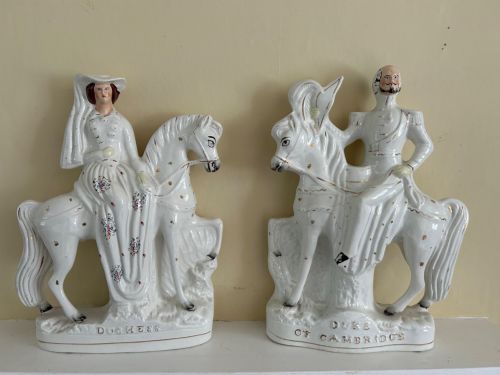
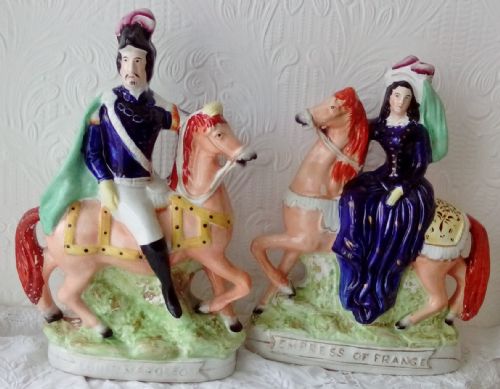
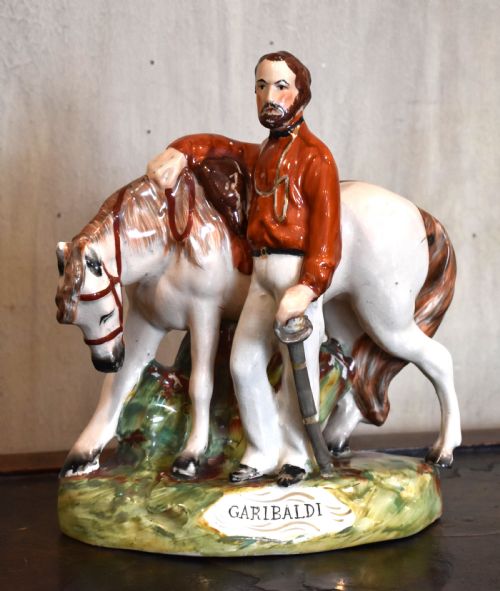
Buyers hunting for a victorian equestrian pottery figure find themselves examining heavy earthenware ceramics depicting riders, royalty, and historical personages mounted on horseback. These pieces span the nineteenth century, with Victorian Staffordshire pottery figures forming the vast majority of the offerings on this page.
The subjects range widely from notable political figures like Garibaldi and Louis Napoleon to Scottish highlanders, jockeys, highwaymen, and fictional hunters. Flatback pottery figures dominate the selection, designed specifically to sit snugly against a wall on a shelf or mantel.
Makers produced these decorative ceramic figurines in pairs as well as solo formats, capturing royal children, musicians on horseback, and legendary heroines like Joan of Arc. The primitive folk art tradition also emerges through Scottish Portobello works portraying ladies on horseback.
Materials and construction
Potters shaped these earthenware bodies using moulds before applying lead glaze and vibrant enamel paint to finish the surface. Many examples incorporate touches of gilt to highlight details on the horses and riders.
The firing process utilised basic kilns of the era, resulting in the sturdy ceramic fabric characteristic of nineteenth-century Staffordshire production. Artisans then hand-painted the enamel colours directly onto the glazed ceramic surface, creating the bright palette seen across the figures.
Victorian Equestrian Pottery Figure Retail Price Guide 2026
Typical asking prices for victorian equestrian pottery figure among the pieces listed under this phrase on Sellingantiques today, from the lower quarter to the upper quarter. They describe what is for sale here now, not the wider market.
Highwayman Tom King shares the saddle with leopard hunters and royal children in this spirited menagerie of mounted ceramics.
Factors of quality and distinction
The complexity and scale of the composition also determine distinction, with large flatbacks and balanced pairs demanding greater skill from the potter. Preservation of the original glaze and the brightness of the enamel paint contribute significantly to the standing of any given piece.
The Victorian Equestrian Pottery Figure Glossary
- Flatback
- A pottery figure moulded with a finished front and a flat, unglazed or minimally glazed rear designed to stand flush against a wall.
- Staffordshire pottery
- Earthenware ceramics produced in the numerous potteries of the Staffordshire district in England during the nineteenth century.
- Lead glaze
- A glossy coating containing lead compounds applied to ceramics before firing to provide a smooth, waterproof finish.
- Enamel paint
- Opaque coloured glass fused to the ceramic surface during a secondary low-temperature firing to create bright decorative details.
- Portobello
- A type of Scottish pottery associated with early primitive figures produced near Edinburgh.
Victorian Equestrian Pottery Figure: Frequently Asked Questions
What are victorian equestrian pottery figures?
These ceramic pieces are nineteenth-century earthenware figures depicting historical, royal, or fictional riders on horseback.
Potters created them primarily for decorative display on mantels and shelves in homes of the era.
Where were these figures made?
The vast majority originate from the pottery kilns of Staffordshire in England, though Scottish works also appear.
Local artisans moulded and painted the ceramic bodies by hand using traditional methods.
How do I display them safely?
Flatback figures suit placement directly against a wall on a stable, level surface away from heavy foot traffic.
Keep the glazed ceramic out of direct sunlight to protect the hand-painted enamel colours from fading over time.
How can I tell periods apart?
Pieces span the nineteenth century, with Victorian examples showing distinctive moulded details and bright enamel palettes.
Earlier works, such as primitive Scottish Portobello pieces, often display simpler forms and coarser earthenware bodies.