

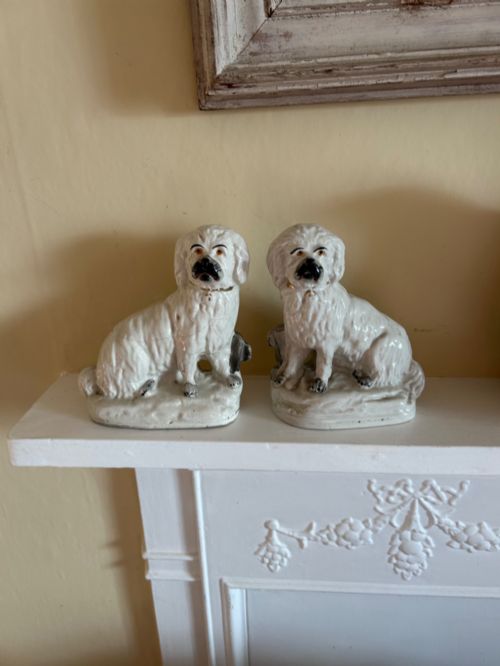


English Country Earthenware Figure
An english country earthenware figure brings the character of nineteenth-century rural hearths straight into a modern room through its naive charm and rich lead glaze.
English Country Earthenware Figure
When you search for an english country earthenware figure, you are looking at vernacular ceramic sculptures created across the nineteenth century, largely in Victorian Staffordshire workshops. These pieces capture everything from domestic animals and theatrical duos to literary figures like William Shakespeare and historical rulers.
The most common versions on this page are pairs of animals such as sheep, lambs, cows with calves, and hunting dogs, alongside flatback figures designed to sit neatly against a mantelpiece. Makers ranged from vernacular folk artists to documented potters like Walton, producing both modest pottery figures and grander decorative busts.
Originating predominantly in England during the Georgian and Victorian eras, these earthenware objects reflect popular culture, rural life, and theatrical entertainment of the period. Their enduring appeal lies in their unpretentious modelling and the straightforward way they record nineteenth-century visual life.
How they were made
Potters built these pieces using earthenware clay, shaping them by hand or in press moulds before finishing the surfaces with lead glaze and enamel paint. The resulting ceramic body is porous and warm in tone, providing a receptive base for fluid glazes that pool in the crevices of the modelling.
Makers applied clear or coloured lead glazes to give the figures their characteristic sheen, often highlighting details with enamel paint in shades of green, black, and rust. Flatback figures were typically left unglazed at the rear because they were intended to be viewed solely from the front on a shelf.
English Country Earthenware Figure Retail Price Guide 2026
Typical asking prices for english country earthenware figure among the pieces listed under this phrase on Sellingantiques today, from the lower quarter to the upper quarter. They describe what is for sale here now, not the wider market.
Listings span the nineteenth century, including periods such as the Victorian era alongside specific dates from 1800 to 1880.
What varies in quality
Quality in these figures rests on the sharpness of the modelling and the expressiveness of the hand-painted details. Stronger examples show confident brushwork on the faces and eyes, whereas weaker pieces rely on hasty, generic strokes that flatten the character of the subject.
The sophistication of the glaze application also defines the upper tier of the work. Rich, even lead glazes that retain their gloss without excessive crazing elevate a piece above simpler, heavily worn alternatives.
Walton
The English Country Earthenware Figure Glossary
- Flatback
- A figure moulded with a flat, often unglazed back designed to stand directly against a wall or mantelpiece. This method saved clay and simplified production for pieces meant for single-aspect display.
- Lead glaze
- A glossy coating containing lead oxide applied to pottery before firing to waterproof the clay and enrich the colours. It gives nineteenth-century earthenware its characteristic warm, reflective shine.
- Pearlware
- A refined earthenware developed in the late eighteenth century featuring a subtle bluish tint in the glaze. This ceramic body was widely used for figures and tableware before the heavier Victorian styles took over.
- Spill vase
- A hollow figural ceramic piece incorporating a small cylinder designed to hold wooden spills for lighting pipes or fires. These dual-purpose objects combined domestic utility with popular sculptural decoration.
English Country Earthenware Figure: Frequently Asked Questions
What is an english country earthenware figure?
These pieces are nineteenth-century ceramic sculptures depicting animals, theatrical characters, and historical figures, produced largely in English regional potteries.
They served as decorative ornaments for mantelpieces and shelves in homes during the Victorian era.
Were these figures meant to be seen from the back?
Most flatback figures were designed specifically to be placed against a wall, meaning the rear is often flat and left unglazed.
Pairs of animals and certain freestanding sculptures, however, are modelled in the round and finished on all sides.
How do I date an english country earthenware figure?
Dating relies on stylistic clues such as the Victorian flatback format, the use of pearlware bodies, and typical nineteenth-century subject matter like theatrical duos or royal portraits.
Potters often left pieces unmarked, so comparison with documented styles from the 1800s to the 1880s provides the best chronological guide.
How do I care for antique earthenware?
Keep these ceramic figures out of direct sunlight and away from damp environments to protect the fragile enamel paint and porous earthenware body.
Dust them gently with a dry, soft brush rather than using liquid cleaners or immersion.