




Victorian Egyptian Revival Bronze
These Victorian Egyptian Revival bronze pieces bring the monumental sculpture and symbolic ornament of the Nile into domestic interiors with striking presence.
Victorian Egyptian Revival Bronze
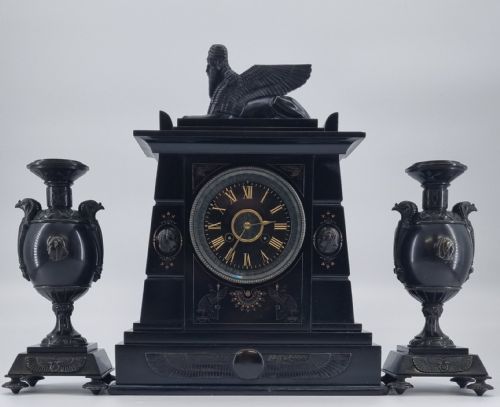
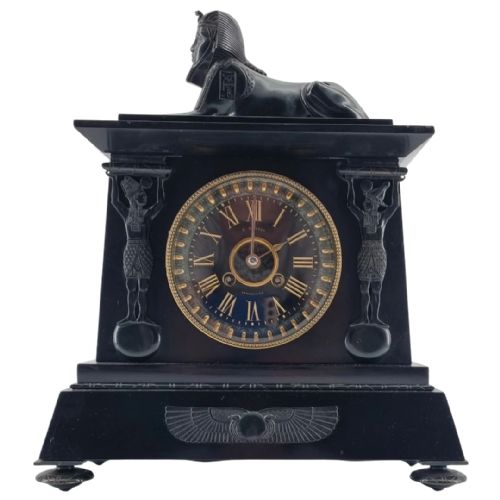
Victorian Egyptian Revival bronze objects capture the nineteenth-century fascination with pharaonic iconography, ranging from grand mantel clocks and garnitures to decorative sculptures and utilitarian hardware. When exploring these items, collectors encounter sphinxes, shabtis, and hieroglyphic motifs cast in metal and mounted on stone bases.
The pieces on this page are most frequently nineteenth-century mantel clocks, paired garnitures, and patinated bronze figures. Makers utilised the classical vocabulary of ancient Egypt alongside Victorian horological movements to create decorative works for the mantelpiece and desk.
Materials and construction
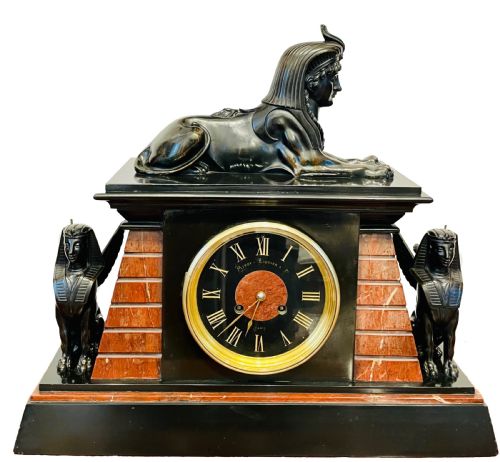
Heavy mounting bases relied upon black slate, marble, and brass to anchor the statues and clock housings. These dense stones provided both structural stability and a formal plinth reminiscent of ancient temple architecture.
Even Victorian timekeeping could not escape the watchful gaze of twin bronze sphinxes guarding the mantelpiece.
Markers of distinction
Quality separates mass-produced decorative items from works of exceptional sculptural definition and precision casting. Finer pieces demonstrate crisp chasing in the bronze, subtle patination, and harmonious integration of the figure with its marble or slate plinth.
Horological examples gain distinction through the movement itself, where renowned makers and specialised clockmakers elevate the mechanical interior to match the sculptural ambition of the bronze case.
D Munsey of Cambridge·Achille Brocot·Barraud and Lund London
The Victorian Egyptian Revival Bronze Glossary
- Sphinx
- A mythical creature with the body of a lion and a human or animal head, frequently utilised as a guardian figure in Egyptian Revival sculpture and architectural ornament. These mythical beasts appear singly or as matching pairs flanking mantel clocks.
- Shabti
- A small funerary figure placed in ancient Egyptian tombs to act as a servant for the deceased in the afterlife. In nineteenth-century decorative arts, these figures were cast in bronze and mounted upon stone plinths.
- Garniture
- A set of decorative ornaments designed to be displayed together on a mantelpiece, typically consisting of a central clock flanked by matching candelabras or urns. These matched suites create a balanced decorative display.
- Patinated bronze
- Bronze that has been chemically treated or naturally aged to produce a specific surface colour, ranging from deep brown to verdigris. This finish emphasises the sculptural contours of the cast metal.
Victorian Egyptian Revival Bronze: Frequently Asked Questions
What is Egyptian Revival bronze?
Egyptian Revival bronze refers to nineteenth-century decorative art objects incorporating pharaonic motifs such as sphinxes, hieroglyphs, and shabtis cast in bronze.
These pieces reflect the European fascination with ancient Egyptian archaeology following major excavations and Nile expeditions.
How were mantel clocks used?
Mantel clocks served as functional timekeepers and prominent decorative centerpieces on drawing room fireplaces.
Paired with matching garnitures or candelabras, they established a formal symmetry in Victorian interiors.
Where should I place these bronzes?
These substantial pieces anchor mantelsides, bookcases, and large sideboards where their weight and dark patination stand out against neutral walls.
They pair effectively with stone surfaces that echo their marble and slate bases.
How do I identify Victorian pieces?
Victorian examples display nineteenth-century casting techniques, mechanical clock movements from the period, and distinct stylistic revivals of pharaonic forms.
Signatures or maker inscriptions on the movement plates and bronze bases often confirm the origin.