


Victorian Earthenware Mantle Ornament
These Victorian earthenware mantle ornament pieces are Staffordshire figures and spill vases that bring character and colour to a fireplace.
Victorian Earthenware Mantle Ornament
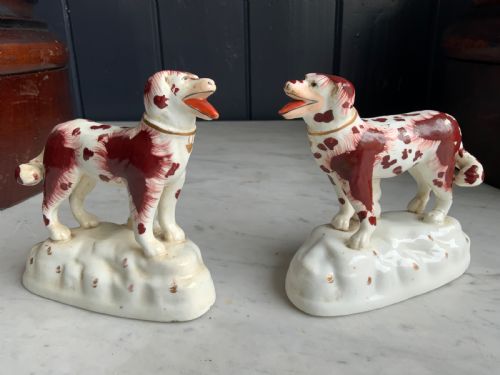
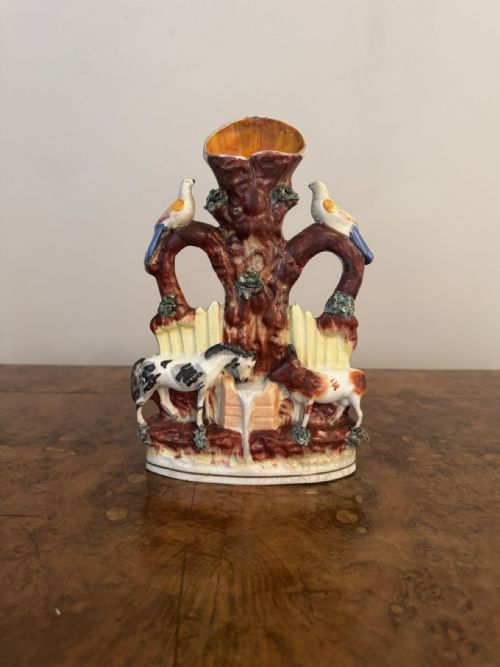
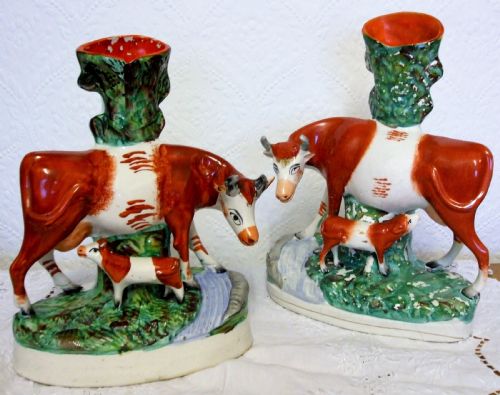
When you search for a victorian earthenware mantle ornament, you are looking at Staffordshire figures, spaniels, greyhounds, pugs, poodles, sheep, cows, and spill vases produced across the nineteenth century. These ornaments include portrait figures, flatback figures, and pairs designed to sit upon a mantelpiece.
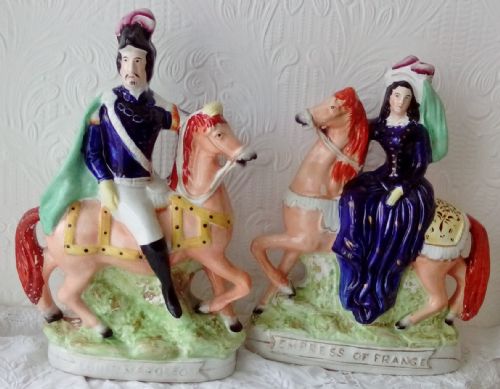
The most common versions on this page are pairs of Staffordshire dogs and spill vases from the Victorian era. You will also encounter royal portrait figures and narrative subjects such as Little Red Riding Hood.
The periods represented span from the Regency era through to the late nineteenth century, predominantly centred on the Victorian decades of 1860, 1880, 1890, and 1900. They originate mainly from English potteries.
How they were made
These pieces are made from earthenware and ceramic bodies, shaped into figures and spill holders. Makers applied glaze, enamel colours, and gold paint to decorate the surfaces.
Some examples incorporate gilt detailing and glass eyes to add expression and finish to the pottery. Figures often feature hand-painted details and occasional encrusting.
Several dogs peer out with glass eyes.
What varies in quality
Quality in a victorian earthenware mantle ornament rests upon the crispness of the moulding and the skill of the hand-painting. Superior examples show careful application of enamel and gold paint.
The presence of fine details such as glass eyes or delicate encrusting distinguishes the finer pairs from standard production. Condition of the glaze and the preservation of the painted surface dictate the standing of a piece.
The Victorian Earthenware Mantle Ornament Glossary
- Flatback
- A figure moulded with a finished front and a plain, unpainted flat back intended to stand against a wall or mantelpiece. This style is common in nineteenth-century Staffordshire pottery.
- Spill Vase
- A hollow ceramic vessel designed to hold taper spills for lighting candles and fires. These often form part of a figural group on the mantel.
- Earthenware
- A porous ceramic body fired at lower temperatures, requiring a glaze to become impermeable. It serves as the primary material for these Victorian figures.
- Enamel
- Vitreous colours applied over the glaze and fired again at a lower temperature. This technique allows for bright surface decoration on pottery.
- Gilt
- A gold paint or leaf applied to highlight details and borders on ceramic figures. It adds a decorative finish to the ornament.
Victorian Earthenware Mantle Ornament: Frequently Asked Questions
Where did these mantel ornaments sit?
They were traditionally displayed on the mantelpiece in a Victorian parlour, often arranged as symmetrical pairs flanking a clock or mirror.
Their flat backs allowed them to sit snugly against the wall of the fireplace.
What subjects do these figures show?
The subjects range from domestic animals like spaniels, greyhounds, pugs, poodles, sheep, and cows to human figures.
You will also find royal portrait figures and characters from stories, such as Little Red Riding Hood.
How do I date a Staffordshire figure?
Dating relies on stylistic clues, the type of ceramic body, and recorded periods like 1860, 1880, or 1900.
Flatback construction and specific portrait subjects help narrow the era of manufacture.
What is a spill vase?
A spill vase combines a decorative figure with an integral hollow tube used to hold wooden spills.
These spills were lit from the fire and used to transfer a flame to candles or pipes.
How do I care for glazed earthenware?
Keep these ornaments away from direct, harsh sunlight to protect the enamel colours and gold paint from fading.
Dust them gently with a dry, soft cloth rather than using liquid cleaners.