




Victorian Drawer Whatnot
A victorian drawer whatnot is a tiered open shelving unit with integrated storage, built to display ornaments and hold papers in nineteenth-century rooms.
Victorian Drawer Whatnot
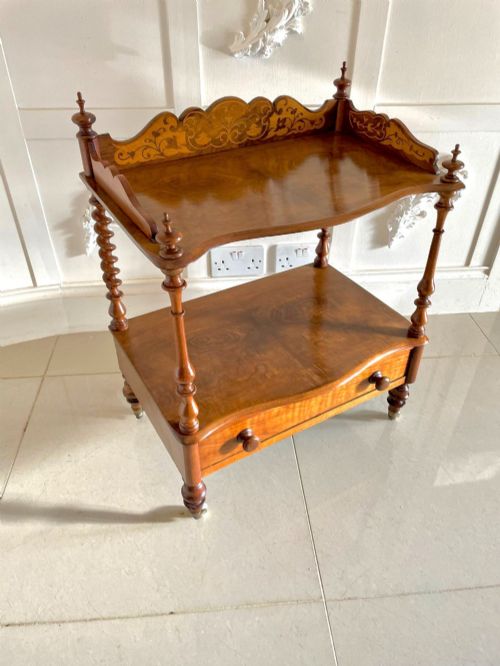
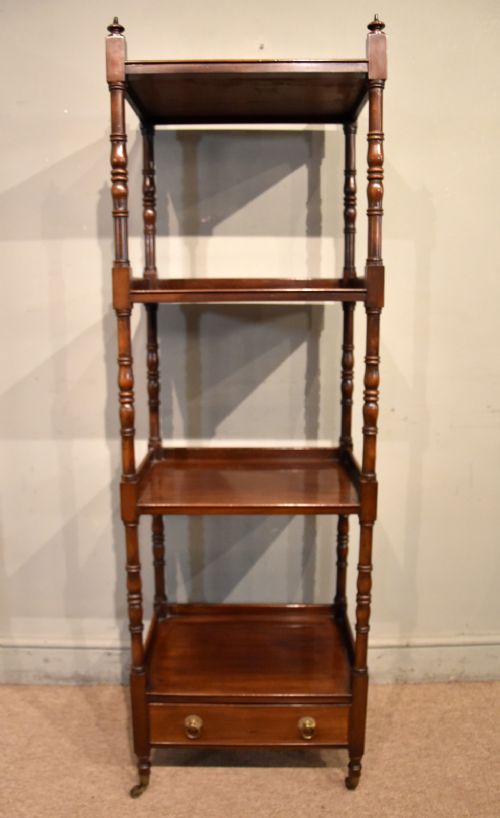
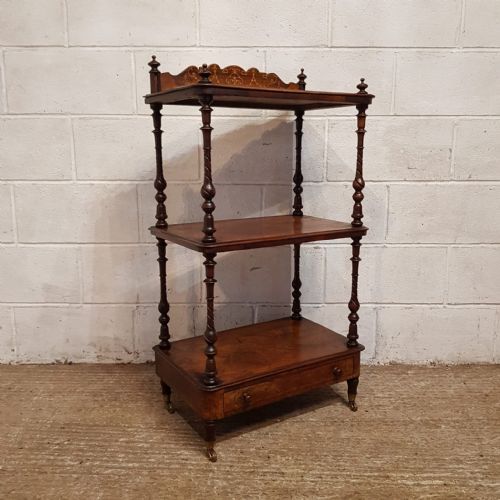
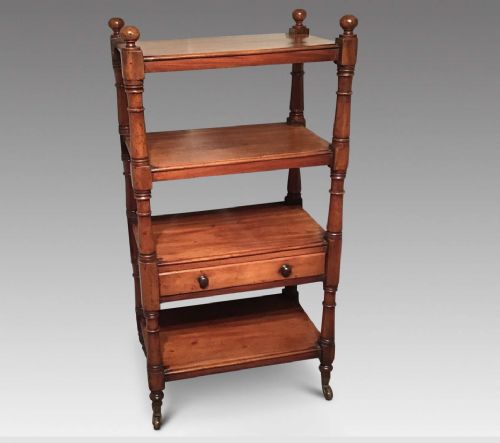
A victorian drawer whatnot typically takes the form of a tiered shelving stand fitted with one or more lower drawers, serving as both a display etagere and a practical cabinet. These pieces belong predominantly to the Victorian and nineteenth-century periods, alongside related Regency and William IV examples that share the multi-tiered format.
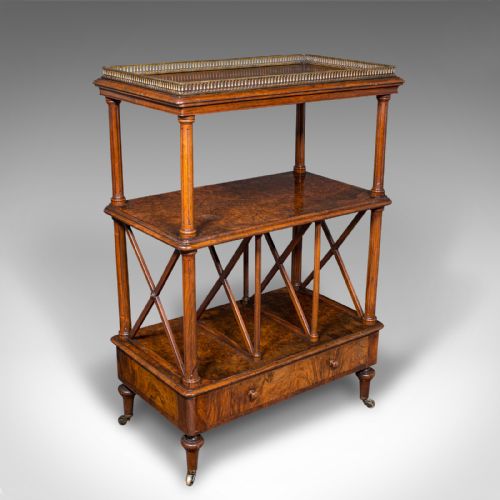
The most common version met on this page is a mahogany or walnut tiered shelf structure standing on slender supports, featuring a base drawer or compartment. Variations include Canterbury combinations with partitioned sections for folios and sheet music, as well as units incorporating mirrors and cellarettes.
Makers and workshops constructed these stands in configurations ranging from three to four distinct tiers, designed to fit into corners or against parlour walls. The combination of open display surfaces and enclosed drawer storage defines the utility of the piece across its various nineteenth-century manifestations.
Materials and Construction
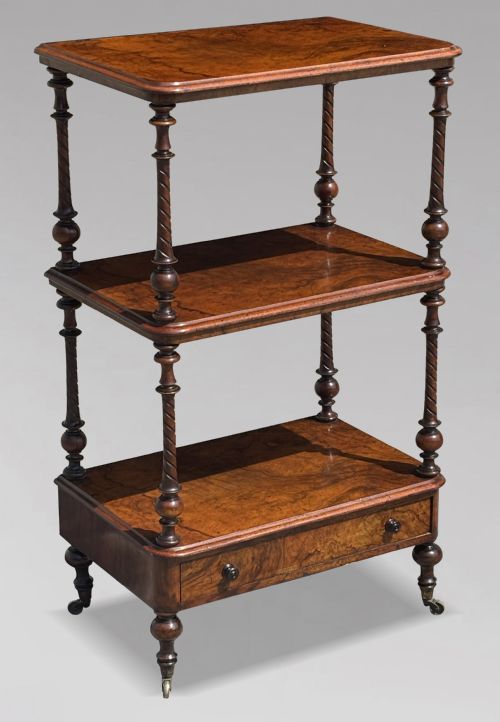
Makers relied on dense hardwoods such as mahogany, rosewood, and walnut for the primary framework and shelves of a victorian drawer whatnot. Burr walnut veneers and contrasting ebony and boxwood inlays frequently decorated the surfaces of finer examples, adding visual depth to the tiered structures.
Structural integrity depended on turned columns or slender upright supports dividing the stacked shelves, secured with traditional joinery. Brass castors often fitted to the feet allowed these display stands to be repositioned easily within a nineteenth-century drawing room or parlour.
Victorian Drawer Whatnot Retail Price Guide 2026
Typical asking prices for victorian drawer whatnot among the pieces listed under this phrase on Sellingantiques today, from the lower quarter to the upper quarter. They describe what is for sale here now, not the wider market.
Listings feature walnut, rosewood, and mahogany, alongside specialised variants incorporating burr walnut veneers and ebony stringing.
Assessing Quality
The choice of timber underpins the distinction between standard and superior pieces, with figured burr walnut and rich rosewood commanding greater visual presence than plain mahogany. Crispness in turned uprights and precision in boxwood and ebony stringing indicate the level of care taken in the workshop.
Samson and Son London
The Victorian Drawer Whatnot Glossary
- Whatnot
- A set of open shelves standing one above another, used for displaying ornaments or holding books in nineteenth-century interiors. These pieces evolved through the nineteenth century into various tiered formats.
- Etagere
- A piece of furniture consisting of a set of open shelves for displaying small objects. This French term is frequently used interchangeably with whatnot in nineteenth-century contexts.
- Canterbury
- A low stand with partitioned sections for holding sheet music, folios, or books, often incorporated into the base of a whatnot. Such combinations provided multi-functional storage in the parlour.
- Cellarette
- A lockable compartment or drawer originally designed for holding bottles, occasionally integrated into the lower section of a nineteenth-century tiered stand. This addition expanded the utility of the piece beyond simple display.
- Stringing
- Thin lines of contrasting wood inlay used to outline panels and drawer fronts on Victorian furniture. This decorative technique highlights the contours of the piece.
Victorian Drawer Whatnot: Frequently Asked Questions
What is a victorian drawer whatnot used for?
These pieces served as multi-purpose furniture in nineteenth-century parlours and drawing rooms, providing open surfaces for displaying decorative objects and porcelain. The integrated drawer offered convenient enclosed storage for letters, writing materials, or small household items.
Placed against a wall or in a corner, the tiered shelves allowed owners to maximise vertical display space without crowding the room. Their adaptable nature made them popular additions to formal living spaces.
How do I tell mahogany from rosewood on these pieces?
Mahogany typically displays a reddish-brown tone with straight grain patterns that can range from plain to deeply figured flame markings. Rosewood presents a heavier, darker brown appearance marked by contrasting dark streaks and an oily natural lustre.
Closer inspection reveals that rosewood is denser and possesses a distinct grain variation compared to the warmer, more uniform warmth of Victorian mahogany.
Can I use a whatnot as a bedside table?
The multi-tiered format and compact footprint of many smaller nineteenth-century examples make them suitable for use beside a low bed. The open shelves accommodate books and nighttime essentials, while the lower drawer keeps personal items out of sight.
Buyers should check the height of the specific tier against the mattress level to ensure comfortable access before placing the unit in a bedroom setting.
What is the difference between an etagere and a whatnot?
While both terms describe multi-tiered open shelving units, etagere derives from French terminology and often emphasises decorative display. Whatnot is the traditional English term applied to similar pieces that frequently incorporate practical elements like drawers or music racks.
In practice, nineteenth-century cabinetmakers and retailers used both names interchangeably for tiered furniture regardless of origin.