
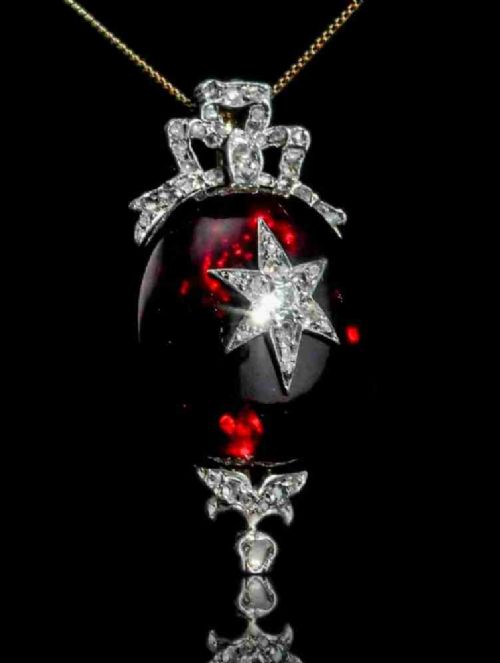
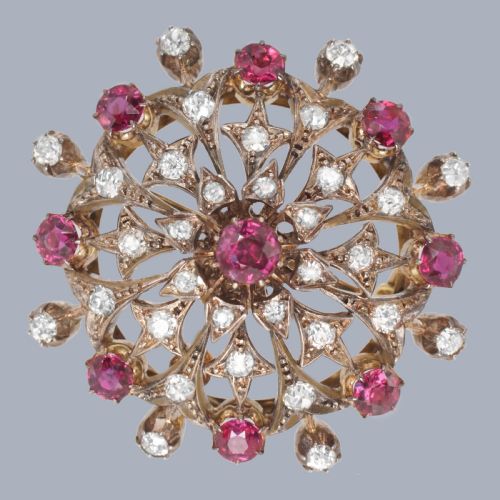


Victorian Diamond Star Brooch
A Victorian diamond star brooch captures celestial brilliance through antique stones and convertible settings.
Victorian Diamond Star Brooch
A victorian diamond star brooch is a celestial-themed jewel designed to be worn as a fastener or suspended as a pendant. These pieces emerge from the nineteenth century, with examples carrying dates from eighteen seventy up to nineteen hundred.
The form frequently appears as a multi-pointed starburst, sometimes adapting into a tiara or pairing with pearls, rubies, garnets, or sapphires. Many survive as versatile convertible pieces that transition seamlessly between a brooch and a necklace pendant.
Makers of this era constructed these star designs during the Victorian period, utilising gold and silver settings. Buyers encounter both small seed pearl iterations and substantial diamond cluster configurations weighing over three carats.
Materials and construction methods
Goldsmiths set old cut and rose cut diamonds into silver fronting soldered to gold backs, a traditional technique that maximised the white brilliance of the stones against dark metal. Yellow gold in fourteen carat, eighteen carat, and nine carat purities provides the structural support for these radiant motifs.
Jewellers incorporated natural pearls, turquoise, garnets, and rubies to accent the central points or surrounds of the starburst. Convertible frames allowed the central brooch mechanism to detach so the star could mount onto tiara frames or suspend from chains.
Victorian stargazers could pin a sparkling galaxy directly to their evening velvet, proving that astronomy was genuinely wearable.
Quality variations in antique star jewels
The distinction between tiers rests upon the stone weight, cut uniformity, and the complexity of the secondary gem combinations. Pieces featuring larger old European cut diamonds paired with clean gold and silver work command greater attention than minor seed pearl variants.
Original convertibility and surviving fitted mounts elevate an example, demonstrating the ingenuity of period workshops. The crispness of the prong work and the symmetry of the graduating rays further separate standard production from exceptional artistry.
The Victorian Diamond Star Brooch Glossary
- Old European cut
- An early diamond cut characterised by a small table, high crown, and open culet, typical of nineteenth-century stones. This facet arrangement scatters candlelight and gaslight effectively.
- Rose cut
- A diamond facet style featuring a flat base and a domed crown with triangular facets. These stones present a subtle, understated shimmer.
- Convertible brooch
- A piece engineered with detachable fittings to function as both a breast ornament and a pendant. Many nineteenth-century starbursts include screw-in bails or collapsible pins.
- Silver set
- A manufacturing method where diamonds are held in silver fronting to enhance their whiteness while backed in gold for strength. This technique prevents the gold from casting a yellow hue into the stones.
- Cabochon
- A gemstone shaped and polished with a smooth, rounded surface rather than faceted. These smooth stones frequently form the central focal point of a star cluster.
Victorian Diamond Star Brooch: Frequently Asked Questions
How do I wear a convertible star brooch?
These versatile pieces transition between lapel pins and necklace pendants using hidden bails or removable fittings.
Larger examples also attach directly to structural frames to serve as ceremonial tiaras.
What metals were used in Victorian star jewellery?
Goldsmiths combined silver fronting with yellow gold backs to showcase the diamonds against a bright reflective surface.
The gold grades span nine carat, fourteen carat, and eighteen carat purity.
How can I date a Victorian star brooch?
Dating relies on stylistic clues, stone cuts like old European or rose cuts, and occasional hallmarks or direct documentation.
The listings demonstrate a production span running primarily from eighteen seventy through to nineteen hundred.
Are coloured gemstones common in these pieces?
While diamonds dominate the ray configurations, makers frequently integrated seed pearls, garnets, rubies, sapphires, turquoises, and emeralds.
These coloured stones appear as central cabochons or accent gems between the diamond points.