


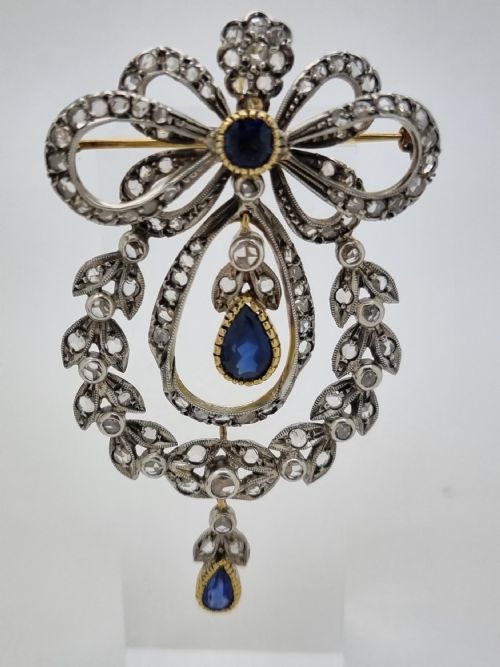


Silver Diamond Brooch Pendant
These silver diamond brooch pendant designs offer dual wearability, converting effortlessly between a lapel ornament and a neckpiece.
Silver Diamond Brooch Pendant
A silver diamond brooch pendant represents versatile jewellery that transitions from a bodice fastening to a necklace centrepiece with a concealed or detachable loop. These hybrid jewels emerge primarily from the Victorian and Edwardian eras, spanning from the mid-nineteenth century up to nineteen ten.
The versions most commonly met on this page combine silver settings with gold or yellow gold backing, often taking the form of celestial starbursts or floral motifs. Pieces from this selection range from convertible tiara starbursts to natural sapphire, ruby, and emerald-accented bow brooches.
Makers of the period utilised convertible mountings to maximise utility, allowing a single jewelled piece to serve multiple formal functions. Buyers encounter both structured geometric shapes and whimsical animal subjects, including butterflies, flies, and monkeys.
Materials and construction methods
Craftsmen set old cut and rose cut diamonds into silver fronts to maximise the brilliance of the stones against a dark metal backdrop, backed by gold to protect delicate clothing from tarnishing. This dual-metal technique defines the construction of Victorian and Edwardian hybrid jewels.
Gemstones such as sapphires, rubies, emeralds, opals, and turquoise are integrated alongside diamonds within floral and celestial configurations. Metalwork incorporates fine articulation to allow brooches to receive pendant Bails or threaded loops securely.
A monkey brooch proves that Victorian jewellers possessed a delightful sense of humour alongside their technical mastery.
Distinguishing quality across the range
Quality rests upon the integration of the conversion mechanism and the symmetry of the stone arrangement, where seamless transformation between pendant and brooch indicates superior workshop execution. The precision of old cut diamond faceting and the natural saturation of accompanying rubies, sapphires, or emeralds further elevate a piece.
The subtlety of the gold backing relative to the silver front demonstrates the maker's attention to structural integrity and weight distribution. Original convertibility intact without later alterations marks the highest standard of survival for these jewels.
The Silver Diamond Brooch Pendant Glossary
- Silver set
- A manufacturing method where gemstones are mounted directly into silver, historically backed with gold to prevent silver tarnish from touching garments. This technique is typical of nineteenth-century fine jewellery.
- Old cut
- A hand-faceted diamond cut predating modern brilliant standards, characterised by a smaller table, higher crown, and open culet. These stones display a distinctive soft glow under candlelight.
- Rose cut
- A gemstone cut with a flat base and a domed crown composed of triangular facets meeting at a point. It imparts a subtle, translucent shimmer rather than intense fire.
- Convertible
- Describing a jewel designed with removable or hidden elements, such as a detachable bail or screw-in fittings, allowing it to function as both a brooch and a pendant.
- Starburst
- A radiating design motif popular during the Victorian and Edwardian periods, frequently executed with central diamond clusters and tapering rays.
Silver Diamond Brooch Pendant: Frequently Asked Questions
How do I convert a brooch into a pendant?
Most convertible pieces utilise a hidden hinge, a fold-down loop, or a detachable screw-in bail at the reverse. This allows a chain to pass through securely without altering the visual presentation as a brooch.
When wearing the piece as a pendant, ensure the pin mechanism is safely locked back against the frame to prevent snagging on clothing.
Why is silver combined with gold in these pieces?
Silver was favoured for its bright white surface that enhanced the appearance of diamonds, but it tarnished easily and stained fabric. Backing the silver with gold protected garments and provided necessary structural strength.
This two-metal construction is a reliable indicator of nineteenth-century manufacturing techniques before platinum became widely used.
What is the difference between Victorian and Edwardian styles?
Victorian designs, spanning from eighteen sixty to eighteen ninety, often feature heavy floral, animal, and starburst motifs with rich multi-gem accents. They lean towards romantic symbolism and bold presence.
Edwardian pieces from around nineteen ten introduce lighter, airier ribbon and bow frameworks, often emphasising pure diamond sparkle with delicate sapphire highlights.
Can these pendants be worn on everyday chains?
Yes, though the scale of the suspension loop dictates the thickness of the chain you can use. Antique loops were often designed for slender antique chains or ribbons.
A jeweller can sometimes add a discreet jump ring if a modern, thicker chain is preferred without altering the antique mount.