





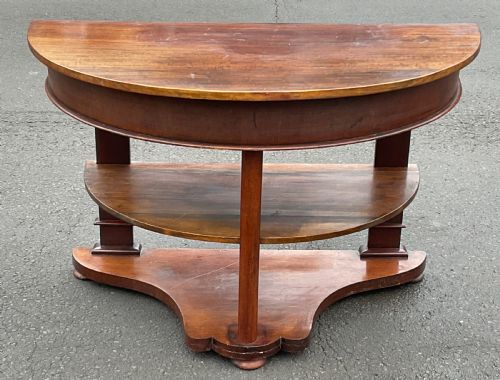


Victorian Demilune Hall Table
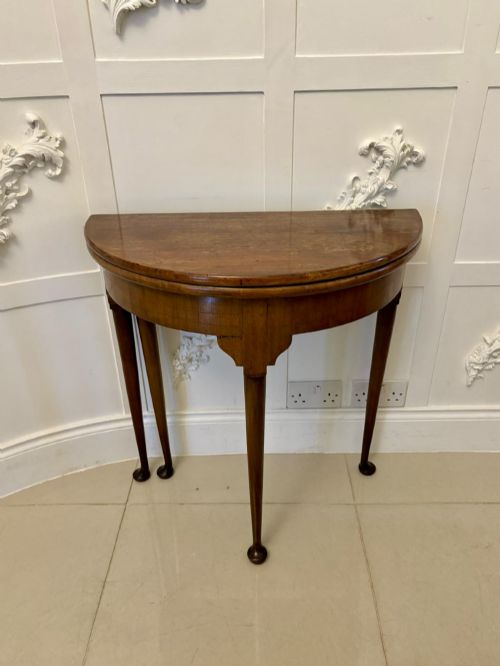
These Victorian demilune hall tables are graceful semicircular console pieces designed to sit tight against a wall in a narrow entryway.
Victorian Demilune Hall Table
When you search for a Victorian demilune hall table, you are looking at semicircular furniture designed to stand flush against a hallway wall without obstructing passage. The examples on this page span the nineteenth century, including specific dates from eighteen hundred through to nineteen hundred, alongside items assigned broadly to the Victorian era.
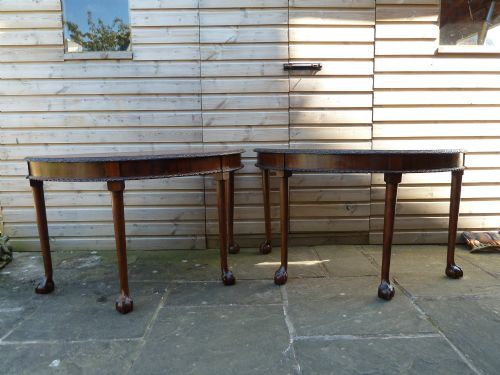
The primary forms found here appear as console tables, tea tables, card tables, and washstands, often categorized by dealers under styles such as Victorian Sheraton Revival, Regency, Chippendale Revival, Aesthetic Movement, and Austrian Bentwood. These pieces served practical domestic functions in period interiors, functioning as surfaces for lamps, calling card trays, or decorative ornaments.
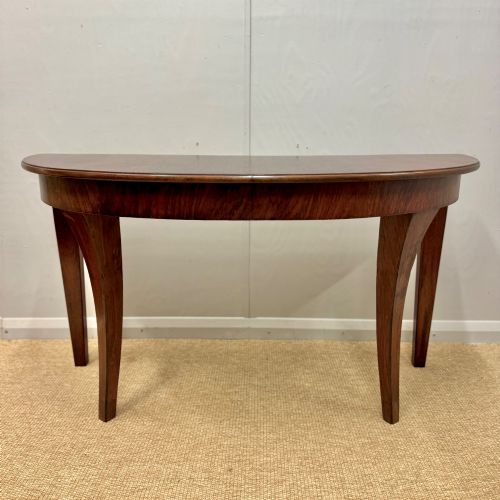
Makers and materials recorded in the archive and current listings range from traditional timbers to bamboo and bentwood, reflecting both formal reception rooms and more eclectic late nineteenth-century tastes. A buyer is most likely to encounter mahogany and rosewood versions supported by concave legs or classic half-round configurations.
How they were made
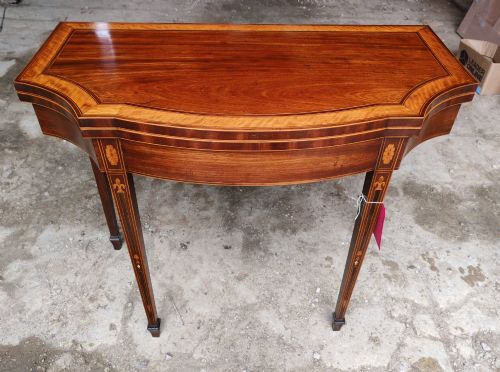
The construction of these pieces relies heavily on cabinet timbers such as mahogany, rosewood, satinwood, and maple, frequently enhanced with wood veneer to create rich grain patterns across the semicircular top. Workshops employed traditional joinery to shape the curved aprons and secure the legs, ensuring structural stability for tables that stood independently against walls.
Selected examples incorporate contrasting decorative elements including brass fixtures and inset marble tops, which provided a durable and cool surface suited to washstands and grand console tables alike. Specialised techniques appear in specific iterations such as Austrian bentwood framing and oriental bamboo construction, demonstrating the diverse manufacturing methods utilised during the period.
Victorian Demilune Hall Table Retail Price Guide 2026
Typical asking prices for victorian demilune hall table among the pieces listed under this phrase on Sellingantiques today, from the lower quarter to the upper quarter. They describe what is for sale here now, not the wider market.
What varies in quality
The distinction between tiers of quality rests upon the selection of timber figures and the precision with which the curved demilune frame is joined. Tables utilising dense mahogany or figured rosewood with crisp veneer work represent a higher standard of cabinetmaking than simpler utilitarian versions.
Integration of contrasting materials such as marble inserts, satinwood stringing, or brass mounts elevates the decorative ambition of the piece. Furthermore, the handling of revival styles, from Sheraton to Chippendale motifs, determines whether a table achieves refined proportion or standard commercial execution.
Thonet
The Victorian Demilune Hall Table Glossary
- Demilune
- A term describing a piece of furniture with a semicircular or half-moon shape, typically designed to stand flat against a wall. This profile allowed tables to occupy narrow spaces like hallways while providing a useful top surface.
- Console table
- A wall-mounted or freestanding table supported by legs at the front, often placed beneath a mirror or in an entrance hall. In nineteenth-century interiors, these served primarily decorative and display purposes.
- Wood veneer
- A thin layer of superior timber applied over a secondary wood base to provide an ornate decorative surface. This technique allowed cabinetmakers to display rich grain patterns without relying entirely on solid costly woods.
- Bentwood
- Wood softened by steam and bent into curved structural forms, a method famously utilised by makers such as Thonet. It produced lightweight yet resilient frames seen in late nineteenth-century console designs.
Victorian Demilune Hall Table: Frequently Asked Questions
What is a demilune table?
A demilune table is a half-moon shaped piece of furniture designed to fit flat against a wall. Its curved front profile provides surface space while taking up minimal floor area in entrance halls.
Historically, these tables functioned as decorative console pieces or occasional surfaces for holding lamps and calling card trays in period homes.
Where were hall tables placed?
Hall tables were positioned in entranceways, corridors, and reception rooms where guests first arrived. Their shallow depth ensured they did not block narrow passageways.
In many Victorian interiors, a matching mirror was hung directly above the console table to reflect light and complete the entryway arrangement.
How do I identify nineteenth-century wood?
Nineteenth-century furniture commonly utilises dense timbers such as mahogany and rosewood, often displaying deep natural colour patination accumulated over decades of polish and use. Later Victorian pieces may incorporate satinwood, maple, or exotic materials like bamboo.
Examining the underside and drawer linings reveals secondary woods and construction marks that help confirm the period of manufacture.
Can these tables be used daily?
These tables are structurally suited for everyday domestic use, provided they are placed on level flooring away from direct heat sources. Their original purpose as display surfaces makes them ideal for modern hallways or living rooms.
Care should be taken with moisture and heavy loads, particularly on pieces featuring delicate veneer work or inset marble tops.