




Victorian Crystal Prism Holders
Victorian crystal prism holders are decorative mantel and table lustres designed to catch and refract candlelight through suspended glass pendants.
Victorian Crystal Prism Holders
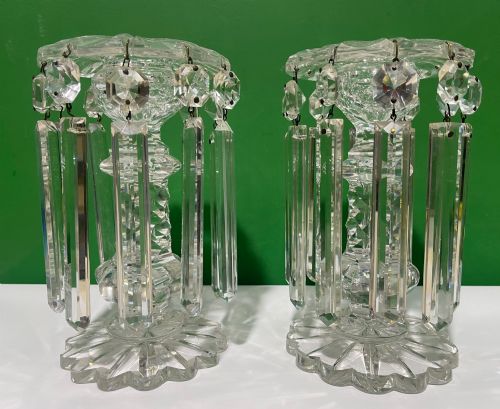
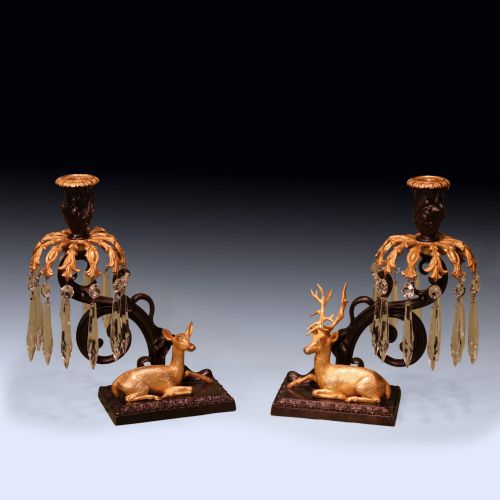
Victorian crystal prism holders encompass table lustres, mantel lustres, and candelabra designed to hold candles while suspending glass drops. These pieces originate from the 19th century, featuring forms that span the Victorian era, Regency period, and around 1900.
The most common versions met on this page are pairs of table and mantel lustres fashioned from ruby or green glass. They frequently incorporate cut glass crystals, crystal prisms, and gilt bronze or brass components to enhance their decorative impact.
How they were made
Makers utilised coloured and flash glass, forming ruby or green glass bodies that were often overlaid and cut back to reveal contrasting layers underneath. This glasswork was combined with cast brass, bronze, and ormolu mounts to create sturdy bases and candle sockets.
Prisms and crystal drops were hand-cut and faceted to maximise light refraction, then suspended from the rims using metal wire or pinned connections. Additional ornamentation sometimes included enamel and gold leaf applied directly to the glass surfaces.
Victorian Crystal Prism Holders Retail Price Guide 2026
Typical asking prices for victorian crystal prism holders among the pieces listed under this phrase on Sellingantiques today, from the lower quarter to the upper quarter. They describe what is for sale here now, not the wider market.
The listings show pieces spanning from the Regency period through the Victorian era up to 1900, using ruby and green glass alongside crystal, bronze, and brass.
What varies in quality
Quality in these pieces depends on the depth and clarity of the glass cutting, alongside the richness of the coloured overlay. Rich ruby and green flash glass showing crisp, deep wheel-cutting sits above simpler plain glass examples.
The sophistication of the metalwork also dictates value, with finely chased ormolu and bronze mounts representing a higher standard of manufacture than standard brass. Complete sets of matching original crystal prisms significantly elevate a piece.
The Victorian Crystal Prism Holders Glossary
- Lustre
- A decorative tabletop vessel or candlestick fitted with hanging glass prisms designed to reflect light. They were popular centrepieces on Victorian mantelpieces.
- Prism
- A cut glass or crystal pendant suspended from the rim of a lustre. These pendants scatter candlelight across the room.
- Flash glass
- Glass comprising a thin layer of coloured glass fused over a thicker layer of clear or contrasting glass. Cutting through the outer layer reveals the contrasting colour beneath.
- Ormolu
- Gilded bronze used for decorative mounts and bases. It provides a rich golden finish that complements the coloured glass.
Victorian Crystal Prism Holders: Frequently Asked Questions
Where were they placed?
Owners typically placed them on drawing room mantelpieces, often flanked by matching sets or paired with clocks. They also stood on side tables and dining room buffets.
Their reflective properties made them effective for brightening dimly lit Victorian rooms when candles were lit.
How do I clean them?
Cleaning requires removing the glass prisms carefully and washing them in warm, soapy water. Avoid harsh chemicals that might damage gilt or enamel details on the glass body.
Dry each crystal thoroughly with a soft cloth before rehanging them with their original wire connectors.
How do I spot Regency from Victorian?
Regency pieces often display neoclassical bronze and ormolu mounts with strict symmetry and restrained classical detailing. Victorian examples tend to lean towards bolder coloured glass, such as deep ruby or green, with more exuberant ornamentation.
Examining the metal casting and the style of the glass cutting helps distinguish between the two periods.