
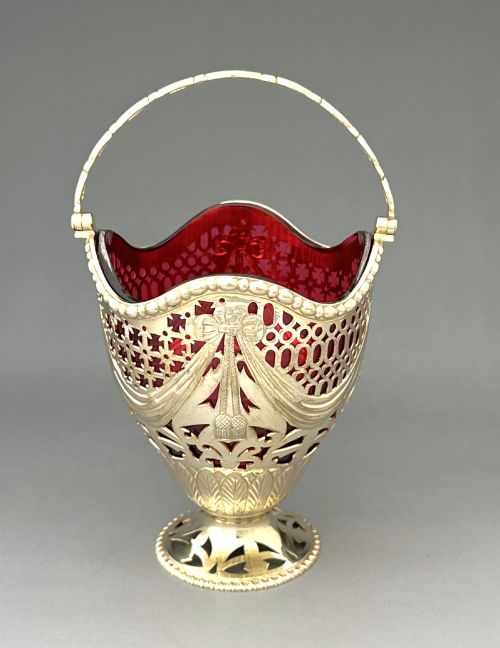


Victorian Cranberry Glass Bowl
A victorian cranberry glass bowl brings rich, glowing colour to a table, combining intense pinkish-red glass with decorative metal mounts.
Victorian Cranberry Glass Bowl
When searching for a victorian cranberry glass bowl, you encounter a variety of tabletop vessels designed for serving preserves, sugar, and fruit. The most common forms on this page include preserve dishes in silver-plated stands, lidded butter dishes, and open decorative bowls dating from the nineteenth and early twentieth centuries.
Many of these pieces combine the characteristic glass with silver plate, gold leaf, or cut clear crystal. You will frequently find them paired with fitted metal baskets, pierced spoons, and swing handles that frame the vibrant glass body.
How they were made
Makers achieved the distinct reddish-pink hue by adding gold chloride to the molten glass batch before blowing or pressing the vessel into shape. Craftsmen often combined this coloured glass with clear crystal, or layered it with opaque white glass in overlay techniques.
Metalwork played a vital role in completing the object, with workshops mounting the glass bowls into silver-plated stands, gilt baskets, or fitted frames. Artisans also applied surface decoration such as gilding, engraving, and enamel painting directly onto the glass.
Listings feature periods spanning from the mid nineteenth century through the Edwardian era, incorporating cranberry glass, silver plate, and gold leaf.
What varies in quality
The depth and consistency of the glass colour separate standard examples from finer pieces, alongside the crispness of any cut or engraved patterns. Richer tones and even saturation indicate careful control during the melting and cooling process.
The substance and detailing of the surrounding metal mountings also define the tier of the piece. Substantial silver plate, intricate piercing on baskets, and original gilded accents elevate a simple glass bowl into a more finished decorative object.
The Victorian Cranberry Glass Bowl Glossary
- Cranberry glass
- A transparent type of glass coloured with gold oxide, producing shades from pale pink to deep ruby red.
- Silver plate
- A base metal coated with a thin layer of silver, commonly used for the stands and baskets holding these bowls.
- Tazza
- A shallow bowl or cup mounted on a stem and foot, often used for serving fruit or sweetmeats.
- Epergne
- An elaborate tabletop centrepiece featuring a central bowl with attached arms, flutes, or hanging baskets.
- Comport
- A decorative dish elevated on a foot or base, used for serving fruit or preserves at the dining table.
Victorian Cranberry Glass Bowl: Frequently Asked Questions
How do I clean a victorian cranberry glass bowl?
Wash the glass gently in warm soapy water using a soft cloth, avoiding abrasive pads that can scratch the surface or remove gilding.
Keep silver-plated stands separate from prolonged soaking and polish the metal with a suitable cloth to maintain its finish.
Were these bowls used for everyday dining?
Most of these pieces served specific functions in wealthy Victorian households, holding preserves, sugar, butter, or sweetmeats during formal meals.
Their decorative metal stands and delicate glass liners meant they belonged primarily to the dining table rather than the kitchen.
How can I tell if a bowl is Victorian?
Look for manufacturing traits such as pontil marks on the base of the glass, hand-finished mounts, and period styles like Victorian Bohemian or Edwardian.
Weight, hand-blown irregularities, and traditional silver-plating techniques also point towards nineteenth-century production.
Can I use these bowls for serving food today?
You can use these glass vessels for serving dry foods or fruit, provided you handle them with care.
Avoid exposing antique glass to sudden temperature changes or putting pieces with metal stands and gilding into a dishwasher.