
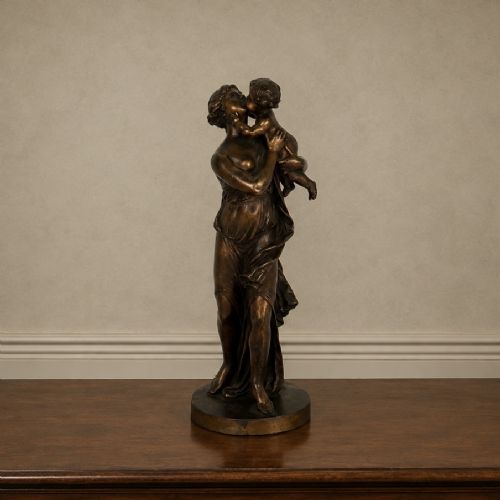


Victorian Child Statue
A victorian child statue captures domestic sentiment and classical form, bringing nineteenth-century craftsmanship into domestic interiors.
Victorian Child Statue
A victorian child statue encompasses nineteenth-century figures and groups rendered in bronze, porcelain, marble, and parian ware. These works frequently depict children at play, alongside animals, or in maternal classical groupings reflecting the aesthetic tastes of the period.
Most pieces encountered on this page date from the nineteenth century, including specific decades such as the eighteen-fifties through the nineteen-tens. Common forms range from small mantel figurines to large bronze and marble groups.
The styles span French nineteenth-century realism, Rococo revival, neoclassical, and art nouveau. These diverse approaches share a focus on juvenile subjects executed with varying degrees of academic precision.
Materials and methods
Bronze sculptures utilise traditional lost-wax casting methods, often enhanced with gilt or gold leaf finishes. Marble and alabaster figures involve meticulous hand-carving by skilled sculptors, while Italian alabaster yields a soft, translucent surface.
Ceramic pieces rely on porcelain, parian ware, majolica, and earthenware. Parian porcelain requires specialist firing to mimic carved marble, whereas porcelain figurines involve detailed hand-painting and enamel application.
Several figures capture children caught in the act of gathering grapes or fast asleep after a long day.
Evaluating quality
Quality rests upon the crispness of the modelling and the finesse of the surface finish. In bronze, sharp chasing and detailed articulation distinguish superior works, whereas finer porcelain and parian figures display subtle facial expressions and clean moulding seams.
Signatures by documented sculptors or production by notable factories elevate a piece above anonymous domestic output. Material density and weight also separate solid craftsmanship from lighter, mass-produced items.
Auguste Moreau·John Durham·Lucien Madrassi·Carl Thieme·Helena Wolfsohn·Royal Dux Bohemia·P Della Vedova·Joseph Gott·Pugi
The Victorian Child Statue Glossary
- Parian ware
- A type of fine biscuit porcelain developed in the nineteenth century to imitate carved white marble. It is prized for its smooth, unglazed matte finish.
- Lost-wax casting
- A metal-casting method where a molten metal is poured into a mould that has been created by a wax model. This technique allows for intricate detail in bronze sculptures.
- Bisque
- Unglazed fired porcelain that has a porous, matte texture. It is frequently employed for nineteenth-century figurative groups.
- Majolica
- Low-fired earthenware covered with an opaque tin-glaze and painted with brightly coloured metal oxide pigments. It was widely utilised for decorative nineteenth-century figures.
- Grand tour
- The nineteenth-century practice of cultural travel through Europe by young nobility, which generated demand for classical bronzes and small sculptures.
Victorian Child Statue: Frequently Asked Questions
What materials were used?
These pieces utilise bronze, marble, porcelain, parian ware, terracotta, and alabaster.
Some items combine materials, such as gilded bronze or painted enamel finishes upon ceramic surfaces.
How do I identify a period?
Dating relies upon stylistic markers like neoclassical drapery or art nouveau curves, alongside material composition.
Maker marks, factory stamps, and artist signatures inscribed into the base or body offer precise temporal context.
Where were they displayed?
Nineteenth-century households placed these figures on mantelpieces, side tables, and pedestals in reception rooms.
Larger bronze and marble groups often occupied entrance halls or served as garden and conservatory ornaments.
Are these works signed?
Certain sculptures bear the incised signature of renowned European artists or workshop stamps from notable factories.
Many decorative figures remain unsigned, representing standard commercial output from British and continental potteries.