



Victorian Ceramic Garniture
These Victorian ceramic garniture sets bring grand nineteenth-century chimneypieces to life with matching vases, urns, and clock sets.
Victorian Ceramic Garniture
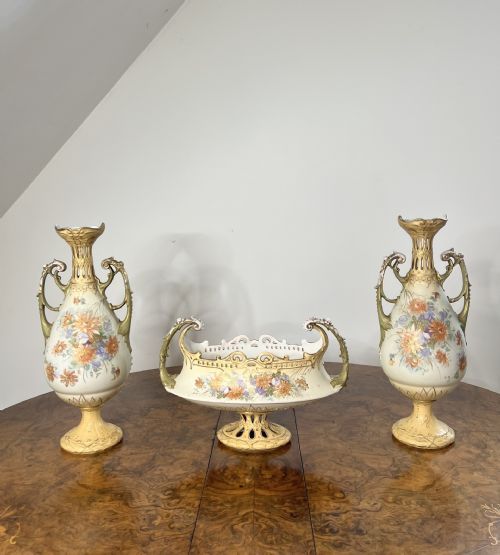
A victorian ceramic garniture typically comprises a matching set of three or more decorative vessels, such as central mantel clocks flanked by vases, urns, or candlesticks. These ensembles were designed to sit harmoniously upon a drawing room mantelpiece or centrepiece.
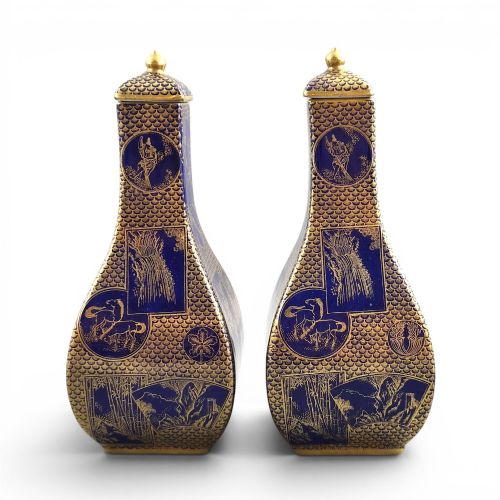
The pieces appearing on this page span the nineteenth century and encompass forms ranging from lidded vases and decorative urns to clock garnitures and candelabras. Buyers frequently encounter sets featuring distinct stylistic influences, including Rococo Revival, French Sevres style, and Victorian Chinoiserie.
Origins and periods represented reach from Georgian iterations through to pieces dated around 1850 and 1880, alongside French and Spanish regional works. Each combination offers a structured symmetry that defines the character of period interior display.
Materials and manufacture
Ceramic bodies such as ironstone and porcelain form the structural core of these garniture pieces, shaped into vases, urns, and candlesticks. These substrates provide a smooth ground for detailed enamelling and applied decoration.
Surface ornamentation relies heavily on gilding, gold leaf, and hand-painted enamel work to achieve rich decorative contrasts. Subsidiary elements incorporate brass fittings or glass components where required by the specific form of the clock set or candelabra.
Victorian Ceramic Garniture Retail Price Guide 2026
Typical asking prices for victorian ceramic garniture among the pieces listed under this phrase on Sellingantiques today, from the lower quarter to the upper quarter. They describe what is for sale here now, not the wider market.
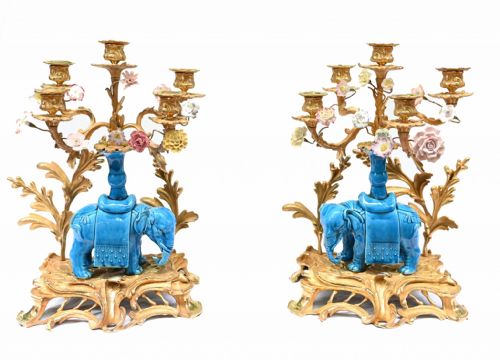
Elephants occasionally support porcelain candelabras, bringing unexpected exotic fauna directly onto the nineteenth-century mantelpiece.
Judgements of quality
The standard of a victorian ceramic garniture rests upon the precision of the hand-painted enamel decoration and the richness of the gilding applied to the porcelain or ironstone body. Finer examples exhibit crisp detailing in motifs such as Chinoiserie patterns or classical figural scenes.
Cohesion within the set dictates overall merit, particularly in multi-piece assemblies where matching vases, urns, and clocks must share a unified design language. The integrity of subsidiary materials, including brass mounts and glass elements, further distinguishes higher grade production.
Mason's Patent Ironstone·Royal Vienna·Minton
The Victorian Ceramic Garniture Glossary
- Garniture
- A set of ornamental vessels designed to be displayed together on a mantelpiece or sideboard. Typically comprises a central object flanked by two matching pieces.
- Ironstone
- A type of durable heavy earthenware patented in the nineteenth century. It provides a robust alternative to porcelain while accepting enamel and gilding readily.
- Gilding
- The application of gold leaf or gold gilt to the surface of ceramics or brass mounts. It highlights raised mouldings and adds metallic lustre to the design.
- Chinoiserie
- A decorative style reflecting European interpretations of Chinese and East Asian artistic traditions. It appears on nineteenth-century ceramics through distinctive motifs and patterns.
- Candelabra
- A branched candlestick holder designed to hold multiple candles. These often form the flanking components of a larger clock garniture set.
Victorian Ceramic Garniture: Frequently Asked Questions
What pieces make up a garniture?
A standard garniture consists of a central decorative object, such as a mantel clock or large urn, accompanied by two matching side pieces like vases or candlesticks.
These sets are designed to create visual balance when arranged across a mantelpiece or furniture surface.
Where were these sets displayed?
Nineteenth-century households placed these sets primarily on drawing room mantelpieces where they reflected firelight from the hearth.
They also served as decorative centrepieces on large tables or sideboards within formal reception rooms.
What styles influence these ceramics?
Many pieces draw upon Revival styles, incorporating Rococo scrolls, classical symmetry, or French Sevres aesthetic influences.
Others incorporate regional interpretations such as Hispano-Moresque glazes or Victorian Chinoiserie patterns.