

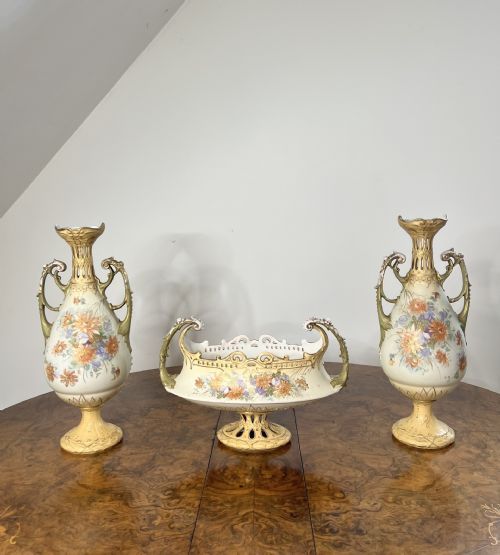
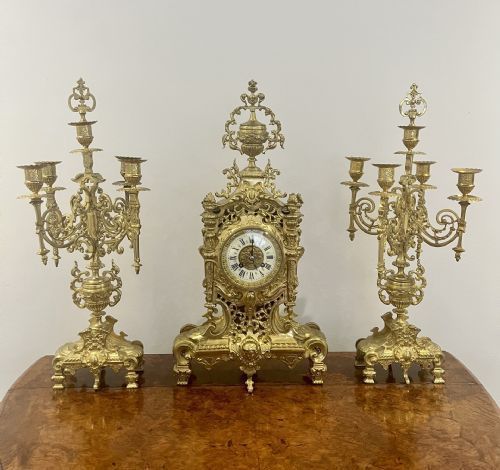


Rococo Style Mantel Set
A rococo style mantel set brings dramatic Victorian flair to a room, pairing ornate central timepieces with matching side vases in porcelain and gilt bronze.
Rococo Style Mantel Set
A rococo style mantel set typically comprises a central clock flanked by matching side vases or urns, forming a cohesive decorative garniture for a chimney piece. These impressive ensembles emerge primarily from nineteenth-century European workshops, capturing the lavish asymmetry and scrollwork of earlier French tastes.
The pieces appearing on this page span the nineteenth century, including specific dates such as 1850, 1880, and 1890, alongside broader nineteenth-century examples. Forms range from clock garnitures and three-piece clock sets to grand centrepieces with side vases.
Makers and regional styles represented in these listings include Royal Vienna, KPM Berlin, Meissen, and French Sevres style works. Buyers most commonly encounter ornate brass and ormolu-mounted porcelain clock sets originating from French and continental makers.
Materials and construction
These sets rely heavily on porcelain bodies combined with gilt bronze, brass, and ormolu mounts to achieve their opulent appearance. Artisans frequently integrated hand-painted enamel details and glass elements into the intricate metalwork frameworks.
Foundries and porcelain manufactories utilised fire gilding and sophisticated ceramic firing techniques to finish the bronze frames and Imari or painted porcelain panels. Steel components commonly drive the internal clockwork mechanisms housed within the heavy cases.
Rococo Style Mantel Set Retail Price Guide 2026
Typical asking prices for rococo style mantel set among the pieces listed under this phrase on Sellingantiques today, from the lower quarter to the upper quarter. They describe what is for sale here now, not the wider market.
Materials documented across the available inventory include porcelain, gilt bronze, brass, enamel, ormolu, glass, gilding, and steel.
Assessing quality and craftsmanship
Quality reveals itself in the crispness of the gilt bronze or ormolu chasing and the delicacy of the hand-painted porcelain panels. Finer sets display deeply sculpted scrollwork and substantial metal weight rather than shallow stamping.
The prestige of the producing pottery or workshop, such as Royal Vienna or Meissen, significantly elevates the standing of a garniture. Complete sets featuring matching side vases that retain their original gilding and undamaged enamel achieve greater architectural presence on a mantel.
Royal Vienna·KPM Berlin·Meissen·Vincenti of Paris
The Rococo Style Mantel Set Glossary
- Garniture set
- A decorative grouping of matching objects, typically a central clock accompanied by side vases or candelabra. These sets were designed to create a balanced, symmetrical display on a mantelpiece or sideboard.
- Ormolu
- Finely ground high-carat gold applied to a bronze base using a mercury amalgamation technique, or later electroplating. It provides the characteristic bright, warm metallic finish seen on nineteenth-century mounts.
- Imari porcelain
- A style of Japanese export porcelain featuring underglaze blue and overglaze red, gold, and black, which European makers frequently imitated or incorporated into their metalwork. These vibrant panels add rich colour to nineteenth-century clock sets.
- Clock garniture
- A timepiece accompanied by matching decorative companion pieces designed to be displayed together. The arrangement creates a unified focal point for interior decoration.
- French Rococo Revival
- A nineteenth-century design movement that revived the curving, asymmetric motifs of the eighteenth-century French rococo period. This style dominates the ornamentation found on these mantel pieces.
Rococo Style Mantel Set: Frequently Asked Questions
What is a clock garniture?
A clock garniture is a matched set consisting of a central mantel clock and two or more companion pieces, such as vases or urns. These items were designed to be displayed together on a fireplace mantel to create a balanced decorative scheme.
In nineteenth-century interiors, such suites anchored the room's visual weight and demonstrated the owner's taste for coordinated art objects.
How do I date a nineteenth-century set?
Dating these pieces involves examining the maker's marks on the porcelain base, the style of the clock movement, and the composition of the metal mounts. Specific dates recorded in our evidence range from 1850 through 1890.
Stylistic shifts between mid-century restraint and late-century ornamentation also help narrow down the period of manufacture.
How do I care for gilt bronze?
Gilt bronze and ormolu require gentle dusting with a soft, dry cloth to prevent the accumulation of grime that can dull the metallic sheen. Avoiding abrasive cleaners and chemical polishes preserves the original surface finish.
Keeping the pieces away from direct sunlight and damp environments protects both the delicate metal gilding and the underlying porcelain bodies.