

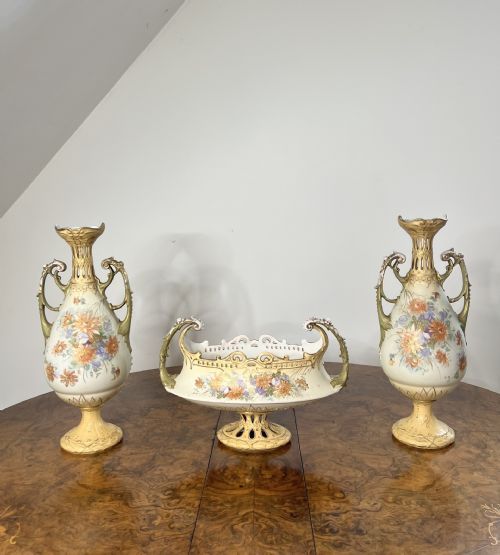


Antique Porcelain Side Vases
Antique porcelain side vases bring colour and classical symmetry to a mantelpiece, offering fine hand-painted detail from the eighteenth and nineteenth centuries.
Antique Porcelain Side Vases
When you search for antique porcelain side vases, you encounter decorative vessels originally designed to sit alongside a central urn or clock on a mantelpiece or sideboard. The listings show that many of these pieces have been converted into table lamps while retaining their original ceramic bodies.
The selection ranges from eighteenth-century Japanese Arita Imari and Chinese export wares to nineteenth-century European factories including Sevres, Royal Vienna and Paris porcelain. Forms include lidded urns, garniture sets and baluster vases decorated in styles such as Chinoiserie, Rococo Revival and Meiji.
Buyers are most likely to meet nineteenth-century pairs decorated with famille rose, famille verte or blue and white palettes. These balanced pairs often incorporate gilt bronze or brass mounts, reflecting the Victorian taste for symmetrical interior decoration.
Materials and manufacture
The foundation of every piece is hard-paste or soft-paste porcelain, shaped by hand or moulded before kiln firing at high temperatures. Artisans then applied underglaze blue pigments or overglaze enamel colours, sometimes returning the ceramic to the kiln for subsequent fixing.
Many European examples feature hand-applied gilding, enamel highlights and ormolu or brass mounts that secure the base and rim. Japanese and Chinese pieces demonstrate traditional brushwork techniques, utilising mineral pigments to achieve deep iron reds, cobalt blues and rich pinks.
Antique Porcelain Side Vases Retail Price Guide 2026
Typical asking prices for porcelain side vases among the pieces listed under this phrase on Sellingantiques today, from the lower quarter to the upper quarter. They describe what is for sale here now, not the wider market.
Several Victorian households happily turned priceless eighteenth-century vases into reading lamps by drilling holes straight through the porcelain.
Assessing quality and execution
Quality rests primarily on the crispness of the hand-painting and the depth of the porcelain body. Finer pieces display confident brushwork and precise enamelling without blurring or pooling in the glaze, whereas simpler productions show repetitive stencilled motifs.
The integration of metal mounts also dictates standard. Heavy cast ormolu mounts fitted specifically to the ceramic body indicate higher workshop standards than standard commercial brass fittings added during later lamp conversions.
Royal Vienna·Sevres
The Antique Porcelain Side Vases Glossary
- Garniture
- A set of matching decorative vases designed to be displayed together on a mantelpiece or cabinet. Typically comprising a central piece flanked by two side vases.
- Famille Rose
- A major palette of Chinese ceramic enamels introduced in the eighteenth century, distinguished by an opaque pink colour derived from colloidal gold. This palette allowed for delicate shading of floral and figurative scenes.
- Ormolu
- Gilt bronze mounts applied to furniture, clocks and porcelain during the eighteenth and nineteenth centuries. The technique involves applying a mercury and gold amalgam to cast bronze before heating.
- Imari
- A style of Japanese export porcelain produced in Arita from the seventeenth century onward, traditionally characterised by a palette of underglaze blue, iron red, and gilt overglaze. These wares were widely exported to European markets.
- Hard-paste porcelain
- A dense, durable ceramic composed of kaolin and petuntse, fired at very high temperatures. It was successfully replicated in Europe during the eighteenth century after centuries of Chinese monopoly.
Antique Porcelain Side Vases: Frequently Asked Questions
Are these vases always wired as lamps?
Many surviving examples have been converted into table lamps to suit modern interiors. Some retain their original hollow interiors and lids as pure decorative garniture pieces.
Check the listing details to determine whether the wiring is removable or if the ceramic body remains unaltered from its original period of manufacture.
How do I display a pair of side vases?
Side vases look best placed symmetrically flanking a larger centrepiece, mirror or clock on a mantelpiece or sideboard. Their matching designs create visual balance in a room.
Ensure they sit on a stable, flat surface away from high-traffic areas where accidental knocks might occur.
How should I clean antique porcelain?
Dust gently with a soft, dry brush to remove surface particles. Avoid submerging mounted pieces in water, as moisture can damage old glues, fabrics or metallic components.
Professional restoration is recommended if structural repairs or deep cleaning of the ceramic body are required.