




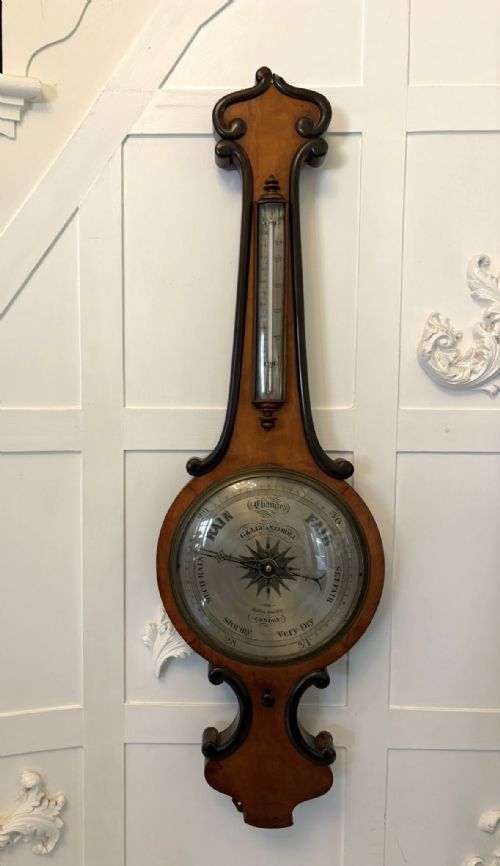
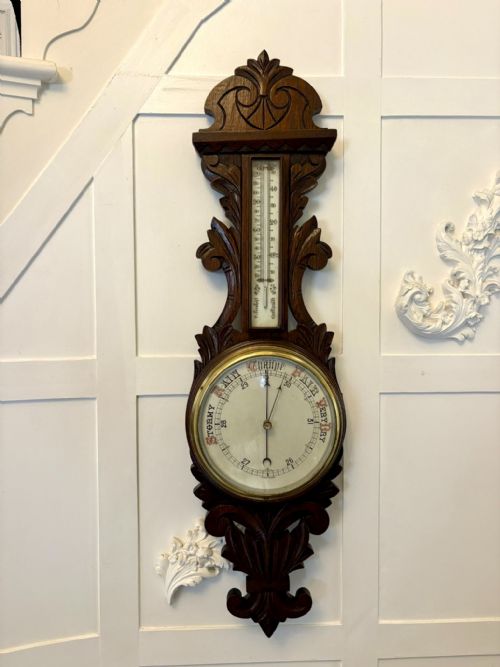


Victorian Carved Weather Instrument
These Victorian carved weather instruments combine domestic utility with intricate woodwork, offering a practical way to read atmospheric pressure while anchoring a room's decorative scheme.
Victorian Carved Weather Instrument
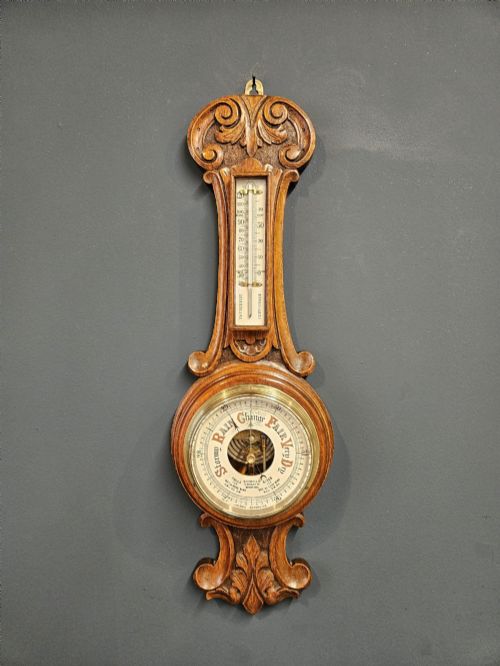
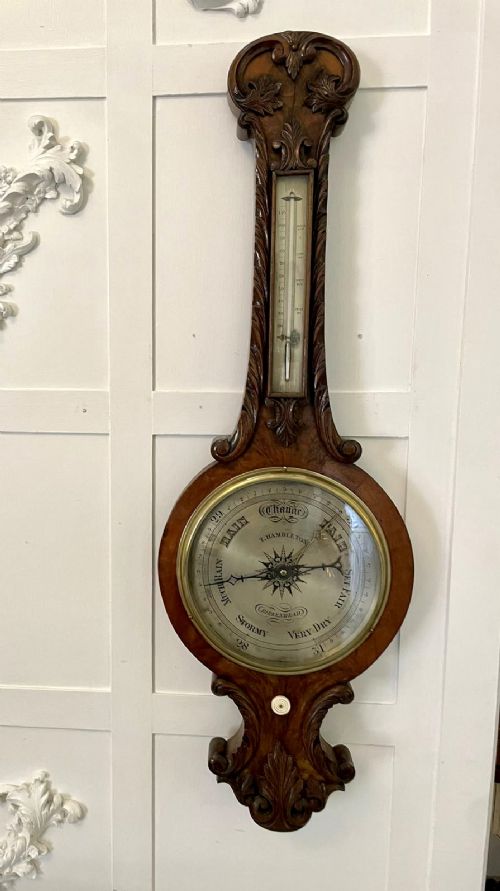
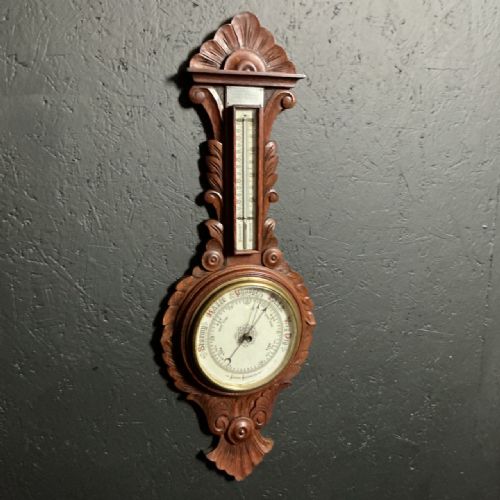
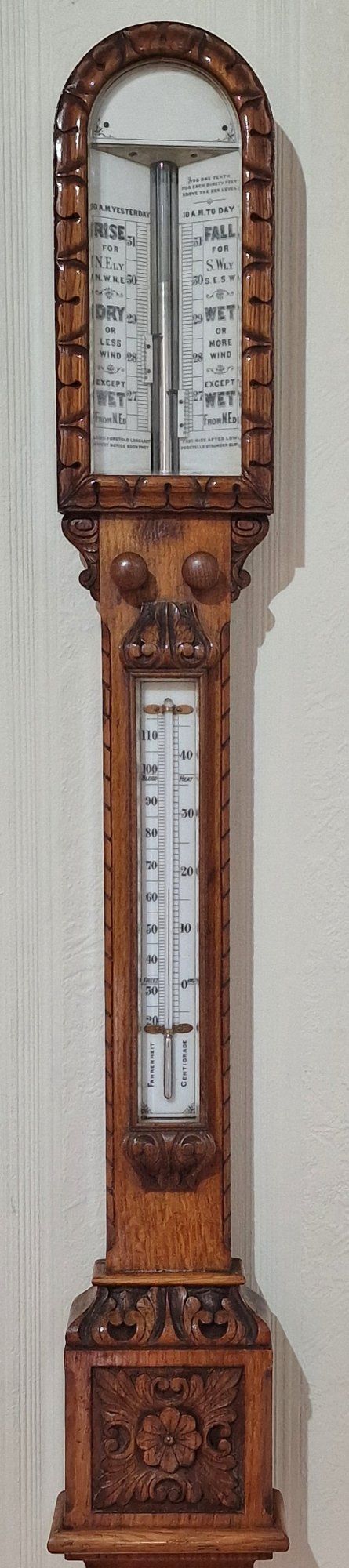
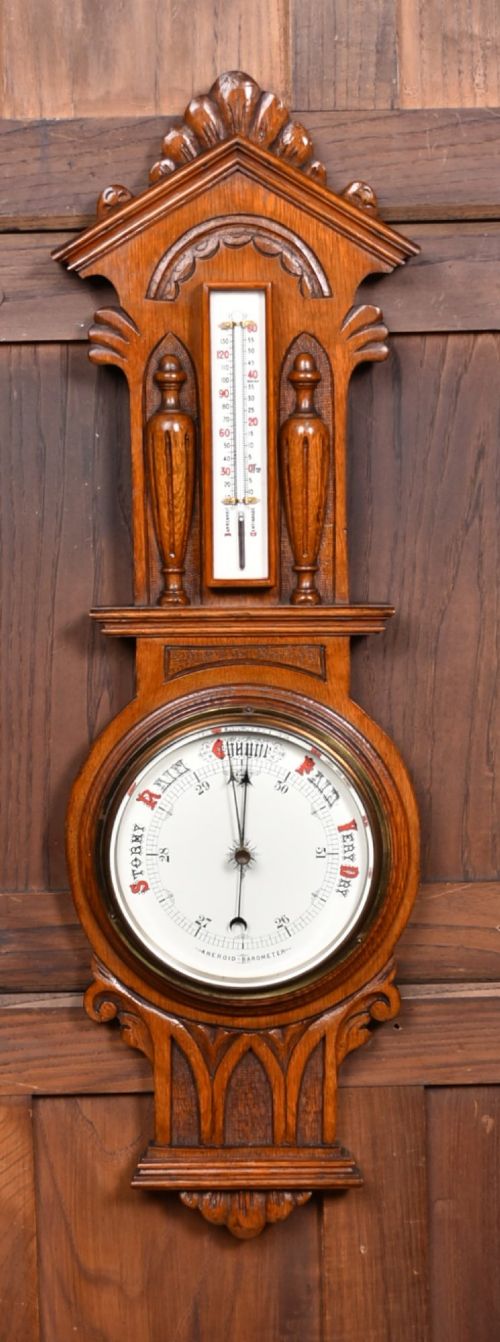
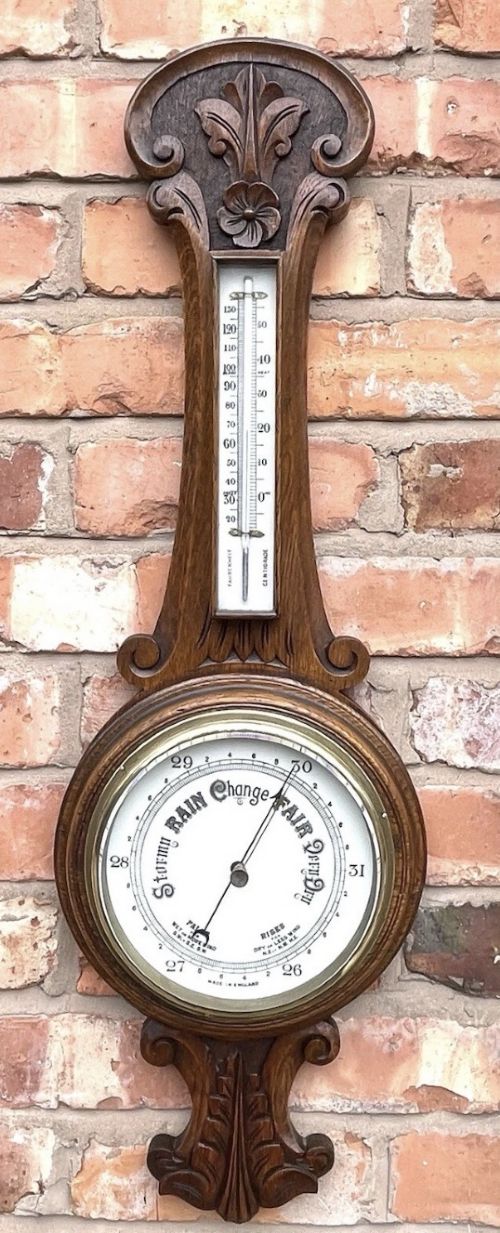
A Victorian carved weather instrument primarily takes the form of a banjo barometer, stick barometer, or wall-hanging clock barometer designed to measure atmospheric changes. You will most frequently encounter carved oak and walnut wheel or banjo barometers produced during the nineteenth century, often incorporating exposed mercury or aneroid dials alongside Fahrenheit thermometers.
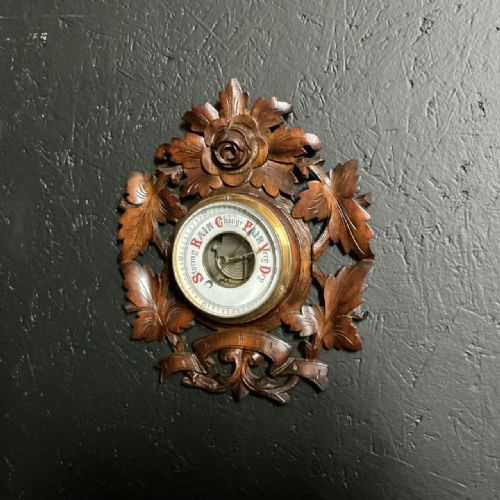
The selection ranges from robust British domestic pieces featuring geometric or bird carvings to continental Black Forest workshop productions adorned with deeply undercut foliage and woodland motifs. Regional variants span standard domestic wall barometers from English makers to specialised marine instruments housed in sturdy oak cases.
Makers ranged from notable scientific instrument houses in London and Darlington to prolific continental workshops producing heavily ornamented frames. Pieces commonly bridge the gap between scientific apparatus and domestic sculpture, utilising the timber and dial configuration to signal the status of the household.
Materials and construction
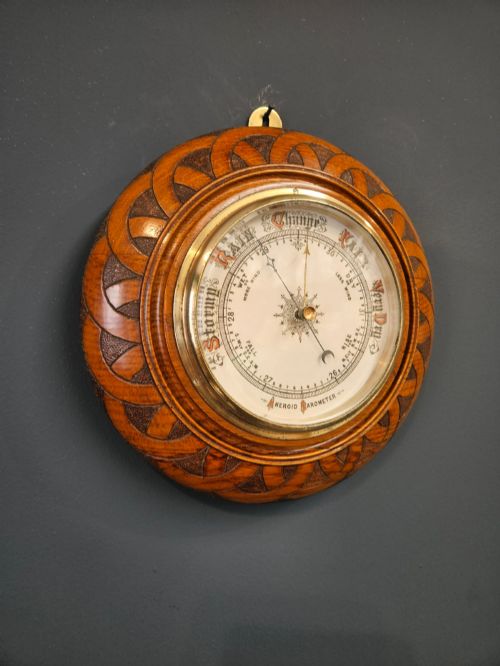
Cases rely heavily on dense hardwoods such as oak, walnut, and mahogany, selected for stability and responsiveness to deep hand-carving techniques. Craftsmen shaped these timbers into architectural frames, banjo bodies, and circular bezels, often employing turning and applied geometric mouldings to add depth.
Dials are constructed from silvered brass, ceramic, or glass, featuring engraved calibrations for barometric pressure and temperature readings alongside delicate indicator needles. Instruments themselves utilise either traditional mercury-filled glass tubes or internal aneroid mechanisms driven by metallic bellows.
Victorian Carved Weather Instrument Retail Price Guide 2026
Typical asking prices for victorian carved weather instrument among the pieces listed under this phrase on Sellingantiques today, from the lower quarter to the upper quarter. They describe what is for sale here now, not the wider market.
One massive oak instrument arrives carved specifically with birds, turning a humble atmospheric gauge into an avian wooden theatre.
Judging quality and execution
Quality rests principally in the depth, crispness, and ambition of the timber carving, moving from simple machine-turned oak edges to deeply undercut Black Forest foliage and sculpted avian figures. The precision of the engraved silvered dial and the reputation of the maker, such as Negretti and Zambra, elevate the standing of an instrument.
Proportion and case integrity also dictate value, with superior examples retaining their original glass bezels, matching thermometer scales, and unblemished wood surfaces. The integration of the dial with the wooden chassis shows whether the instrument was conceived as a unified piece of furniture or an assembled utility.
G and L Guanziroli·Bramwell and Harbron·Negretti and Zambra·W Watson and Sons·J Hughes London·Maple and Co
The Victorian Carved Weather Instrument Glossary
- Aneroid barometer
- An instrument measuring atmospheric pressure by the expansion and contraction of a flexible metal bellows, avoiding the use of liquid mercury. These units often drive a visible dial on the front of a banjo case.
- Stick barometer
- A tall, narrow wall instrument containing a vertical mercury-filled glass tube that exposes the fluid column directly to air pressure. They offer precise readings and usually feature a sliding vernier scale.
- Banjo barometer
- A domestic weather glass housed in a shaped wooden case resembling a banjo, typically combining a dial at the base with a thermometer and hygrometer along the vertical stem.
- Silvered dial
- A brass clock face treated with a silver solution and engraved with graduated scales for pressure and weather predictions. The process creates a matte metallic finish that contrasts cleanly against black numerals.
- Black Forest style
- A distinctive nineteenth-century carving tradition originating in central Europe, known for realistic representations of animals, leaves, and natural timber textures. These frames are heavily undercut and deeply sculptural.
Victorian Carved Weather Instrument: Frequently Asked Questions
How do aneroid and stick barometers differ?
Aneroid barometers use a sealed metal capsule that flexes with air pressure changes to move a dial pointer. Stick barometers rely on a tall column of liquid mercury in a glass tube.
Stick models tend to offer greater scientific precision, while aneroid versions provide a compact layout suited to domestic wall hanging.
Where should I hang a wall barometer?
Select an interior wall away from direct sunlight, radiators, and heavy draughts. Rapid temperature swings can interfere with the internal mechanism and wood movement.
Height should place the dial at eye level so you can easily read the pressure indicators and adjust the forecast needle.
Are mercury barometers safe to own?
Contained mercury within a sealed glass tube poses no risk during normal domestic display. The fluid remains safely housed behind the wooden case and glass face.
Exercise caution only if the instrument undergoes relocation or restoration, ensuring the tube remains vertical to prevent glass breakage.
How do I set the indicator needle?
Tap the glass lightly to settle the mechanism, then rotate the external brass bezel so the marker needle sits directly over the current pressure pointer. Observing whether the mercury or dial needle moves away from your marker reveals upcoming weather shifts.
Adjust the setting daily to track rising or falling atmospheric trends.
What distinguishes Black Forest barometers?
These pieces feature deeply carved walnut or oak cases decorated with natural motifs like ivy, oak leaves, and wildlife. The woodwork is often sculptural and extends far beyond standard geometric framing.
Carvers in the region applied intense manual detail to turn utilitarian weather instruments into striking decorative objects.