
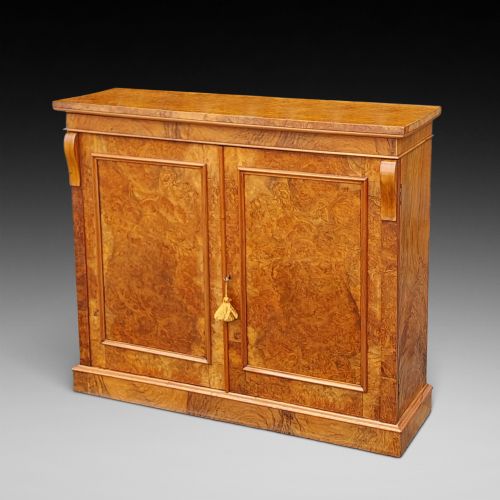
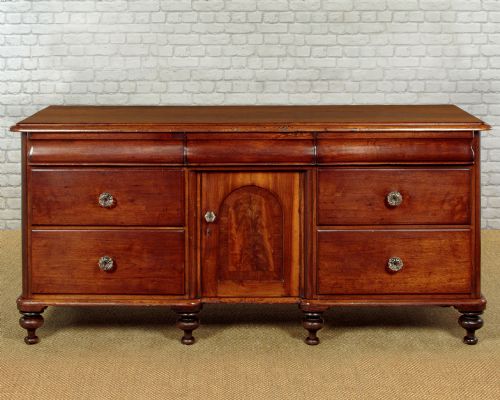
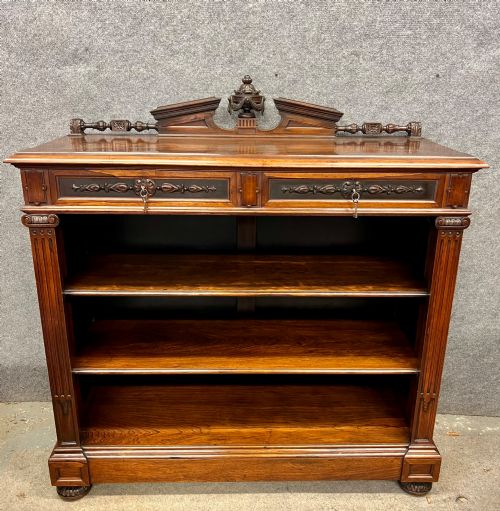

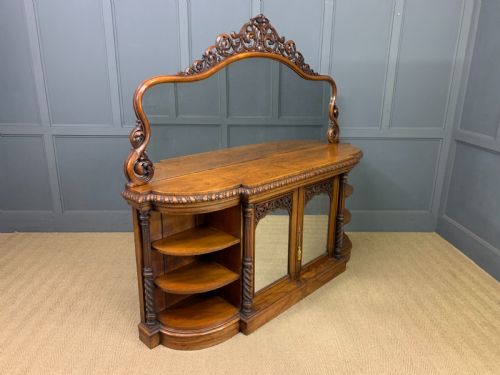


Victorian Carved Walnut Credenza
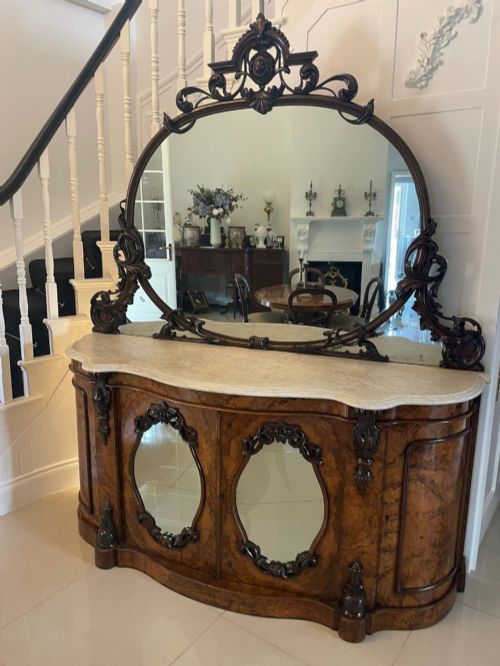
A victorian carved walnut credenza brings undeniable weight and presence to a room, combining rich timber with polished marble and glass.
Victorian Carved Walnut Credenza
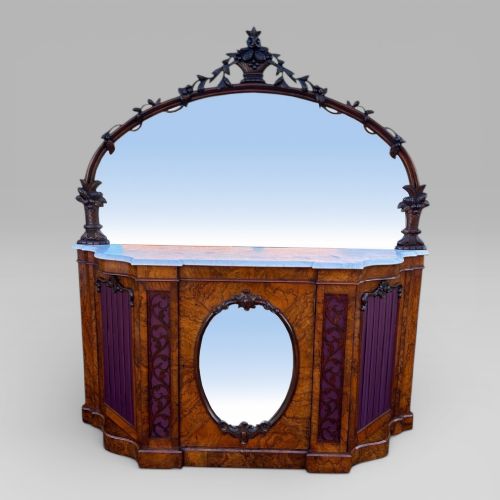
A victorian carved walnut credenza is a sophisticated cabinet designed for display and storage in principal rooms, most frequently encountered in mid-nineteenth-century forms with mirror backs, marble tops, and serpentine fronts.
These pieces range from compact salon cabinets to large exhibition-quality credenzas with four doors and elaborate marquetry inlay.
Makers often drew upon Renaissance, Rococo, and Gothic revival styles, integrating carved walnut with brass mounts and inset mirrors.
Materials and Construction
Cabinet makers built these pieces using solid walnut and burr walnut veneers, applying figured timber grains across curved and serpentine surfaces.
Interiors and structural elements incorporated secondary woods like oak, while decorative details relied on hand carving, mother-of-pearl inlay, and ormolu mounts.
Heavier display items integrated polished marble tops and mirrored glass panels within carved wooden frames.
The records show pieces spanning from the early Victorian era through to the late nineteenth century, predominantly utilising walnut, burr walnut, and marble.
Distinctions in Execution
Quality reveals itself in the selection of burr walnut veneer and the depth of the hand carving rather than the mere presence of decoration.
Exhibition-quality examples demonstrate superior cabinet-making through tight joinery on serpentine fronts, balanced marquetry patterns, and substantial marble slabs.
Lesser pieces rely on simpler flat surfaces and standard timber figures without the intricate mirror-back architecture found in top-tier versions.
Shoolbred & Co.
The Victorian Carved Walnut Credenza Glossary
- Credenza
- A low cabinet originally used for serving or display, evolving in the nineteenth century into an elaborate glazed or mirrored parlour piece.
- Burr Walnut
- A highly prized timber veneer taken from the warted growths of walnut trees, noted for swirling, knotty grain patterns.
- Serpentine Front
- A curved furniture front characterised by a convex centre flanked by concave ends, requiring skilled carpentry.
- Marquetry
- Decorative patterns formed by fitting together thin slices of various wood veneers and materials like mother-of-pearl.
- Ormolu
- Gilded bronze mounts and decorative details applied to furniture surfaces during the nineteenth century.
Victorian Carved Walnut Credenza: Frequently Asked Questions
Where did people place credenzas?
These cabinets stood principally in drawing rooms, formal dining spaces, and grand reception halls where hosts displayed ceramics, silver, and glass.
The mirrored backs reflected candlelight and daylight, brightening formal rooms while providing a backdrop for ornaments on the marble or wooden surface.
What is burr walnut?
Burr walnut is a specialised veneer harvested from tree growths that produce dense, complex patterns of swirling knots and rings.
Cabinet makers laid these decorative veneers across the primary doors and panels of high-status furniture to create rich visual texture.
How should I care for marble?
The marble tops require gentle cleaning with soft cloths and neutral soaps, avoiding acidic liquids that can etch the polished stone surface.
Protecting the stone from harsh impacts preserves the original finish and the integrity of the fitted edges.