






Victorian Canterbury Whatnot
A victorian canterbury whatnot combines open display tiers with a compartmented base, offering a practical nineteenth-century multi-purpose piece for the refined interior.
Victorian Canterbury Whatnot
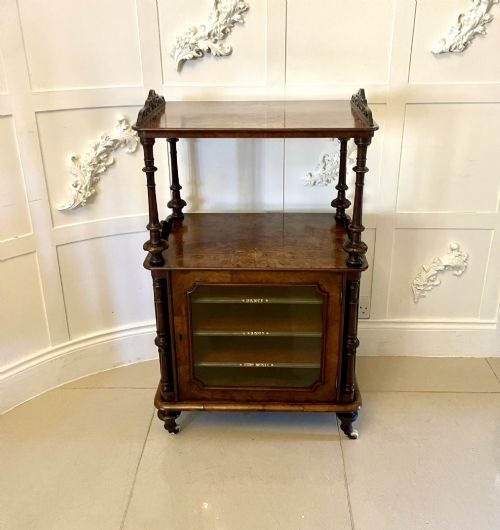
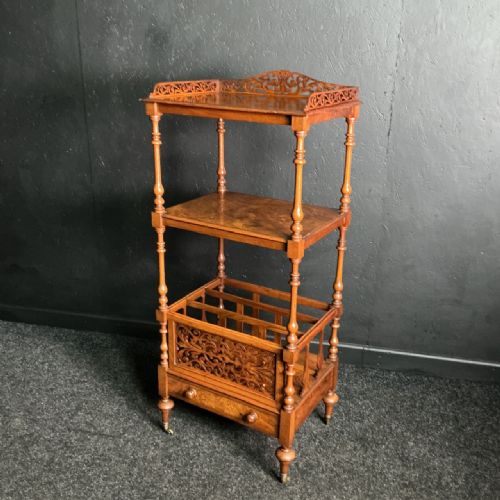
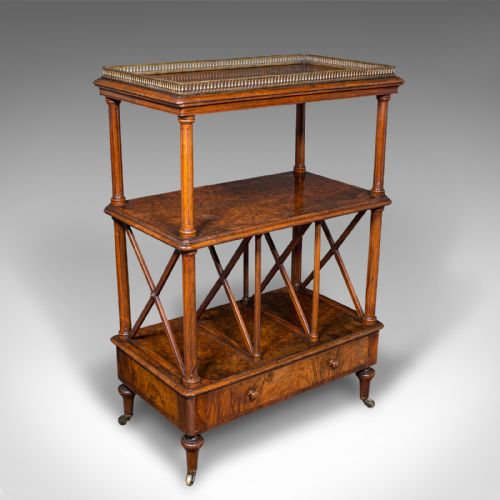
A victorian canterbury whatnot merges the tiered display function of the standalone etagere with the partitioned rack of the sheet music or periodical holder. These combination items appear predominantly in nineteenth-century forms, spanning the mid-Victorian era and the Regency period.
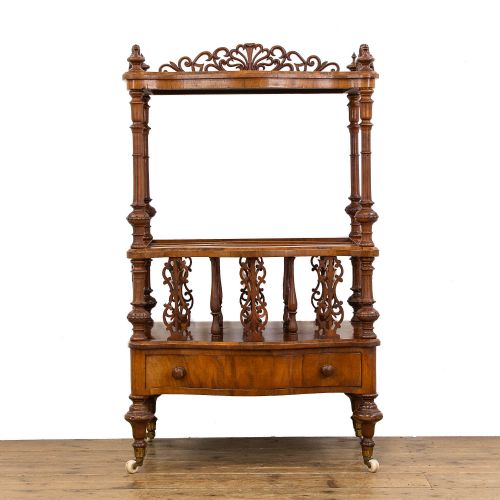
The standard configuration places open shelving supported by slender turned or carved columns above a slotted under-tier fitted with vertical dividers. Variations range from serpentine profiles and integrated small drawers to occasional tables adapted with storage partitions.
Burr walnut and rich rosewood dominate the surviving examples, often enriched with delicate boxwood and ebony inlay. Walnut surfaces showcase figured grain patterns that define the aesthetic of these multi-tier furnishings.
Materials and Construction Techniques
Cabinetmakers utilised dense tropical hardwoods and decorative veneers, applying burr walnut and rosewood over sound structural carcases. Boxwood and ebony stringing or marquetry panels frequently decorate the uprights and shelf edges.
Brass castors support the feet on many pieces, allowing easy movement across carpets in nineteenth-century drawing rooms. Turned wooden columns and delicate spindle galleries provide the structural support for the upper display tiers.
Listings demonstrate that burr walnut is the most frequently encountered primary timber for these combination stands.
Distinctions in Quality
The selection of timber grain and the precision of the marquetry inlay establish the visual hierarchy among these combination stands. Highly figured burr walnut and deeply saturated rosewood indicate superior material selection by the maker.
Structural refinement shows in the turned details of the supporting columns, the joinery of the drawer linings, and the crispness of the pierced fretwork partitions. Integration of functional elements like smooth-running small drawers distinguishes more ambitious workshop productions.
T Wilson of London
The Victorian Canterbury Whatnot Glossary
- Canterbury
- A low stand fitted with vertical partitions, originally designed to hold sheet music, portfolios or newspapers. Later examples frequently merge this lower compartment with upper display shelves.
- Whatnot
- An open set of multi-tier shelves used for displaying ornaments, books or small decorative objects. It developed during the eighteenth century and remained popular throughout the Victorian period.
- Etagere
- A piece of furniture consisting of a set of open shelves for displaying small articles and curiosities. The term is often used interchangeably with whatnot.
- Burr Walnut
- A decorative wood veneer taken from the warted growths on walnut trees, prized for its swirling, highly figured grain patterns. Cabinetmakers applied it to prominent surfaces on mid-nineteenth-century furniture.
- Stringing
- A narrow inlay of contrasting timber used to outline panels, drawers or table edges. Boxwood and ebony are typical contrasting woods found in nineteenth-century inlaid furniture.
Victorian Canterbury Whatnot: Frequently Asked Questions
What was a canterbury whatnot used for?
These dual-purpose pieces served the Victorian drawing room by providing open shelf space for decorative objects and ceramics above a partitioned base.
The lower slatted section held sheet music, newspapers, or periodicals near seating areas for daily convenience.
How do I date a Victorian whatnot?
Dating relies on timber choices, decorative motifs, and secondary construction details recorded across nineteenth-century pieces.
Burr walnut veneers and aesthetic movement inlays typically point toward the middle and later decades of the Victorian period.
Are these pieces freestanding?
Most surviving examples are designed to stand away from walls, finished with polished timber surfaces on all four sides.
Brass castors fitted to the feet allowed owners to reposition the furniture easily within the room.
What woods were used?
Makers relied heavily on rich exotic hardwoods, with burr walnut and dark rosewood appearing across the majority of examples.
Contrasting details often incorporate boxwood and ebony stringing, while earlier or alternative pieces utilise mahogany.