
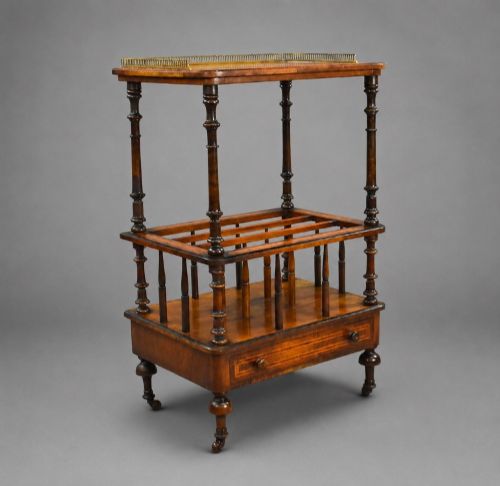


Victorian Music Divider
These Victorian music dividers and canterburys organise sheets and folios with the timber and brass typical of nineteenth-century parlours.
Victorian Music Divider
A victorian music divider or canterbury is a low stand designed to hold sheet music, folios, and magazines upright in a drawing room. These pieces appear most frequently in burr walnut, mahogany, and bamboo, reflecting the varied tastes of the nineteenth century.
The standard form combines vertical slatted partitions with a low drawer underneath for smaller accessories, sometimes mounted on castors for easy movement across carpeted floors. Examples range from simple open rack designs to more enclosed music cabinets featuring glazed doors.
How they were made
Cabinetmakers utilised dense hardwoods such as mahogany and burr walnut, often applying decorative inlay and contrasting veneers to the primary surfaces. Turning and joinery formed the structural slats and uprights that kept fragile paper scores separated.
Brass fittings, handles, and castors provided both structural reinforcement and functional mobility. Selected pieces also incorporated woven materials like rattan and bamboo within lighter, exotic frameworks.
The listings show materials spanning brass, walnut, burr walnut, mahogany, bamboo, rattan, metal, and leather.
What varies in quality
The choice of timber grain fundamentally distinguishes standard production from finer work, with figured burr walnut and rich mahogany commanding greater visual depth. Intricate inlay and careful attention to the turning of structural supports indicate a higher grade of craftsmanship.
Internal integration, such as the inclusion of a smoothly running fitted drawer or the quality of the original brass castors, marks the difference between utilitarian items and sophisticated parlour furniture.
The Victorian Music Divider Glossary
- Canterbury
- A low stand with partitions for holding music sheets and folios. It typically includes a single drawer at the base.
- Burr walnut
- A figured timber grain prized for its swirling patterns. Cabinetmakers utilised this veneer on prominent surfaces for decorative effect.
- Whatnot
- A piece of open shelving standing on legs, sometimes combined with a canterbury base. It served to display decorative objects.
- Regency
- An early nineteenth-century design style preceding the Victorian era. Pieces from this period often display clean architectural lines in mahogany.
Victorian Music Divider: Frequently Asked Questions
What is a canterbury used for?
A canterbury served as a dedicated stand for storing sheet music and folios near a piano or music stool in the Victorian parlour.
The vertical partitions kept paper scores upright and sorted, while the lower drawer held smaller musical accessories.
How do I date a music cabinet?
Dating relies on identifying timber choices, construction methods, and prevailing decorative styles recorded across the nineteenth century.
Heavier timbers like mahogany and burr walnut typically align with mid-Victorian production, while bamboo and rattan point towards later aesthetic tastes.
Are these stands suitable for modern magazines?
The original vertical partitions accommodate contemporary magazines and periodicals as effectively as nineteenth-century music sheets.
Their compact footprint makes them practical for organising reading material beside a sofa or armchair.
What timber was used most often?
Mahogany and walnut appear frequently across surviving nineteenth-century examples, often enhanced by decorative veneer work.
Alternative materials like bamboo also emerge in later periods to satisfy shifting interior design preferences.