





Victorian Candelabra Set
A victorian candelabra set brings symmetry and formal illumination to a mantelpiece, combining matching candlesticks or multi-light branches with a central clock.
Victorian Candelabra Set
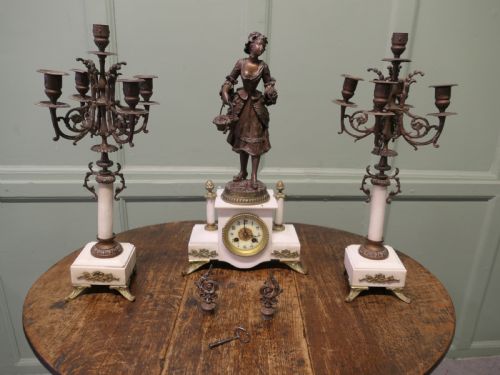
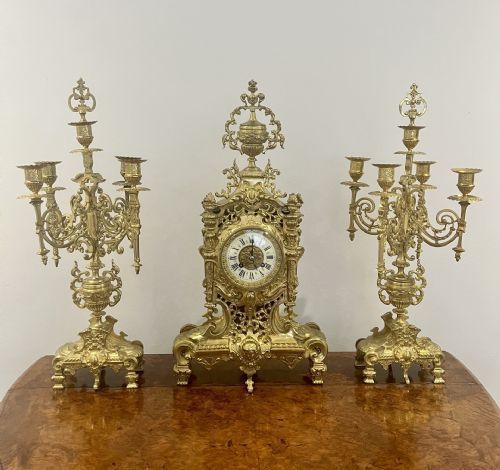
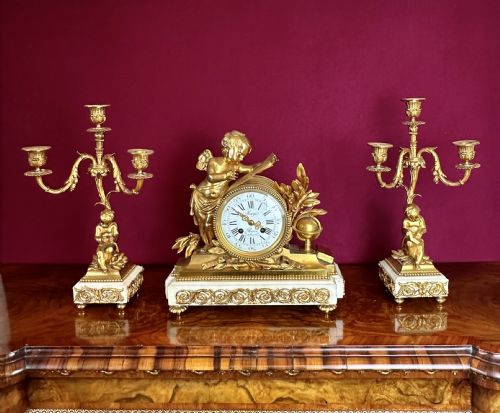
A victorian candelabra set typically comprises a central mantel clock flanked by matching candelabras or candlesticks as part of a garniture arrangement. These groupings emerged from nineteenth-century French and British workshops, designed specifically to balance the decor of formal reception rooms.
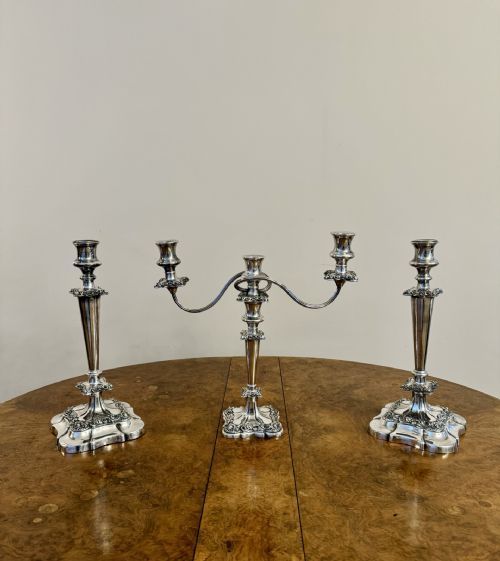
The pieces appearing on this page span the nineteenth century, including specific dates from eighteen-fifty to nineteen-ten, alongside items attributed to the Regency period. Forms range from heavy clock garniture sets and table garnitures to carved wooden Black Forest groups and porcelain-mounted designs.
Buyers will encounter various configurations, from three-piece bronze assemblies to elaborate sets featuring porcelain panels and detailed metalwork. The unifying characteristic across these groupings is the deliberate coordination of materials and stylistic motifs between the central object and its flanking companions.
Materials and construction
Metal components rely heavily on cast ormolu, brass, gilt bronze, and silver plate, often utilising patinated finishes to create contrast. These metals are shaped into ornate rococo revival scrolls, architectural facades, and figural elements.
Decorative accents incorporate carved marble, green onyx, porcelain, enamel, and black slate. Artisans combined these mineral substrates with metal mounts to build layered, tactile surfaces typical of nineteenth-century decorative arts.
Materials recorded across the inventory include ormolu, brass, enamel, gilt bronze, marble, porcelain, patinated bronze, and silver plate.
Assessing quality in sets
Quality rests in the crispness of the casting and the depth of the chasing across the ormolu, bronze, or brass elements. Finer examples display sharp relief and carefully smoothed joints, whereas lesser pieces show softer details and simpler finishing.
The integrity of the ensemble determines its standing, particularly where porcelain panels, marble bases, or enamel dials match precisely in tone and wear. Sets that retain their original harmonious pairing across every component command greater regard.
Smith & Sissons & Co·Raingo Fres Paris·Ferdinand Barbedienne·Meissen
The Victorian Candelabra Set Glossary
- Garniture
- A set of ornamental objects designed to be displayed together, commonly consisting of a clock flanked by matching vases, candelabras, or urns. These arrangements were placed on mantelpieces to create a balanced focal point in a room.
- Ormolu
- Gilded bronze, produced by applying a mixture of mercury and gold to a bronze base and heating it to leave a rich gold coating. The technique creates a durable, luminous surface found on many nineteenth-century mounts.
- Patinated bronze
- Bronze that has been chemically treated to alter its surface colour, usually towards dark brown, green, or black. This finish provides contrast against bright gilt or polished metal details.
- Sevres style
- A term describing ceramics decorated in imitation of the famous French porcelain factory, often featuring hand-painted panels set against coloured grounds. These inserts appear frequently on nineteenth-century clock cases and garniture sets.
- Rococo revival
- A nineteenth-century design style drawing on eighteenth-century French motifs, characterised by asymmetrical scrolls, naturalistic floral elements, and flowing, organic lines. It dominates the ornamentation of many victorian metal and ceramic sets.
Victorian Candelabra Set: Frequently Asked Questions
What is a clock garniture?
A clock garniture is a coordinated set of decorative objects intended to sit together on a mantelpiece or sideboard. The primary clock forms the centrepiece, flanked by matching items such as candelabras or urns.
These sets were manufactured in large numbers during the nineteenth century to provide symmetrical decoration for formal interiors. The components share identical materials, styles, and decorative motifs.
How do I clean ormolu and gilt bronze?
Ormolu and gilt bronze require gentle dusting with a soft, dry brush to prevent the accumulation of dirt in recessed areas. Water and chemical polishes should be avoided because they can strip the delicate gold layer.
Professional intervention is recommended if tarnishing or grime obscures the underlying metal. Proper maintenance preserves the historic surface finish without causing abrasion.
Can these clocks still keep time?
Many nineteenth-century mantel clocks retain their original mechanical movements and can keep time if serviced by a qualified horologist. Movements often require professional cleaning and adjustment due to age and accumulated dust.
Buyers should verify whether a key or pendulum is included with the listing. Regular maintenance ensures the longevity of the internal springs and gears.
How do I style a garniture set?
Garniture sets are traditionally arranged on a mantelpiece, with the clock in the centre and the candelabras or candlesticks placed symmetrically on either side. This placement creates visual balance and anchors the focal point of the room.
They also function effectively on large sideboards, consoles, or deep bookshelves. The surrounding decor should remain relatively simple to let the intricate metalwork and stone stand out.