

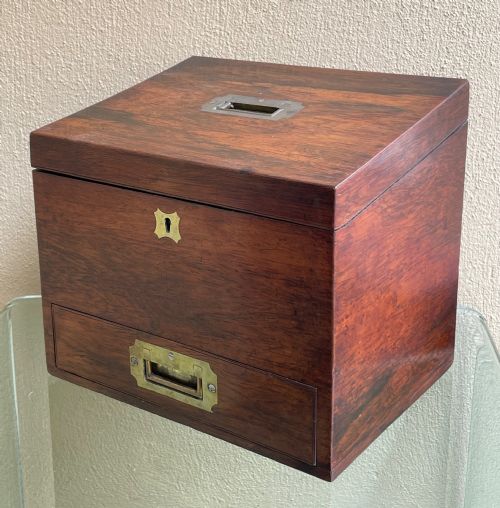
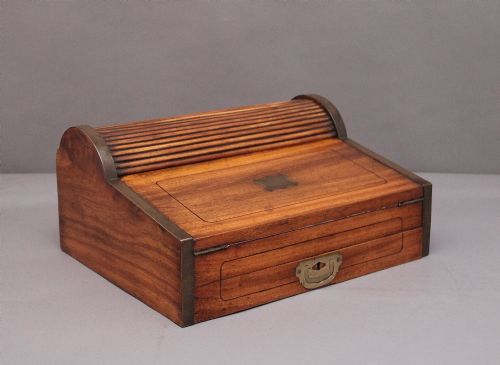
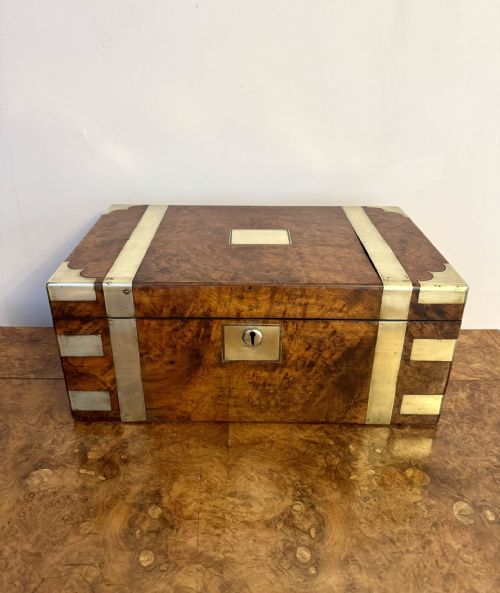
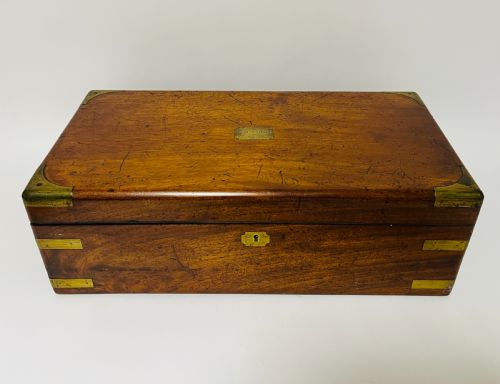


Victorian Campaign Stationery Box
A victorian campaign stationery box is a portable timber desk made for travel, holding paper and pens securely on the move.
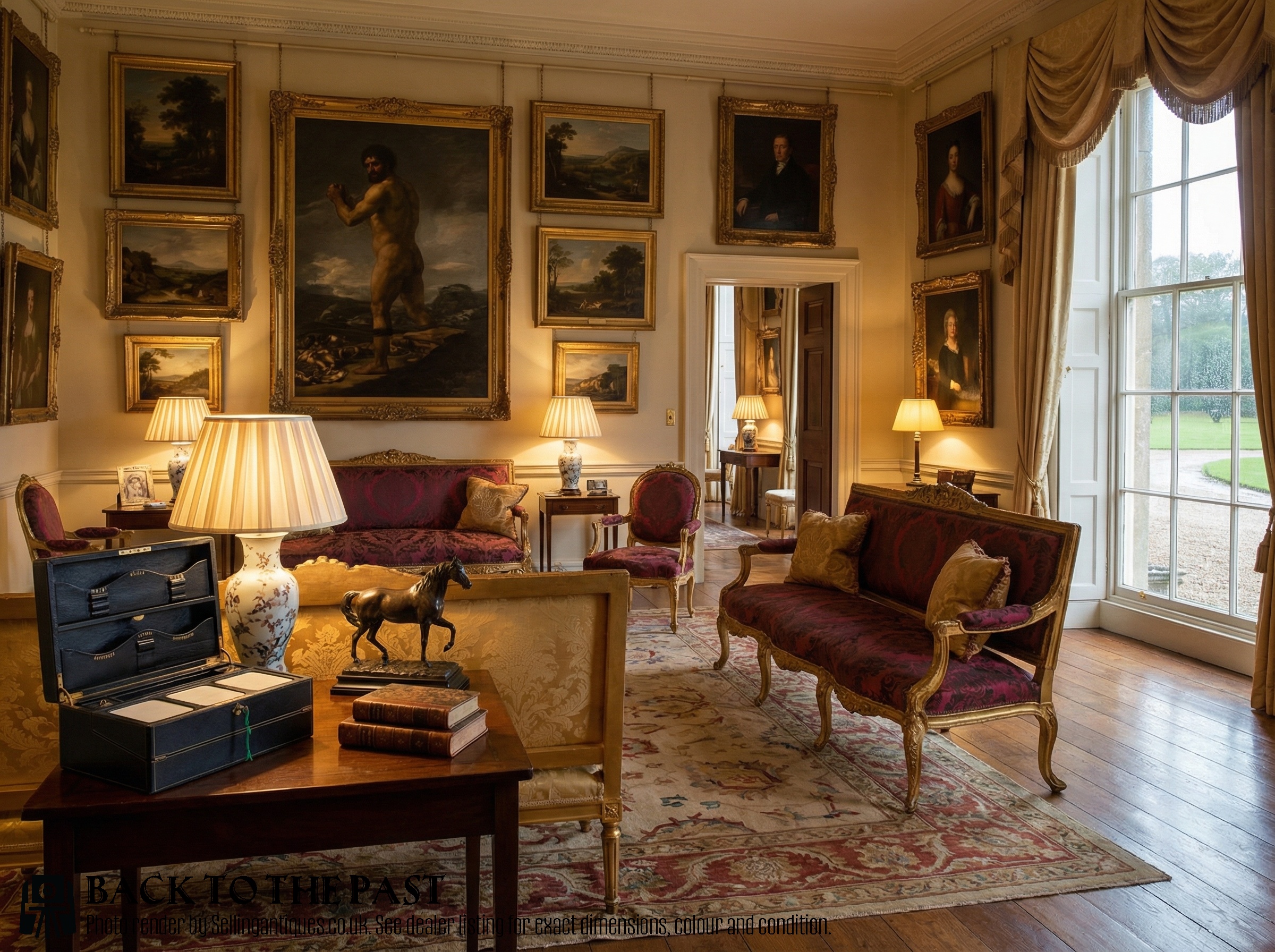
Victorian Campaign Stationery Box
When you search for a victorian campaign stationery box, you encounter portable writing desks and correspondence boxes designed for officers and travellers during the nineteenth century. These pieces combine compact storage for letters, ink, and paper with folding surfaces intended for use away from a fixed desk.
The versions most common on this page date from the Victorian era and the mid-nineteenth century, constructed to withstand rough movement. Many examples originate from British military service or colonial postings, showing heavy timber carcases reinforced against humidity and transit.
Forms range from simple slope-front writing boxes to metamorphic cabinets and fitted correspondence cases with internal secret drawers. The overarching purpose remains the organisation of writing materials within a secure, lockable enclosure.
Judging quality and execution
Quality separates standard travelling boxes from exhibition pieces through the precision of the brass work and the selection of timber veneers. Superior examples display perfectly flush brass corners, neatly mitred joints, and highly figured burr walnut or rosewood surfaces.
Internal complexity and hardware sophistication dictate the upper tier of the range, including functional Bramah locks with original keys and secret drawer mechanisms that operate smoothly. The integration of leather inserts and quality pen trays further distinguishes finer workshops from basic utility boxes.
The archive records stationery boxes and writing slopes originating from British colonial postings in India alongside standard military formats.
Mappin & Webb·P&F Shafer·Fisher
The Victorian Campaign Stationery Box Glossary
- Campaign slope
- A portable writing desk with a hinged lid that folds down to form an inclined writing surface. These were built for military officers on the move.
- Bramah lock
- A high-security cylindrical lock patented by Joseph Bramah, commonly found on superior nineteenth-century writing boxes.
- Secret drawers
- Concealed compartments hidden behind removable panels or triggered by secret latches within the interior fittings.
- Flush mount
- Hardware such as handles and escutcheons set level with the wood surface so nothing catches on travel bags.
- Correspondence box
- A desk accessory specifically arranged for holding paper, envelopes, and writing implements rather than serving primarily as a sloping writing desk.
Victorian Campaign Stationery Box: Frequently Asked Questions
What is a campaign stationery box?
A campaign stationery box is a portable timber chest designed to hold writing paper, envelopes, and ink safely during travel.
These pieces were used by officers and officials on military or colonial service to maintain correspondence away from permanent offices.
How do I spot a Bramah lock?
A Bramah lock uses a distinctive cylindrical key rather than a flat bit key, operating via internal sliding plates.
This mechanism represents high security for the period and typically appears on better-quality nineteenth-century boxes.
What woods were used?
Common timbers include mahogany, rosewood, burr walnut, camphor wood, and ebony, chosen for strength and grain.
Camphor wood was particularly favoured in colonial postings for its insect-repellent properties.
Are secret drawers common?
Secret drawers appear frequently in nineteenth-century writing slopes and stationery boxes as a feature of fine cabinet work.
They are usually hidden behind false partitions or released by pressing internal spring catches.
How do I care for the leather?
Leather writing surfaces benefit from gentle cleaning and occasional light conditioning to prevent drying and cracking.
Keep these boxes away from direct sunlight and extreme humidity changes to protect the wood and glue joints.