


Victorian Burr Walnut Lap Desk
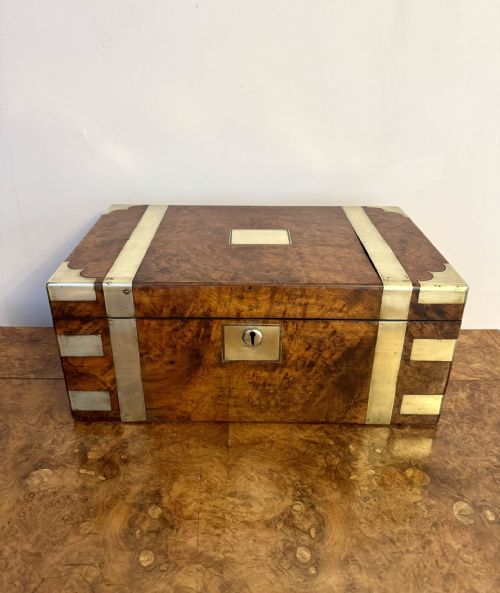
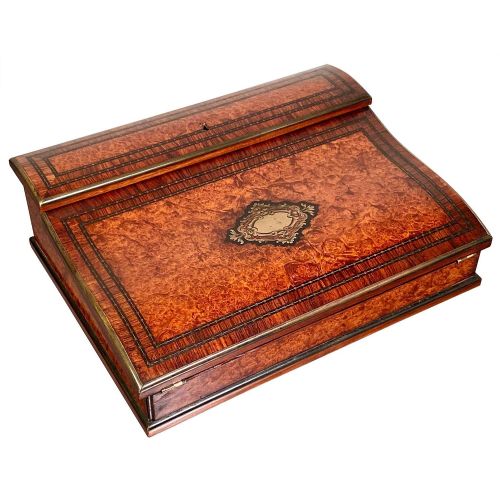
These Victorian burr walnut lap desk pieces are portable writing slopes and boxes crafted for correspondence.
Victorian Burr Walnut Lap Desk
When you search for a Victorian burr walnut lap desk, you are looking at portable writing slopes and boxes designed for correspondence in the nineteenth century. The examples met on this page span the Victorian period, including pieces from the middle and later decades of the nineteenth century. Forms range from compact writing slopes to larger document and stationery boxes.
Most entries take the form of writing slopes and boxes, alongside designated campaign pieces and stationery boxes. Origins reflect English and French workshops of the nineteenth century, with specific pieces dating to around eighteen fifty, eighteen sixty, eighteen seventy, and eighteen eighty. The selection centres firmly on walnut surfaces enriched by distinct figuring.
Makers and houses recorded in the evidence include George Austin of Dublin and Mappin & Webb. Such pieces provide a tangible link to nineteenth-century writing habits, combining portable utility with decorative cabinetwork.
How they were made
These pieces rely primarily upon burr walnut and figured walnut veneers applied to a stable timber carcase, creating rich and swirling grain patterns across the surfaces. Many examples incorporate brass binding, brass inlay, and mother-of-pearl details to accent the exterior woodwork. Boxwood and mixed wood inlay appear alongside Tunbridge Ware elements on specialised decorative boxes.
Internal arrangements utilise fitted compartments, secret drawers, and slope mechanisms designed to hold writing paper and ink. Secure storage is achieved through the integration of quality locks, including Bramah locks operated by matching keys.
Listings feature periods spanning from eighteen hundred through the Victorian era to eighteen ninety, utilising brass, boxwood, and mother-of-pearl.
What varies in quality
Quality rests in the selection and matching of the burr walnut veneer, where superior pieces display a dense, even curl across every surface. The precision of the brass binding and the finesse of any mixed wood or Tunbridge Ware inlay further separate standard boxes from finer productions.
Internal fittings dictate the standard of the piece, particularly the complexity of secret drawers and the inclusion of working Bramah locks with original keys. Maker attribution, such as work linked to George Austin or Mappin & Webb, adds a distinct layer of distinction.
George Austin of Dublin·Mappin & Webb
The Victorian Burr Walnut Lap Desk Glossary
- Burr walnut
- A veneer taken from the warted excrescence of a walnut tree, prized for its swirling and complex grain patterns. It forms the defining exterior visual characteristic of these writing slopes.
- Writing slope
- A portable box with a hinged sloping lid that opens to reveal a writing surface and internal compartments for stationery. It serves as the primary functional form found in this category.
- Bramah lock
- A high-security barrel lock invented by Joseph Bramah, frequently fitted to better-quality nineteenth-century writing boxes. These locks require a cylindrical slotted key.
- Tunbridge Ware
- Small decorative woodwork characterised by tiny mosaic tiles formed from differently coloured woods to create pictorial or geometric designs. It appears on specific inlaid writing boxes.
- Campaign writing desk
- A portable desk designed for travel, typically reinforced with brass corners and strapping to withstand movement. These pieces reflect military or colonial use.
Victorian Burr Walnut Lap Desk: Frequently Asked Questions
What is a Victorian lap desk?
A Victorian lap desk is a portable wooden box designed to be opened on the knees or a table, providing a slanted writing surface and storage for paper and ink.
These pieces were essential for private correspondence during the nineteenth century before the widespread availability of fixed home writing furniture.
How do secret drawers work?
Secret drawers are concealed compartments hidden behind false panels or beneath stationery dividers within the interior of a writing slope.
To access them, an owner often has to remove a specific partition or release a hidden wooden spring catch.
What is burr walnut?
Burr walnut is a specialised wood veneer harvested from the knotty growths of walnut trees, displaying chaotic and highly decorative grain patterns.
Cabinetmakers utilised this timber for the exterior surfaces of high-status boxes to create rich visual depth.
Are these desks portable?
These desks are entirely portable boxes fitted with hinged lids, internal partitions, and secure locks for travel.
Many campaign versions feature exterior brass banding to protect the corners and edges during transit.