


Victorian Burmese Furniture
Victorian burmese furniture brings heavy colonial carving and dense tropical timbers into the nineteenth-century interior.
Victorian Burmese Furniture
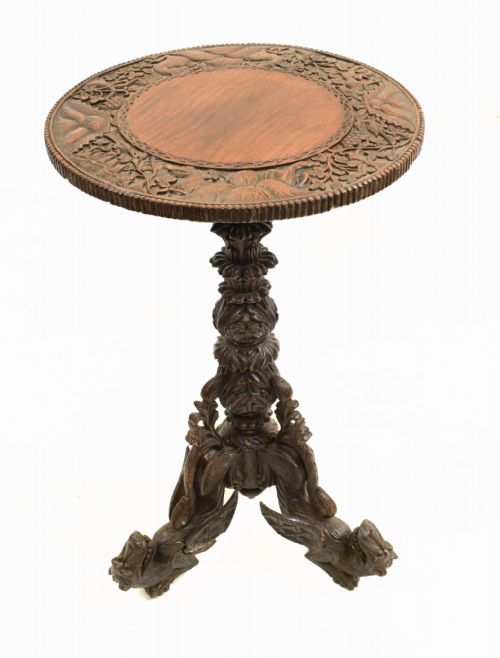
Victorian burmese furniture comprises heavily carved wooden tables, cabinets, and chairs produced during the nineteenth century under colonial influence. Buyers searching this phrase meet side tables, console tables, and tiered buffets alongside distinct seating forms like harpist chairs and temple chairs.
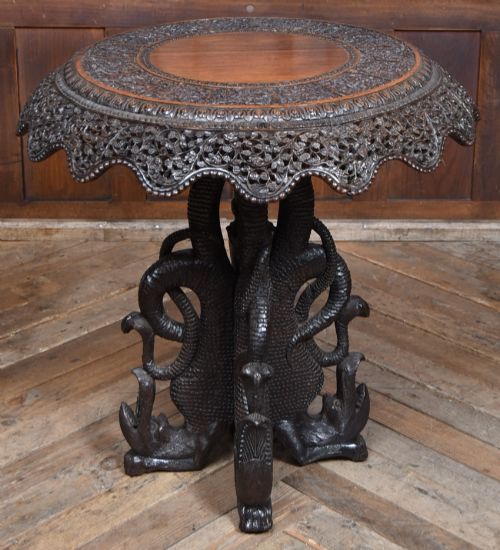
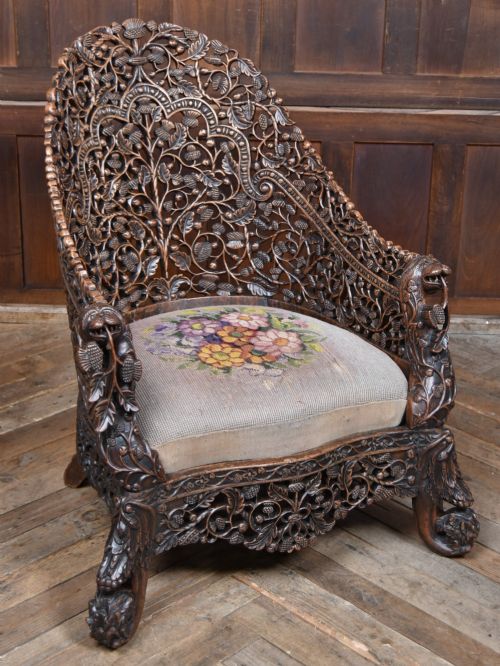
The aesthetic merges British Victorian furniture proportions with intricate Burmese carving traditions, often labelled as Anglo-Indian or Anglo-Burmese colonial pieces. Side tables with elephant legs and ornate peacock armchairs dominate the examples recorded on this page.

Materials and Construction
Makers utilised dense regional hardwoods, predominantly teak and padauk wood, alongside general hardwoods and oak. These heavy timbers provided the stable foundation required for deep, sculptural relief carving across panels, legs, and frames.
Brass fittings occasionally reinforced structural elements, while upholstery such as tapestry completed seating forms like armchairs and side chairs. Surface decoration relied entirely on hand carving rather than applied veneers or marquetry.
Materials appearing across the current listings include teak, padauk wood, general hardwood, brass, oak, and tapestry.
Judging Quality and Execution
Quality rests upon the depth, crispness, and symmetry of the hand carving across the timber. Pieces featuring fully realised figural elements, such as elephant legs or detailed peacock motifs, demonstrate superior artisan execution compared to repetitive geometric scoring.
The selection of timber grain and the structural integrity of dense woods like padauk and teak determine the durability and visual weight of tables, cabinets, and chairs.
The Victorian Burmese Furniture Glossary
- Padauk wood
- A heavy, dense tropical timber prized for its rich reddish-brown colour and durability in carved colonial furniture.
- Teak
- A robust Southeast Asian hardwood utilised extensively for nineteenth-century tables, cabinets, and structural frames.
- Buffet
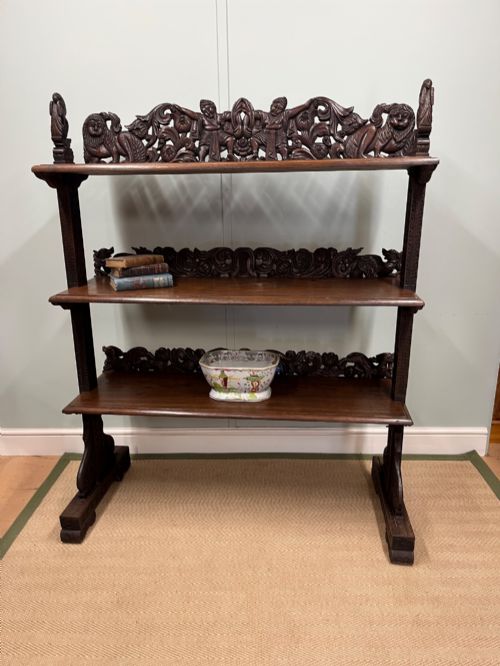
- A multi-tiered sideboard or shelving unit designed for display and storage in nineteenth-century dining rooms.
- Folio stand
- A vertical rack designed for holding newspapers, magazines, or large documents, constructed here in carved teak.
Victorian Burmese Furniture: Frequently Asked Questions
How were these pieces used?
Tables, consoles, and tiered buffets served practical display and surface functions in nineteenth-century drawing rooms and reception spaces. Seating forms, including harpist chairs, temple chairs, and armchairs, provided specialised seating while doubling as decorative showpieces.
Smaller items like folio stands functioned specifically as gentleman's newspaper racks, combining utility with elaborate aesthetic carving.
How do I live with these pieces?
Their dense timber construction means these items possess considerable physical weight, requiring sturdy placement on level flooring. The deeply carved wooden surfaces need periodic dusting with a soft brush to maintain the intricate recesses without damaging the timber.
Keep them away from direct heat sources to prevent the heavy hardwoods from splitting or drying out over time.
How do I tell periods apart?
Dating relies on matching the construction methods, timber choice, and specific Victorian stylistic crossovers recorded across nineteenth-century examples. Pieces often feature specific decade attributions based on the evolution of colonial trade and cabinet-making techniques between the eighteen-fifties and nineteen-hundreds.
Detailed inspection of the joinery and the sharpness of the hand carving helps distinguish genuine nineteenth-century production from later reproductions.