
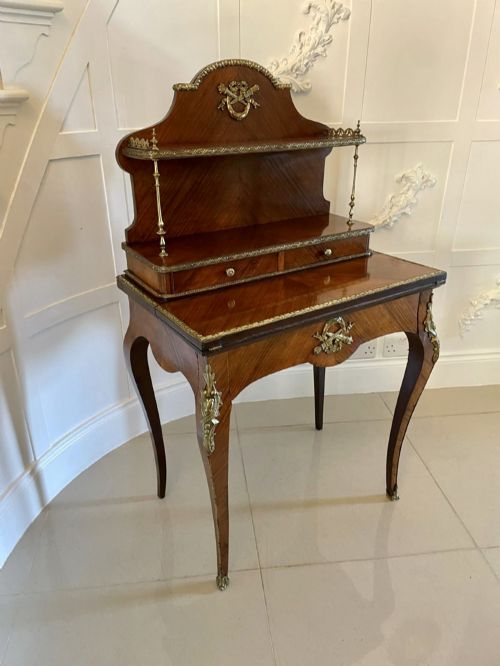
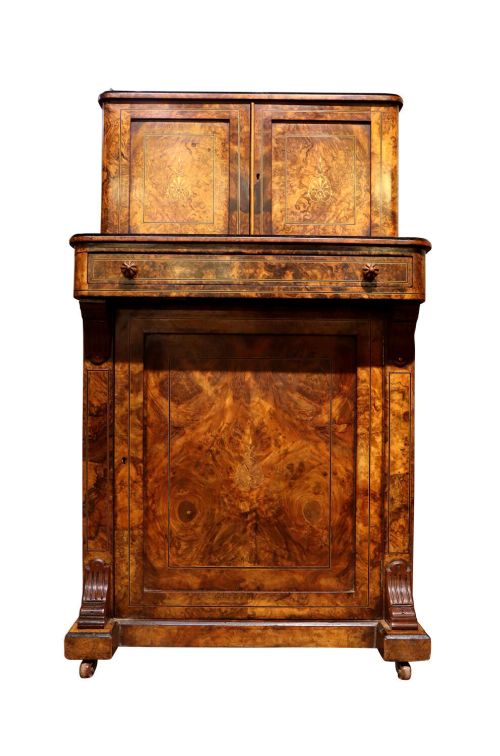


Victorian Bureau De Dame
These Victorian bureau de dame pieces offer compact, elegant writing spaces scaled for personal correspondence, combining ornamental cabinetry with practical tabletop surfaces.
Victorian Bureau De Dame
A Victorian bureau de dame provides a dedicated writing surface, often accompanied by small drawers, shelves, or compartments within a refined desk format. These pieces serve primarily as ladies writing desks or bonheur du jour units, originating from Victorian interpretations of French revival styles.
Visitors to this page will most frequently encounter burr walnut, walnut, and rosewood examples dating from the 1850s to the 1880s. Many incorporate inlaid details, brass accents, or freestanding construction suited for placement within a principal room rather than against a wall.
The objects bridge utilitarian desk furniture and decorative cabinetry, reflecting mid to late nineteenth-century tastes for continental forms. They appear alongside related desks and bureaux in the broader category of writing furniture.
How they were made
Cabinet makers utilised choice timbers such as burr walnut, walnut, kingwood, and rosewood, often applying decorative veneers to the primary surfaces. These woods provided distinctive grain patterns that defined the visual character of each desk.
Detailing relied on brass inlay, marquetry, and cast mounts in ormolu or gilt bronze, echoing French Louis XV revival aesthetics. These applied elements required precise joinery and metalworking skills to integrate smoothly with the curved and shaped wooden carcases.
Victorian Bureau De Dame Retail Price Guide 2026
Typical asking prices for victorian bureau de dame among the pieces listed under this phrase on Sellingantiques today, from the lower quarter to the upper quarter. They describe what is for sale here now, not the wider market.
Some desks hide secret compartments behind miniature doors, perfect for concealing love letters or misplaced postage stamps.
What varies in quality
The refinement of the timber selection and the precision of the marquetry or brass inlay set individual pieces apart. Higher grade examples display carefully matched burr veneers and crisp metal mounts that complement the overall proportions.
Structural complexity also distinguishes the range, from simpler ladies writing desks to elaborate bonheur du jour designs with integrated superstructures. The sophistication of the internal compartments and the fluidity of the revival styling indicate the maker's ambition.
The Victorian Bureau De Dame Glossary
- Bureau de dame
- A small ladies writing desk, typically featuring a sloped writing flap or fitted superstructure. These compact desks were designed for personal correspondence in private apartments.
- Bonheur du jour
- A light day-desk featuring a small cabinet or set of shelves mounted upon the writing surface. The form gained popularity during the nineteenth-century revival of French eighteenth-century furniture.
- Ormolu
- Gilded bronze mounts applied to furniture for decorative effect. The technique involves treating metal with a gold amalgam to produce a bright, durable finish.
- Marquetry
- The art of applying pieces of veneer to a structure to form decorative patterns or pictures. Craftsmen used various coloured woods to achieve tonal depth and pictorial detail.
- Burr walnut
- Timber taken from a walnut tree growth, yielding swirling, highly figured grain patterns. Cabinet makers prized this wood for high-status veneered surfaces.
Victorian Bureau De Dame: Frequently Asked Questions
What is a bureau de dame?
A bureau de dame is a small, decorative ladies desk designed for writing letters and storing personal papers.
These pieces typically date from the Victorian period and often incorporate compartments or small drawers above the writing surface.
How do I date a Victorian desk?
Dating relies on stylistic clues, timber choices, and construction methods recorded across the Victorian era. Pieces from the 1850s through to the 1880s show shifts in revival styling and veneer preferences.
Examining secondary woods, joinery, and the presence of brass inlay helps narrow the decade of manufacture.
Where should I place my desk?
Many Victorian bureau de dame examples feature finished backs designed for freestanding placement within a room. This allows the piece to act as a focal point rather than resting strictly against a wall.
Consider natural light levels and circulation space when positioning these compact writing desks.
What woods were commonly used?
Cabinet makers utilised walnut, burr walnut, rosewood, and kingwood for their rich tones and decorative grain. Mahogany also appears alongside exotic veneers.
Contrasters such as brass and gilt bronze frequently highlight the primary timber surfaces.