
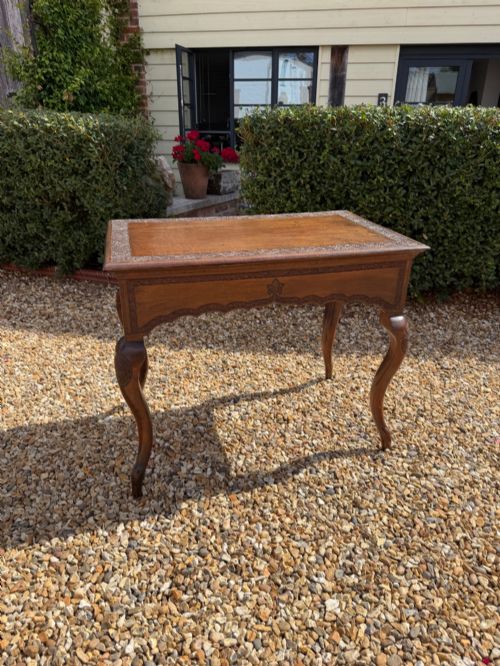
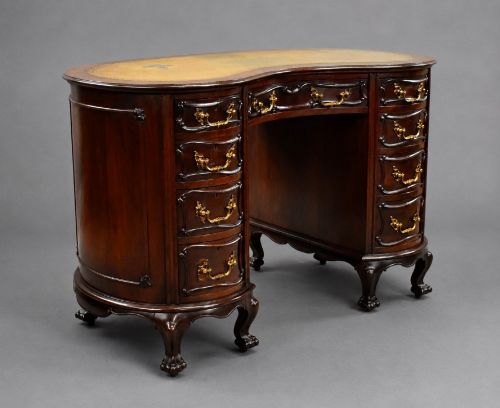
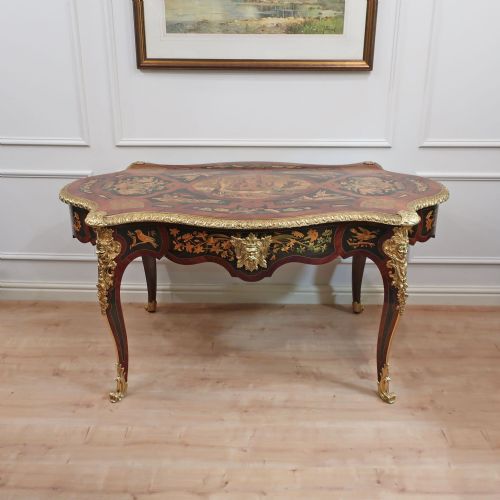
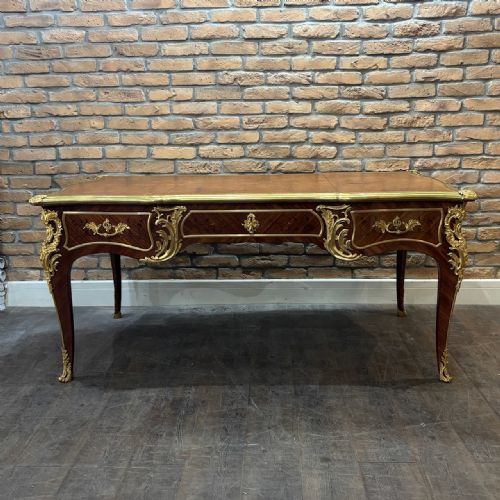


Ornate Writing Desk
An ornate writing desk brings heavy carving, gilt mounts and fine veneers to the study, offering a working surface steeped in nineteenth-century craftsmanship.
Ornate Writing Desk
When you search for an ornate writing desk, you encounter pieces primarily from the nineteenth century, spanning the Victorian and Edwardian eras alongside French revival styles. These items range from large partners desks and bureau plats to smaller Davenport desks and tabletop writing surfaces.
The most common examples on this page are Victorian and French-influenced pieces utilising walnut, mahogany, and kingwood veneers. Many incorporate decorative brass work, champleve enamel, or ormolu mounts to heighten their visual presence.
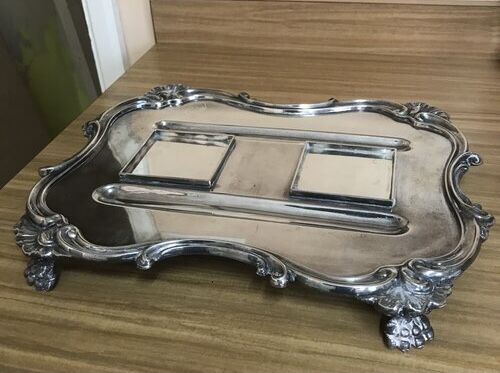
Alongside full-sized desks, the selection includes related writing accessories such as inkstands, stationery boxes, and inkwells. These smaller pieces share the same decorative ambitions as the main writing tables.
How they were made
Cabinetmakers built these desks using foundational timbers like mahogany, walnut, and hardwood, often applying intricate marquetry and parquetry patterns in kingwood or rosewood. Surfaces frequently received detailed hand-carving, particularly visible in Anglo-Indian and Italian pieces.
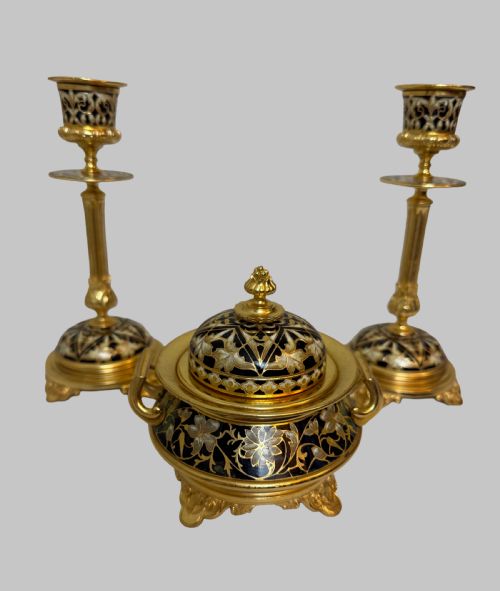
Metalwork played a defining role in the construction of ornate writing furniture, with cast brass, gilt bronze, and ormolu mounts screwed or pinned to corners, legs, and galleries. Desk accessories combined these metals with cut glass, porcelain, and champleve enamel.
Materials across the inventory include brass, gilt bronze, ormolu, leather, walnut, kingwood, mahogany, and hardwood.
What varies in quality
Quality rests upon the crispness of the hand-carving and the precision of the marquetry inlay across the timber surfaces. Finer desks display seamless timber matching and deeply chased ormolu mounts rather than mass-produced cast metal.
The integration of secondary materials like porcelain plaques, champleve enamel, and bevelled glass separates standard items from exceptional ones. Well-executed interior fittings and drawers finished in solid secondary woods indicate higher manufacturing standards.
James Cartland And Sons·Angiolo Barbetti Firenze·Minton·Moser
The Ornate Writing Desk Glossary
- Bureau Plat
- A freestanding French writing table featuring a rectangular top, typically with drawers, designed to sit in the centre of a room rather than against a wall.
- Ormolu
- Gilded bronze ornamentation applied to furniture and decorative objects during the eighteenth and nineteenth centuries.
- Marquetry
- The art of applying decorative pieces of veneer to a structure to form intricate floral, geometric, or pictorial designs.
- Davenport Desk
- A compact pedestal writing desk featuring a sloping top hinged over a set of drawers accessed from the side.
- Champleve
- An enamelling technique where troughs are dug into a metal surface and filled with vitreous enamel before firing.
Ornate Writing Desk: Frequently Asked Questions
What is a partner's desk?
A partners desk is a large writing table designed with cupboards and drawers accessible from both sides simultaneously. This allowed two people to work face to face in a shared study or library.
These pieces typically date from the nineteenth century and utilise heavy timbers such as mahogany or carved hardwoods. They represent some of the most substantial writing furniture available.
How do I identify French revival styles?
French revival styles like Louis XV and Rococo incorporate curved cabriole legs, asymmetrical scrollwork, and rich gilt bronze mounts. Makers used these Continental motifs to project elegance and status.
Walnut and kingwood veneers combined with marquetry work further signal this design influence. Such pieces often appear alongside champleve enamel desk accessories.
Where were Davenport desks placed?
Davenport desks were compact writing units designed to sit within smaller drawing rooms or bedrooms where a full partners desk would not fit. Their footprint allowed them to occupy corners or float near windows.
The hinged sloping top provided a writing surface while enclosing storage compartments for stationery and inkwells inside.
What materials make up desk sets?
Antique desk sets combine heavy brass castings, cut glass inkwells, and silver plating to create matched groups of writing accessories. Many feature letter holders, pen rests, and blotting pads.
Materials like ceramic, champleve enamel, and carved wood also appeared in sets produced during the Victorian and Edwardian periods.