



Victorian Brass Letter Scales
Victorian brass letter scales are dependable desk instruments for weighing correspondence, prized for their gleaming metalwork and fine hardwood bases.
Victorian Brass Letter Scales
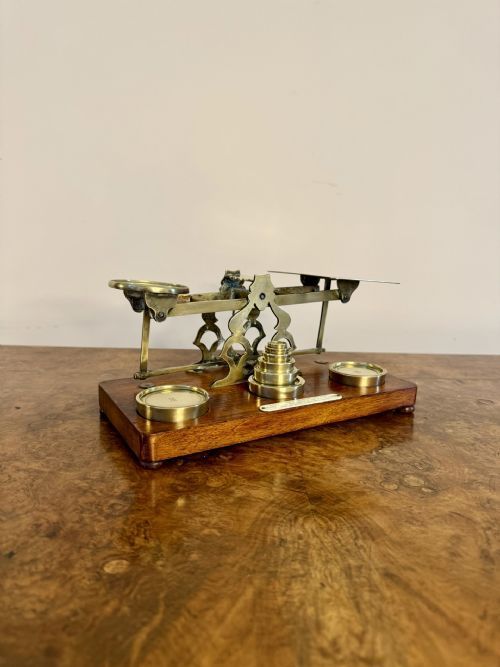
Victorian brass letter scales are functional desk accessories designed to weigh post accurately before the introduction of uniform postal rates. These pieces combine polished brass balance mechanisms with supportive bases fashioned from timber or stone.
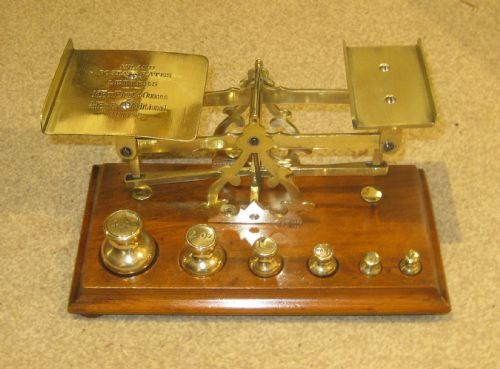
You are most likely to meet rectangular wooden bases in mahogany or walnut carrying matching brass weights alongside the swinging beam. Examples span the middle and late nineteenth century, extending into the Edwardian period with simpler proportions.
The assortment includes larger double-platform postal balances intended for heavy office parcels alongside miniature designs meant for portable use. Certain variations incorporate decorative minerals such as malachite or marble into the foundation.
Materials and construction
Makers constructed the primary balance arms and pans from cast and sheet brass, ensuring a durable, corrosion-resistant mechanism for daily office work. These metallic elements were often paired with heavy wooden plinths shaped from dense hardwoods like mahogany and walnut.
Foundations frequently incorporate contrasting materials such as marble or malachite inlay to elevate the visual weight of the instrument. Selected models feature fitted wooden compartments or specific recesses designed to store calibrated brass weights neatly alongside the beam.
Listings feature periods spanning from eighteen fifty to nineteen hundred, utilising materials including mahogany, walnut, malachite, marble, and brass.
Assessing quality and craftsmanship
The distinction between standard office equipment and finer desk pieces lies in the crispness of the brass casting and the refinement of the wooden base. Superior examples display elegant proportions, sharp maker signatures, and harmonious integration of decorative stone elements.
Completeness dictates much of the appeal, particularly the presence of matching stamped brass weights housed within the intended platform recesses. Maker marks from established firms such as S. Mordan or Ratcliff further distinguish exceptional pieces from unmarked workshop output.
S Mordan Co London·Ratcliff Birmingham
The Victorian Brass Letter Scales Glossary
- Balance beam
- The central pivoting metal arm that supports the weighing pans at either end. It relies on a knife-edge fulcrum to ensure smooth movement.
- Postal scale
- An instrument specifically calibrated to weigh letters and small parcels for postal charges. These devices typically operate with fractional weights measured in ounces and drams.
- Base plinth
- The heavy foundation block, usually formed from mahogany, walnut, or slate, that anchors the upright pillar and provides a stable platform.
- Weights set
- A matching group of small brass weights stored on the scale base. Each piece corresponds to specific postal tariffs of the period.
Victorian Brass Letter Scales: Frequently Asked Questions
How do these scales work?
The balance operates by placing correspondence on one platform while calibrated brass weights sit on the opposite side until the arm levels. Pivoting on a central fulcrum, the beam reveals the exact weight required for postage.
Most surviving examples retain their original configuration, allowing collectors to test the mechanical balance easily on a flat surface.
What periods do they cover?
Most pieces date from the Victorian and Edwardian eras, spanning the mid-nineteenth century through to nineteen hundred. Construction details and wood choices generally align with the prevailing furniture styles of those decades.
Design evolution moved from robust utilitarian office models toward more decorative domestic desk accessories by the turn of the century.
Why are some mounted on stone?
Makers occasionally utilised slate, marble, or malachite to provide a heavier, more stable foundation and a striking visual contrast to the polished brass. These mineral bases were favoured for high-end retail stationers supplying wealthy households and executive offices.
Such materials also protected polished wooden desks from ink stains and moisture during daily use.
Are the weights usually original?
Many surviving scales retain their matching set of stepped brass weights, often nested neatly within dedicated slots carved into the wooden base. Because weights were easily misplaced over decades of use, complete matched sets enhance desirability significantly.
Collectors look for consistent stamping and uniform wear across both the balance and the accompanying weights.