
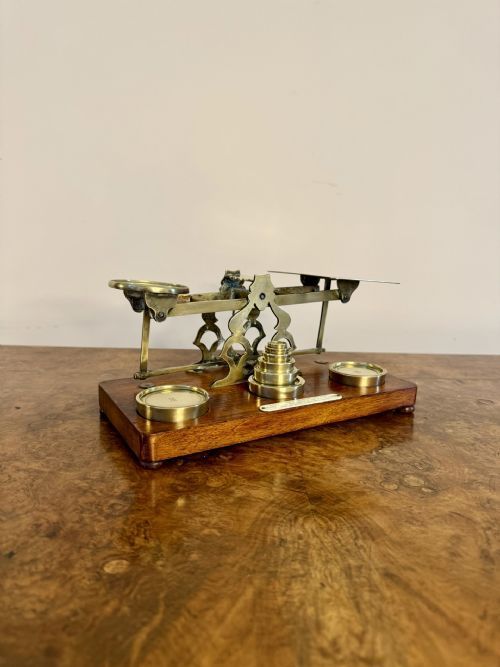


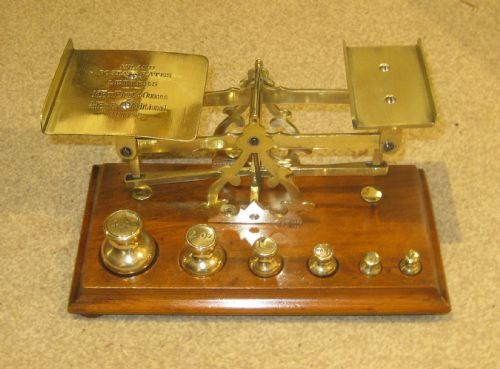

Victorian Brass Letter Balance
These Victorian brass letter balance scales are the precise desktop instruments once used to weigh mail before postage stamps were universally standardised.
Victorian Brass Letter Balance
A victorian brass letter balance is a functional desktop instrument designed for weighing mail, most commonly encountered mounted on wooden bases made from mahogany, walnut, or hardwood. These postal scales typically date from the nineteenth century, spanning periods from eighteen fifty to nineteen hundred, and incorporate fitted brass weights alongside the swinging balance arm.
You are most likely to meet Victorian examples featuring brass mechanisms fixed to rectangular timber plinths, though variants with marble or malachite mounts and specialised designs like candlestick forms also appear. The pieces combine utilitarian engineering with decorative appeal, reflecting the administrative demands of the period alongside domestic or commercial desk requirements.
How they were made
Maker workshops constructed these balances using cast and turned brass for the levers, pans, and matching square weights, ensuring the moving parts achieved a precise equilibrium. The metal components were frequently mounted onto seasoned hardwood bases such as mahogany and walnut, which provided both stability and a substantial platform for daily desk use.
Specialised iterations integrated decorative stones like malachite or marble into the design, while makers inscribed maker marks and city locations directly onto the brass components or wooden plinths. Structural integrity relied upon robust joinery for the timber bases and accurate calibration of the fulcrum and beam to measure letter weights correctly.
Listings for this phrase include pieces utilising brass, mahogany, walnut, malachite, and marble across Victorian and Edwardian periods.
What varies in quality
Quality in a victorian brass letter balance is determined by the crispness of the brass casting, the retention of the original matched set of weights, and the integration of the wooden or stone base. Superior examples exhibit finely turned components, clear maker inscriptions, and harmonious proportions between the metal mechanism and the supporting plinth.
The choice of base materials also distinguishes the range, with dense hardwoods like mahogany and walnut or decorative elements such as malachite indicating higher ambition in manufacture. Simpler utilitarian pieces lack the refined finish and decorative flourishes seen on those produced by established makers.
S Mordan London·Ratcliff Birmingham
The Victorian Brass Letter Balance Glossary
- Letter balance
- A device for weighing correspondence to determine postage rates, typically operating with a swinging beam and a flat platform or pan.
- Postal scales
- Alternative terminology for instruments used to weigh letters and small parcels, often supplied with fitted compartments for brass weights.
- Square weights
- Flat-topped metal masses designed to sit neatly within dedicated slots on the wooden base when not placed on the weighing pan.
- Fulcrum
- The pivot point upon which the balance beam rests and pivots, essential for accurate measurement in mechanical scales.
Victorian Brass Letter Balance: Frequently Asked Questions
How did a victorian brass letter balance work?
The user placed a letter on the top platform or hanging pan, which caused the brass beam to tilt on its central pivot against the weight placed on the opposing side. Adjusting the weights allowed the operator to determine the correct postal rate based on the mass of the correspondence.
These mechanical scales relied entirely on physical equilibrium rather than springs, making them durable instruments for Victorian offices and studies. Their accurate calibration ensured letters met postal regulations before dispatch.
What woods were used for the bases?
Makers predominantly mounted brass balance mechanisms on dense hardwoods including mahogany and walnut, chosen for their durability and attractive grain. These timber plinths often featured recessed compartments specifically shaped to hold the corresponding brass weights securely.
Occasionally, alternative materials like marble or malachite formed the decorative base instead of wood. The timber plinth provided a heavy, stable foundation required for precise weighing on a desk.
Are the original weights usually included?
Many surviving examples retain their original matched sets of brass weights, which fit neatly into dedicated slots carved into the wooden base. Finding a complete set enhances the integrity of the piece for collectors.
Weights were typically cast in square forms to sit flush within the base compartments. Lacking the complete set was common due to heavy daily use in nineteenth-century offices.
How do I date a postal scale?
Dating relies on stylistic clues, timber choices, and stamped maker inscriptions found on the brass work or wooden bases. Pieces span the Victorian and Edwardian periods, with earlier examples from eighteen fifty often showing distinct structural forms like the candlestick design.
Maker marks associated with known London or Birmingham firms provide firmer chronological anchors. Examining the construction methods and materials helps place the instrument within its nineteenth-century context.