


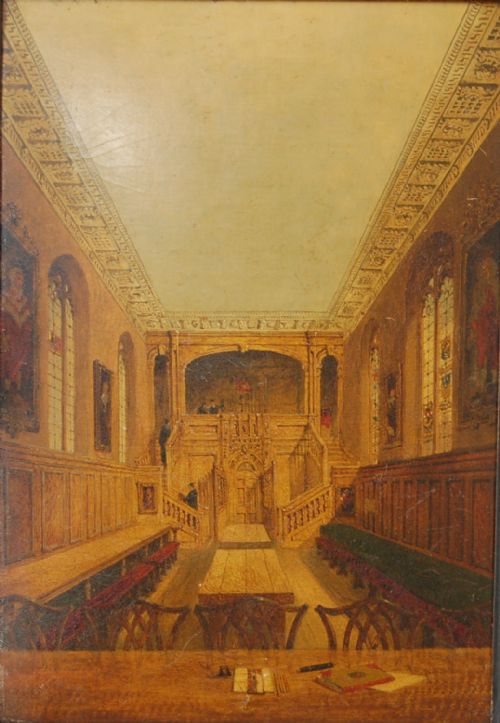


Victorian Architectural Oil Art
Victorian architectural oil art captures historic buildings, street scenes, and grand interiors painted in oil during the nineteenth century.
Victorian Architectural Oil Art
Victorian architectural oil art comprises oil paintings depicting buildings, street scenes, townscapes, castles, and interior rooms produced across the nineteenth century.
The pieces you encounter span naive depictions of young girls in architectural settings through to detailed views of British and continental castles, cathedrals, and canals.
Makers recorded in these works include named painters such as Cornelis Christian Dommersen, Frederick Tully Lott, and Lewis J Wood.
How they were made
These works utilise oil paint applied to canvas, board, or wood supports, often framed in giltwood or gesso mouldings.
Artists built up the compositions using traditional nineteenth-century brushwork techniques to render stone facades, figures, and atmospheric townscapes.
Victorian Architectural Oil Art Retail Price Guide 2026
Typical asking prices for victorian architectural oil art among the pieces listed under this phrase on Sellingantiques today, from the lower quarter to the upper quarter. They describe what is for sale here now, not the wider market.
One canvas preserves a saints' procession making its way through the historic streets of Bruges.
What varies in quality
Quality separates through the precision of architectural perspective and the skill with which artists handle light upon stone and canvas.
Works by recognised nineteenth-century painters command attention for their detailed brushwork and compositional depth compared to simpler naive pieces.
Cornelis Christian Dommersen·Frederick Tully Lott·William George Meadows·Lewis J Wood·Karl Herrle·Samuel Sidley·Alfred Pollentine·Henry Schafer·Joseph Murray Ince
The Victorian Architectural Oil Art Glossary
- Oil on canvas
- Pigments bound in a drying oil applied to a woven fabric support. This was the standard method for producing fine art paintings throughout the period.
- Giltwood
- Wood carved and covered with a thin layer of gold leaf or gold paint. Frames of this material frequently accompany nineteenth-century oil paintings.
- Naive art
- Artwork produced by an artist without formal academic training, often characterised by a direct perspective and charming simplicity. Several nineteenth-century street and figure scenes reflect this approach.
- Townscape
- A painting depicting a city view, streets, or urban architecture. These form a major category among continental and British architectural oil art.
Victorian Architectural Oil Art: Frequently Asked Questions
What subjects appear in Victorian architectural oil art?
The paintings depict historic townscapes, castles, cathedrals, village churches, and interior reception rooms. Scenes range from British landmarks like Windsor Castle to continental canals in Venice and Bruges.
Artists recorded specific locations with varying degrees of topographical precision, capturing the architectural styles popular during the nineteenth century.
How should I hang these paintings at home?
These works suit traditional reception rooms, studies, or hallways where their giltwood frames complement period interiors. Ensure they avoid direct sunlight to protect the oil paint and canvas.
Pairing smaller oil boards or matched pairs creates a strong focal point on a wall without overwhelming the space.
How do I identify the date of a painting?
Examine the canvas or board substrate, the style of the giltwood frame, and any signatures or inscriptions on the reverse. Many nineteenth-century works include artist signatures or dates within the composition.
Subject matter and costume details on figures within street scenes or interiors also provide clues to the decade of creation.
What is the difference between townscapes and interior scenes?
Townscapes focus on exterior architecture, streets, cathedrals, and city views under natural daylight. Interior scenes transport the viewer inside formal halls, rooms, and historic buildings.
Both genres utilise oil paint on canvas or board to record nineteenth-century architectural spaces.