
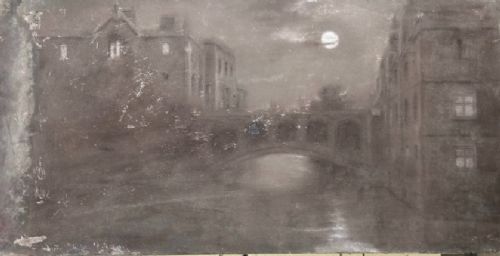


Victorian Architectural Drawing
These pieces of victorian architectural drawing capture buildings and details through ink, watercolour, and charcoal on paper, offering direct insight into period design.
Victorian Architectural Drawing
A victorian architectural drawing represents the foundational planning and study of structures, ranging from school exercises of royal palaces to detailed representations of cathedrals, churches, and botanical glasshouses. These works emerge from the nineteenth century and the early twentieth century, spanning periods such as the Victorian and Edwardian eras.
The selection on this page includes framed original artwork, lithographs, and technical or artistic studies executed by named draughtsmen, students, and established artists. Forms vary from single sheet elevations and perspective views to bound book illustrations and sets of plans.
Subjects draw heavily on historic styles including Gothic Revival, Victorian Classical Revival, and technical renderings. Many pieces document specific British and European landmarks, from Cambridge colleges to London gardens.
What separates the tiers
The distinction between ordinary and exceptional pieces lies in the sureness of the hand and the complexity of the subject matter. Masterful control of pen and ink or watercolour wash transforms a standard technical plan into a compelling visual document.
Provenance and attribution elevate certain works significantly, particularly those signed and dated by identifiable artists, students at institutions like the South Kensington School, or professional architects. The condition of the paper and the integrity of the original framing also influence the overall character of the piece.
One young draughtsman proudly noted his age as seventeen right alongside his detailed rendering of a royal palace.
H. H. Wyatt·Thomas Dunn·John Scott Russell·Joseph Hansom·Margaret Thompson
The Victorian Architectural Drawing Glossary
- Lithograph
- A print made from a planographic process in which the image is drawn on limestone or metal. This technique allows for the faithful reproduction of architectural plans and artistic designs.
- Pantograph
- A mechanical linkage connected in a parallelogram form based on planar geometry. Draughtsmen utilise this instrument to scale drawings up or down with accuracy.
- Gothic Revival
- An architectural movement that draws inspiration from medieval design elements. This style is frequently documented or emulated in the period drawings found in this collection.
- Watercolour
- A paint consisting of colour suspended in a water-soluble vehicle. Artists employ this medium on paper to add washes of tone and colour to architectural elevations and landscapes.
Victorian Architectural Drawing: Frequently Asked Questions
What is a victorian architectural drawing?
A victorian architectural drawing is a period work on paper depicting buildings, plans, or structural studies created during the nineteenth and early twentieth centuries. These pieces range from student exercises and technical plans to finished watercolours of notable British landmarks.
They serve as both historical records of period construction and decorative artworks suited for display in domestic interiors.
How should I frame these drawings?
These works on paper require conservation-grade mounting to prevent acid transfer and discolouration from older backing materials. Retaining or complementing period wooden frames, particularly those with gold leaf or gilt details, preserves their historical context.
Positioning the framed artwork away from direct sunlight protects vulnerable ink and watercolour pigments from fading over time.
Are these drawings original works?
The selection encompasses both unique hand-drawn originals executed in ink, watercolour, or charcoal and period lithographic prints of architectural plans. Individual listings specify whether a piece is an original artwork or a framed lithograph.
Signatures, dates, and inscriptions on the paper often provide direct evidence of the draughtsman or school responsible for the creation.
How do I identify the period?
Period attribution relies on stylistic indicators such as Gothic Revival motifs, paper characteristics, and handwritten inscriptions or signatures. Dates within the titles often reference specific years of execution or exhibition dates spanning the Victorian and Edwardian eras.
Scientific instruments and draughting tools associated with the pieces also offer contextual clues to their exact nineteenth or early twentieth-century origins.