
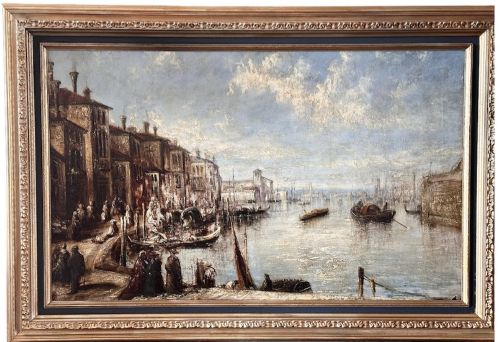
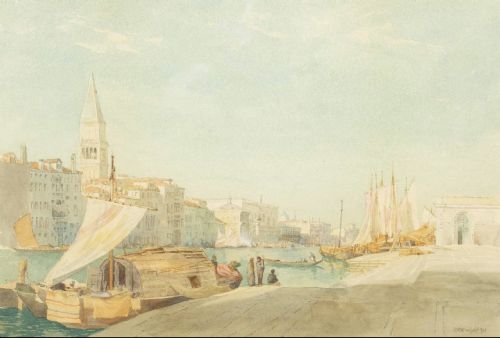
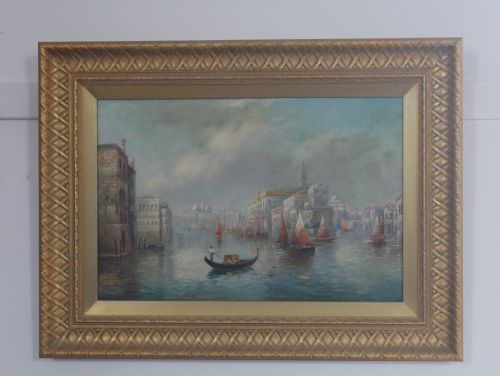
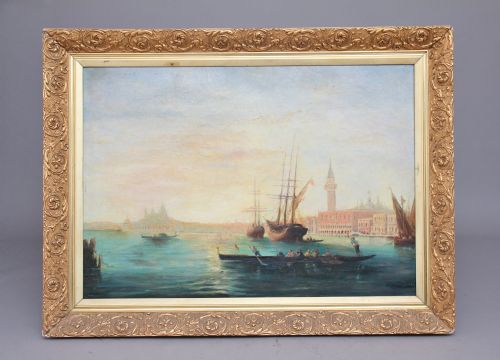

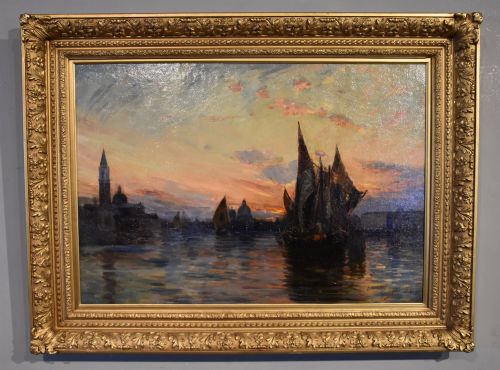


Venice Seascape Painting
A venice seascape painting captures the light, canals, and architecture of the lagoon through the eyes of nineteenth and twentieth-century artists.
Venice Seascape Painting
A venice seascape painting brings the distinctive atmosphere of the lagoon, the Grand Canal, and historic landmarks like the Doge's Palace into an interior. Collectors seek out these works for their atmospheric depiction of Italian light and maritime scenes.
The selection on this page centres on nineteenth and twentieth-century formats, ranging from Victorian and Edwardian periods up to later twentieth-century interpretations. Works appear primarily as framed paintings, watercolours, and mixed media on paper or canvas.
Oil paintings and delicate watercolours dominate the offerings, depicting familiar viewpoints such as the Grand Canal, the Guidecca Canal, and Santa Maria della Salute. Buyers encounter both intimate watercolours and substantial oil paintings framed in giltwood and gesso.
How they were made
Artists captured these lagoon views using oil on canvas or watercolour on paper, sometimes employing pastel, gouache, and ink pen. Oil paintings utilise canvas stretched over wooden supports, allowing for rich layers of pigment and textured brushwork.
Watercolour paintings rely on fluid washes applied to paper to render the luminous skies and shimmering reflections of the Venetian canals. Many surviving works retain their period framing, incorporating carved wood, gesso, and giltwood mouldings.
Gondoliers occasionally appear as mere splashes of dark paint navigating the bright canals, yet they anchor the entire composition.
What varies in quality
Quality rests in the handling of light and water, where skilful brushwork or translucent washes successfully evoke the shifting atmosphere of the lagoon. Stronger examples demonstrate confident perspective in complex architectural elements such as bridges and palazzos.
The integrity of the medium and the preservation of the surface distinguish superior works, alongside the quality of the accompanying period frame. Finer paintings maintain vibrant pigments and stable grounds on canvas or paper without excessive retouching.
Francis Moltino·Richard Henry Wright·Thomas Hodgson Liddell·Jane Vivian·Alfred Pollentine·William Raymond Dommersen·Frank Wasley·William Knox·George Stanfield Walters·Wilfred Knox·Henry Wimbush·John D. Walker·Arthur Severn·Alberto Trevisan
The Venice Seascape Painting Glossary
- Giltwood
- Wood carved and coated with gold leaf or a gold-coloured finish. This material is commonly found on traditional frames surrounding nineteenth-century paintings.
- Gesso
- A plaster-like mixture applied to wood frames to create a smooth surface for gilding. It allows for intricate moulded decorative details.
- Lagoon
- The shallow body of water surrounding Venice. This setting appears frequently in nineteenth and twentieth-century landscape art.
- Watercolour
- A paint consisting of pigment suspended in a water-based solution, applied to paper. It creates luminous, transparent effects favoured by British and Italian artists of the period.
Venice Seascape Painting: Frequently Asked Questions
What subjects appear in these paintings?
The artworks primarily depict the Grand Canal, the Venetian lagoon, the Doge's Palace, and local scenes featuring gondolas.
Artists focused on capturing famous architectural landmarks alongside quieter waterways and atmospheric evening views.
How do I identify the period of a painting?
Dating relies on stylistic clues, artist signatures, and framing materials associated with Victorian, Edwardian, and later twentieth-century movements.
Documentation on the reverse of the canvas or paper often provides additional historical context.
How should I care for a watercolour?
Watercolours require protection from direct sunlight to prevent fading of the delicate pigments on paper. Displaying them away from moisture fluctuations preserves the condition of the paper and mount.
What framing is typical for these works?
Many pieces retain period frames constructed from wood with gesso and gilt finishes. These frames complement the traditional aesthetic of nineteenth and early twentieth-century fine art.