
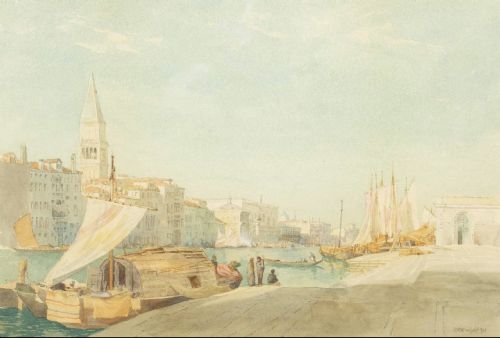


Blue Watercolour Venice Painting
A blue watercolour venice painting captures the Italian lagoon on paper, offering delicate washes of pigment that bring historic canals into light.
Blue Watercolour Venice Painting
A blue watercolour venice painting is a work on paper depicting scenes of canals, lagoons, and historic architecture. The pieces seen here span the Victorian era, the Edwardian period, and the early twentieth century.
Most examples date from the late nineteenth century to the nineteen-forties, capturing subjects such as the Grand Canal, the Guidecca Canal, and the Bridge of Sighs. These works range from intimate depictions to broader views across the Venetian lagoon.
Materials and technique
These works are executed using watercolour pigment and watercolour paint applied to paper surfaces. Artists utilised fluid washes to capture the luminous atmospheric conditions and shifting light of the Venetian waterways.
Framing typically incorporates wood and glass to protect the delicate pigment on paper from moisture and light damage. The physical construction relies on traditional paper supports that preserve the transparency of the watercolour medium.
Styles represented include Victorian fine art, impressionism, and late nineteenth-century Italian painting.
Variations in quality
Quality rests upon the artist's ability to manipulate pigment and water to convey the distinct atmosphere of Venice. Stronger works demonstrate confident brushwork and a balanced composition that brings depth to the canal scenes.
The distinction between standard examples and finer pieces involves the precision of architectural detail paired with atmospheric washes. Works by named artists often exhibit superior handling of light across the water and historic facades.
Richard Henry Wright·Vittore Zanetti Zilla·Benedetto Salviati·Frank Wasley·David Law·William Knox·George Stanfield Walters·Wilfred Knox·Henry Wimbush·John D Walker·Arthur Severn
The Blue Watercolour Venice Painting Glossary
- Watercolour pigment
- The finely ground colour substance mixed with a binder to create the paint used on paper.
- Gondolier
- A traditional Venetian rowing boat operator, frequently depicted in canal scenes.
- Lagoon
- The shallow body of saltwater in which Venice is situated, often shown in wide views.
- Impressionism
- An art style focused on capturing light and movement rather than strict realism.
Blue Watercolour Venice Painting: Frequently Asked Questions
What periods do these paintings come from?
The available pieces span from the late nineteenth century through the Victorian and Edwardian eras into the nineteen-forties. Most examples cluster around nineteen hundred and the early decades of the twentieth century.
This timeframe reflects a period when British and European artists travelled frequently to Italy to paint picturesque Venetian subjects.
How should I frame a watercolour?
Watercolours require protection behind glass to prevent atmospheric damage to the pigment and paper surface. Acid-free mounts should be used to keep the paper from touching the glass directly.
Keeping these works away from direct sunlight preserves the delicate blue and grey tones characteristic of Venetian watercolours.
What subjects appear most often?
Common subjects include the Grand Canal, the Guidecca Canal, and the Bridge of Sighs. Artists frequently painted Santa Maria della Salute and views across the open lagoon.
These landmarks provide the architectural focal points that define nineteenth and early twentieth-century depictions of the city.
Are these works signed by artists?
Several pieces feature named Victorian and Edwardian artists such as Frank Wasley, William Knox, and Richard Henry Wright. Signatures, where present, help attribute the work to specific painters active in that era.
Unsigned examples also appear, reflecting the wider tradition of topographical watercolour painting from the period.