



Venetian Watercolour Painting
A venetian watercolour painting brings the light and waterways of the lagoon straight to your wall, capturing the city through historic washes.
Venetian Watercolour Painting
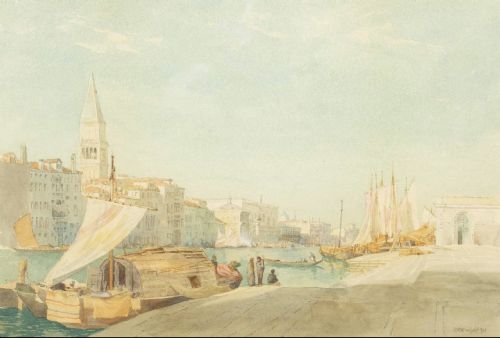
A venetian watercolour painting captures the unique atmosphere of the lagoon, depicting iconic views such as the Grand Canal, the Bridge of Sighs, and the Giudecca. You will encounter works spanning the Victorian and Edwardian eras through to the mid-twentieth century, showing how British and continental artists recorded the city.
The compositions on offer range from expansive vistas taken from the lagoon to intimate studies of gondoliers navigating narrow canals. Many examples date from the nineteenth and early twentieth centuries, reflecting a sustained fascination with Italian topography among travellers and collectors.
Makers and painters represented include established figures such as Hercules Brabazon Brabazon, Clara Montalba, and Frank Wasley, alongside skilled contemporaries. These artists applied fluid pigments to paper, balancing architectural precision with the luminous effects of Mediterranean light.
Assessing Quality and Execution
Quality rests upon the artist's ability to handle the fluid medium without muddying the lighter washes, particularly when rendering complex architecture like Santa Maria della Salute. The finest pieces demonstrate a confident economy of line and an assured sense of tone that brings the water and sky to life.
The strength of provenance also elevates certain works, especially when signed by noted Victorian and Edwardian painters who specialised in Italian subjects. Preservation plays its part, with superior examples retaining the vibrancy of their original pigments rather than suffering from excessive fading.
Listings feature works spanning the nineteenth and twentieth centuries, executed on paper using watercolour pigments and housed in wood and glass frames.
Thomas Ellison·Richard Henry Wright·F J Aldridge·Clara Montalba·Vittore Zanetti Zilla·Benedetto Salviati·Hercules Brabazon Brabazon·Frank Wasley·David Law·William Knox·George Stanfield Walters·Wilfred Knox·Henry Wimbush·John D Walker·Arthur Severn·Helen DonaldSmith·Samuel Prout·A Venutti
The Venetian Watercolour Painting Glossary
- Bodycolour
- Watercolour paint mixed with white pigment to make it opaque, used by artists to add highlights and solid details to a composition.
- Grand Canal
- The main thoroughfare of Venice, depicted frequently in nineteenth and twentieth-century art for its sweeping architectural vistas.
- Lagoon
- The enclosed bay of the Adriatic Sea in which Venice sits, providing the expansive skies and reflective waters seen in these works.
- Provenance
- The documented history of ownership of an artwork, helping to confirm its attribution and authenticity.
Venetian Watercolour Painting: Frequently Asked Questions
How do I care for a historic watercolour?
Keep the piece away from direct sunlight to prevent the pigments from fading over time. Ensure it remains behind glass with adequate spacing so the paper does not touch the glazing.
Maintain a stable room temperature and avoid hanging the work in damp areas such as unheated hallways or kitchens. Professional framing using acid-free materials safeguards the paper from chemical deterioration.
How can I tell a Victorian painting from a later one?
Examine the framing, paper stock, and stylistic signatures, as Victorian works often feature heavier gilt mouldings and distinct handwriting. Artists working in the nineteenth century frequently favoured tighter architectural detail compared to the looser washes of the early twentieth century.
Signatures and dates written in pencil or ink help place the work within a specific decade. Comparing the subject matter to known exhibition dates of the artist provides further clues.
Where were these watercolours typically displayed?
Travellers returning from the Grand Tour brought these paintings back to adorn the drawing rooms and libraries of British homes. They served as sophisticated souvenirs that recalled the romance and artistic heritage of Italy.
Later collectors continued this tradition by acquiring views of Venice to create focal points in studies and reception rooms. Their modest scale made them well-suited for domestic interior displays.
Are these paintings original works?
Every piece recorded here is an original watercolour painted by hand directly onto paper, rather than a later print or reproduction. Artists applied wet pigments individually, meaning no two compositions are identical.
Brush marks, pencil underdrawing, and the texture of the paper confirm the hand-painted nature of each artwork. Archival records and signatures further substantiate their unique status.