




Veneered Round Table
These pieces known as a veneered round table are circular tables finished with fine wood veneers, offering functional surfaces that anchor a room with geometric harmony.
Veneered Round Table
When you search for a veneered round table, you encounter circular surfaces shaped from timber and surfaced with decorative veneers spanning several distinct historical periods. The inventory on this page ranges from nineteenth century centre tables and tilt top pieces to twentieth century coffee tables and occasional tables.
The forms vary considerably according to their intended function within a room. You will find small occasional tables and coffee tables alongside larger dining tables, breakfast tables, and centre tables designed to stand free in a space.
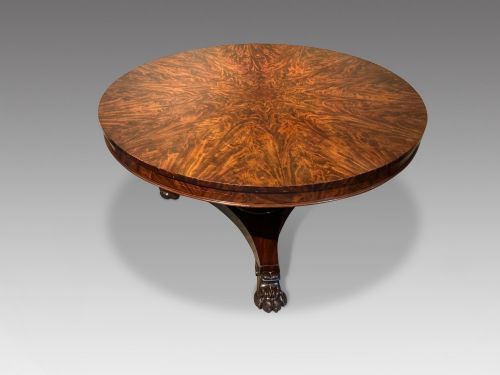
Origins stretch from Victorian and Georgian eras through to the early twentieth century, taking in Art Deco, Biedermeier Revival, and Mid-Century Modern movements. Walnut, mahogany, and burr timbers dominate the selection, often arranged in striking radial or segmented patterns across the circular top.
How they were made
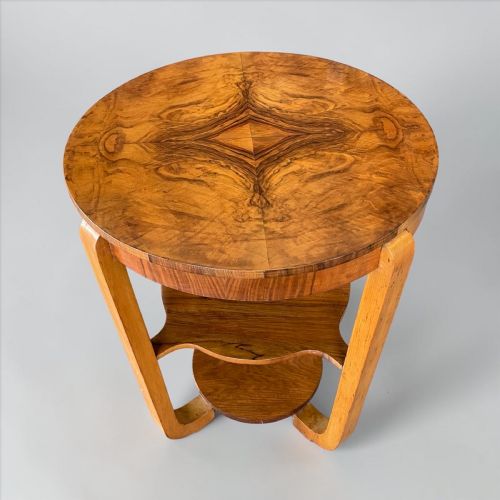
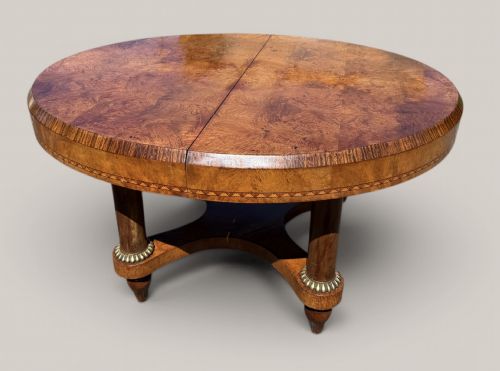
Cabinetmakers applied thin leaves of decorative wood veneer onto stable secondary timbers to create patterned surfaces without warping. Woods such as walnut, burr walnut, mahogany, satin birch, birds eye maple, and rosewood were sliced and laid out in symmetrical arrangements like segmented or radially veneered tops.
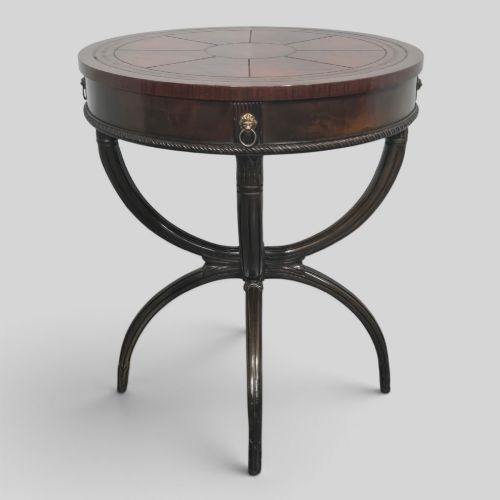
Support structures rely on traditional joinery, utilising solid timber frames for tripod bases, pedestal columns, and four-legged occasional or centre tables. Brass mounts, inlay work, and carved details occasionally punctuate the design, particularly in Regency and Art Deco examples.
Listings feature circular tables spanning the nineteenth century through to the 1940s, constructed from walnut, mahogany, oak, and birch veneers.
What varies in quality
The ambition of the veneer work dictates much of the distinction between pieces, particularly where cabinetmakers selected figured woods like burr walnut, pollard oak, or birds eye maple. Symmetrical matching across a segmented circular top requires precise hand-cutting and patience from the maker.
Structural integrity and the retention of original surfaces separate standard examples from finer ones. The stability of the central pillar, the firmness of a tilt top mechanism, and the crispness of any inlaid border or carved foot all contribute to the overall standard of the piece.
The Veneered Round Table Glossary
- Veneer
- A thin slice of decorative wood applied to a base timber to provide a figured surface. This technique allows cabinetmakers to display rich grain patterns that would be unstable if used in solid boards.
- Tilt Top
- A table mechanism allowing the circular top to pivot vertically when not in use. This practical Victorian invention enabled tables to be stored flat against a wall.
- Burr
- A woody growth on a tree that produces intricate and swirling grain patterns when sliced. Cabinetmakers prized burr walnut, burr elm, and burr oak for high-status circular tables.
- Centre Table
- A freestanding table finished on all sides, intended to occupy the middle of a room rather than sit against a wall. These often feature decorative circular tops supported by a central pillar or tripod base.
- Radially Veneered
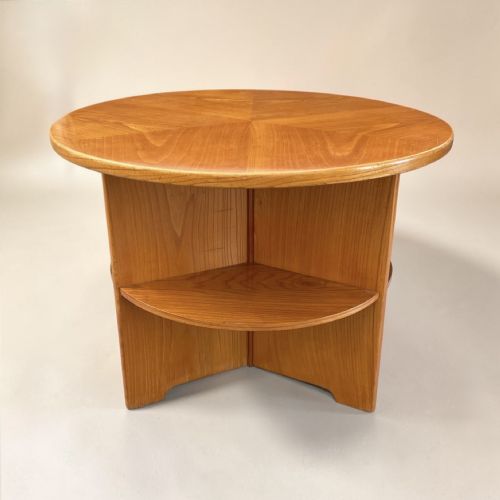
- A method of laying veneer pieces outward from a central point like spokes on a wheel. This creates a geometric star or sunburst effect across a circular tabletop.
Veneered Round Table: Frequently Asked Questions
What is a tilt top table used for?
A tilt top table functions as a standard occasional or dining surface during use. The pivoting mechanism allows the circular top to fold vertically to save space against a wall when not needed.
This design was common in nineteenth century interiors where rooms served multiple purposes throughout the day.
How do I identify an Art Deco round table?
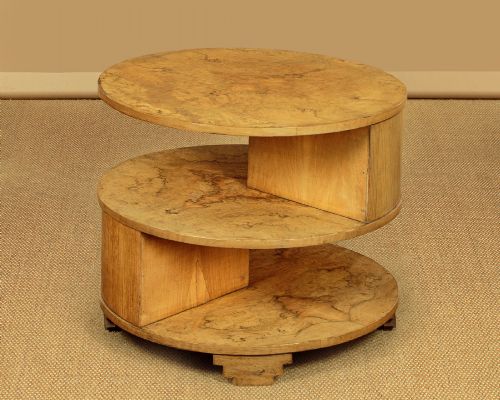
Art Deco round tables typically date from the 1920s and 1930s, utilising exotic woods like birds eye maple, satin birch, and walnut. They often feature clean geometric lines, two tiers, or contrasting inlay work.
Unlike ornate Victorian pieces, these twentieth century designs emphasise smooth surfaces and the natural grain of the timber.
Where should I place a centre table?
A centre table is designed to stand freestanding in the middle of a room rather than pushed against a perimeter wall. Because the circular top and base are finished from all angles, it acts as a visual focal point.
Ensure there is sufficient clearance around the piece for movement and seating.
What is burr wood?
Burr wood comes from a deformed growth on a tree, yielding an extraordinary density of swirling growth rings. When sliced into thin veneers, it creates highly decorative surfaces with deep visual texture.
Cabinetmakers used burr walnut, burr oak, and burr elm on prominent tabletops to showcase wealth and skill.